White Paper Shattering the Permitting Wall How Behind-the-Meter Edge AI Compute Solves the Data Center Power Interconnection Crisis
Author/Institution: DeReticular Venture Labs & The Institute for Automated
Mobility
Date: Late 2026
Classification: Strategic White Paper / Infrastructure Research Group
Executive Summary
The rapid maturation of proactive, agentic artificial intelligence has collided
with the physical realities of the centralized electric grid. Hyperscale data
center operations in the United States face an unprecedented “Permitting Wall.”
Grid interconnection queues managed by regional transmission organizations now
regularly exceed five years, further prolonged by the National Environmental
Policy Act (NEPA) review timelines. With data centers projected to consume
between 7% and 12% of total U.S. electricity generation by 2028, the centralized
utility pipeline is no longer capable of matching the scaling velocity of
computing infrastructure. This crisis is compounded by regulatory bottlenecks in
federal broadband deployment (the $42.5 billion BEAD program) and capital
freezes on clean energy programs (the USDA REAP grant rewrite of early 2026).
This paper presents a structurally independent alternative: Behind-the-Meter
(BTM) Edge AI Compute powered by DeReticular’s Sovereign Stack. By deploying
modular, ruggedized computing containers—the RIOS-CC-1000—directly at the local
energy source, infrastructure developers can bypass the transmission grid
entirely. These units operate in complete “Island Mode” using localized 1,500°C
plasma waste-to-energy gasifiers (Agra Dot Energy) and vertical bifacial
agrivoltaic arrays, producing continuous, carbon-negative baseload power.
To ensure long-term economic viability, the system employs the proprietary
“Spark Spread” algorithm. This algorithm dynamically arbitrates local energy
allocation in real time, routing power to either high-margin Edge AI inference
on Sovereign Sentry Pro nodes or the chemical synthesis of Advanced Synthetic
Fuel (ASF™).
Through innovative financing structures—including Node-as-a-Service (NaaS)
leasing and Sovereign-Public-Private Partnerships (S-P3) leveraging the
Inflation Reduction Act’s Section 6417 Direct Pay provisions—the Sovereign Stack
provides a self-funding, rapidly deployable blueprint for absolute computational
and energetic self-determination.
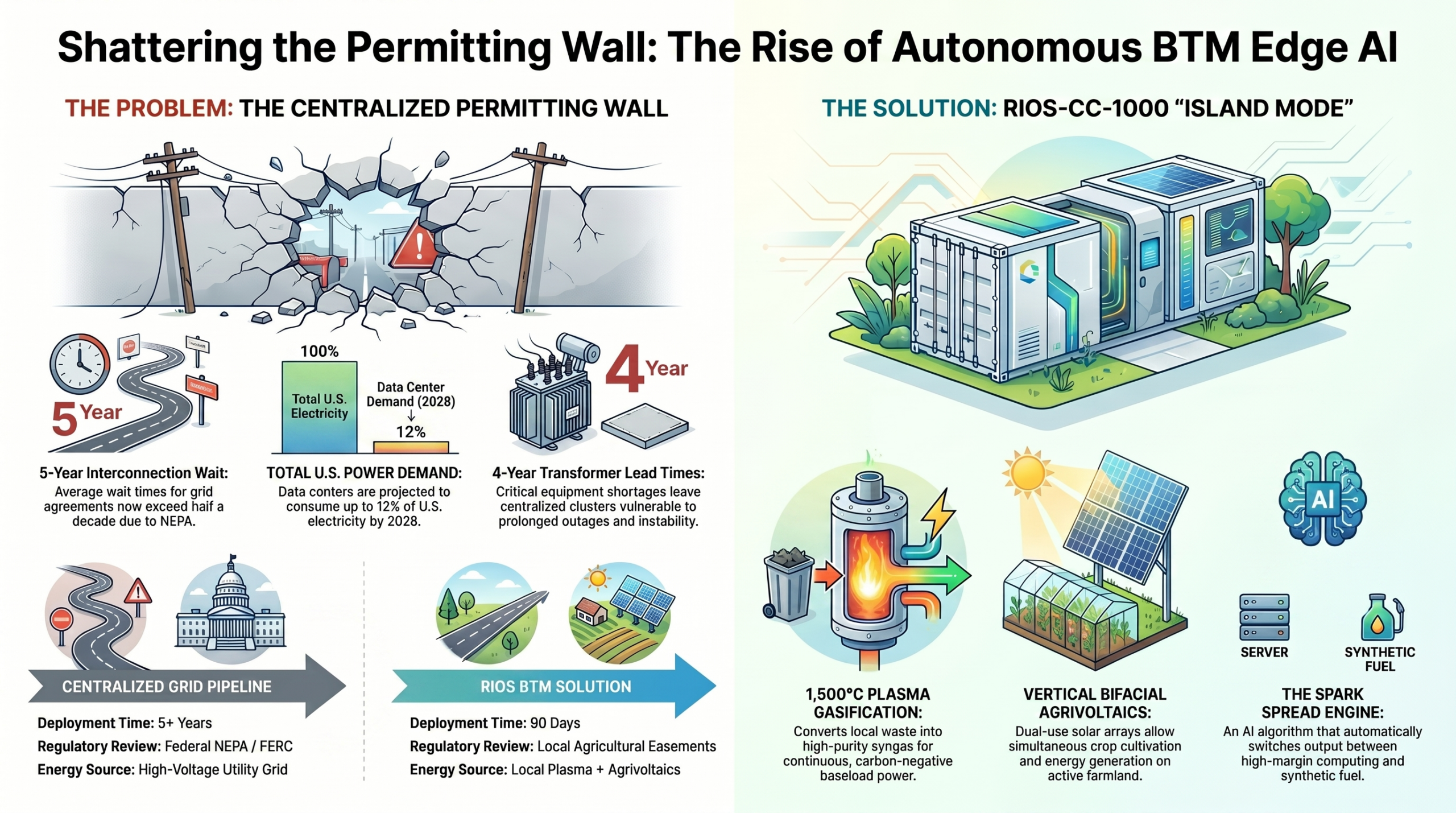
THE PERMITTING WALL (Centralized Pipeline Bottleneck)┌─────────────────────────────────────────────────────────────────────────────┐
│ Centralized Grid Interconnection ──► 5-Year Wait Queue (NEPA Delays) │
└──────────────────────────────────────┬──────────────────────────────────────┘
│
▼ (The DeReticular BTM Solution)
┌─────────────────────────────────────────────────────────────────────────────┐
│ Agra Dot Energy Gasification Node ──► Behind-the-Meter Power Generation │
│ RIOS-CC-1000 Compute Container ──► Direct Local Inference (Island Mode) │
└─────────────────────────────────────────────────────────────────────────────┘
Section 1: The Permitting Wall & The Centralization Crisis
1.1 The Transmission Logjam and FERC Order 2023
The centralization of high-performance computing has exposed the vulnerabilities
of the legacy high-voltage transmission grid. Under the Federal Energy
Regulatory Commission (FERC) database tracking system, over 2,000 gigawatts (GW)
of generation and storage capacity sit active in regional interconnection
queues. The average wait time for an interconnection agreement now exceeds five
years.
While FERC Order 2023 attempted to transition the queue system from a
“first-come, first-served” to a “first-ready, first-served” cluster study
process, the physical constraints of high-voltage transmission lines remain
unchanged.
Building new regional high-voltage transmission lines requires securing
multi-state rights-of-way and navigating the National Environmental Policy Act
(NEPA) review process. This process takes an average of 4.5 years per
environmental impact statement (EIS), creating an insurmountable regulatory
bottleneck for hyperscalers trying to keep pace with rapid AI development.
┌────────────────────────────────────────────────────────────────────────────┐
│ CENTRALIZED UTILITY FRAGILITY TIMELINE │
├─────────────────┬──────────────────────────────────┬───────────────────────┤
│ Year 1–2: │ Year 3–4: │ Year 5+: │
│ NEPA EIS and │ FERC Cluster Studies & │ Physical Buildout & │
│ Rights-of-Way │ Interconnection Cost Allocation │ Grid Interconnect │
└─────────────────┴──────────────────────────────────┴───────────────────────┘
1.2 Grid Buckling and National Security Risks
According to joint intelligence briefs from the Cybersecurity and Infrastructure
Security Agency (CISA) and the White House Task Force on AI Datacenter
Infrastructure, the rapid concentration of load centers presents severe national
security risks. The projection that data center operations will consume 7%
to 12% of total U.S. electricity generation by 2028 has raised alarms regarding
grid stability.
Single-point-of-failure vulnerabilities—such as regional transformer shortages
(with lead times for high-voltage step-up transformers reaching 3 to 4
years)—expose massive computing clusters to prolonged outages from extreme
weather events or coordinated cyberattacks on regional SCADA systems.
1.3 Federal Policy Stagnation
The centralized infrastructure model is further constrained by federal policy
logjams. The $42.5 billion Broadband Equity, Access, and Deployment (BEAD)
program remains bottlenecked by state-level administrative overhead, cost
inflation, and permitting disputes.
Simultaneously, on March 31, 2026, the United States Department of Agriculture
(USDA) officially halted all grant awards for the Rural Energy for America
Program (REAP) to rewrite procurement guidelines. This freeze aimed to restrict
subsidies for foreign-controlled components, but it effectively stalled capital
flow for standard rural solar and wind projects.
Consequently, developers can no longer rely on traditional federal grant
pipelines to finance utility-scale projects, making localized, off-grid
self-funding architectures an operational necessity.
Section 2: Behind-the-Meter (BTM) Edge AI Architecture (The RIOS-CC-1000)
To bypass the transmission logjam, DeReticular has engineered the RIOS Pilot
Command Center (SKU: RIOS-CC-1000), an off-grid compute module designed to
operate behind-the-meter in total “Island Mode.”
RIOS-CC-1000 OFF-GRID ENCLOSURE SPECIFICATIONS┌─────────────────────────────────────────────────────────────────────────────┐
│ – 10ft ISO High-Cube Shell (NEMA 4X Environmental Sealing) │
│ – Anodized Aluminum Passively Cooled Compute Trays │
│ – Sovereign Sentry Pro Cores utilizing Honeywell PTM7950 PCM │
│ – Integrated 150 kW Solar Array & 400 kWh Battery Storage (BESS) │
└─────────────────────────────────────────────────────────────────────────────┘
2.1 Physical and Enclosure Specifications
The RIOS-CC-1000 is housed in a ruggedized, 10-foot High-Cube ISO shipping
container equipped with NEMA 4X environmental sealing. The container’s outer
shell is coated in multi-layered, ceramic-based heat-reflective paint to
minimize solar thermal gain in harsh desert or tropical environments.
Internally, the container is divided into two sealed compartments:
- The Power & Storage Vault: Houses the grid-forming inverters and a 400 kWh
Lithium Iron Phosphate (LFP) Battery Energy Storage System (BESS). - The Compute Core: Houses rack-mounted Sovereign Sentry Pro compute nodes.
2.2 Sovereign Sentry Pro Thermal Engineering
Traditional edge servers rely on high-volume active fan assemblies, making them
vulnerable to mechanical failure, dust infiltration, and high parasitic power
loads. The Sovereign Sentry Pro nodes utilize a fanless anodized aluminum
monoblock chassis.
To handle the extreme thermal dissipation requirements of dense GPU/NPU
operations, the processor and accelerator dies interface directly with the
aluminum monoblock heatsink via Honeywell PTM7950 Phase Change Material (PCM).
This material undergoes a physical phase transition from solid to liquid
at 45°C, providing a highly efficient thermal conductivity rate of 8.5 W/mK.
This design eliminates mechanical fans, reduces internal dust build-up, and
lowers the node’s idle power draw to just 5W.
2.3 “Island Mode” Operating Mechanics
The RIOS-CC-1000 operates on RIOS Core, an edge-native, microkernel operating
system. Rather than relying on constant, high-bandwidth connection to
centralized cloud platforms, RIOS executes workloads locally.
The container communicates with neighboring nodes using a private, self-healing
TriFi mesh network (operating on unlicensed 5.8 GHz and 6 GHz spectrum bands).
By utilizing local ledger validation and localized AI inference, the container
maintains 100% operational uptime and decision-making capabilities even when
completely disconnected from fiber lines and the macro-utility grid.
Section 3: The Energy Muscle Layer: Plasma Gasification & Vertical Agrivoltaics
The energy-generation subsystem of the RIOS-CC-1000—engineered by Agra Dot
Energy—combines high-temperature thermal conversion with dense agricultural land
utilization to deliver clean, continuous, behind-the-meter baseload power.
┌─────────────────────────────────┐ ┌─────────────────────────────────┐ ┌─────────────────────────────────┐
│ Negative-Cost Feedstock │ │ Plasma Gasifier (1500°C+) │ │ Product Yields │
│ – Agricultural waste / Biomass │ ──► │ – Syngas Composition Monitor │ ──► │ – High-Purity Syngas │
│ – Municipal solid waste │ │ – Real-Time NIR Spectroscopy │ │ – Advanced Synthetic Fuel (ASF) │
│ – Rubber tires / Plastics │ │ Feedstock Tuning │ │ – Biochar & Vitrified Slag │
└─────────────────────────────────┘ └─────────────────────────────────┘ └─────────────────────────────────┘
3.1 1,500°C Plasma Gasification
Unlike standard low-temperature municipal incinerators that burn waste and
produce toxic fly ash, Agra Dot Energy utilizes an advanced thermal plasma
reactor:
- Molecular Cracking: The reactor operates at temperatures exceeding 1,500°C
using an ionized gas arc. This completely breaks down the carbonaceous
molecular bonds of incoming organic feedstocks (manure, crop residues,
rubber tires, municipal waste) into their basic elemental constituents. - Near-Infrared (NIR) Spectroscopy Tuning: The input hopper integrates an NIR
spectroscopy sensor that analyzes the moisture, carbon, and hydrogen
composition of the incoming feedstock in real time. The system automatically
adjusts oxygen levels and plasma arc intensity, optimizing syngas purity
(CO + H_2) and increasing total energy output by 30% to 43%.
3.2 Vertical Bifacial Agrivoltaic Arrays
To complement the continuous baseload power of the gasifier, the RIOS container
integrates vertical agrivoltaic arrays:
- Spatial Alignment: N-type bifacial solar panels are installed vertically in
fields, spaced at strict 7-meter row intervals. This spacing allows standard
agricultural combines and tractors to cultivate crops (such as industrial
hemp or soy) directly between the rows. - The Land Equivalent Ratio (LER) Advantage: By combining agricultural
production with vertical solar generation, the system achieves a Land
Equivalent Ratio above 1.2 (meaning the land is 20% more productive than if
used solely for farming or solar). - Regulatory Bypass: This high LER ensures the property retains its active
agricultural classification. Developers can bypass industrial utility zoning
restrictions and lengthy permitting reviews, operating instead under local
Agricultural Easement protections.
3.3 Byproduct Economics & Local Monetization Paths
The plasma gasification process yields four valuable outputs that can be
monetized locally:
- Syngas: Fed directly into local off-grid generator engines to produce clean
electricity for the compute racks. - ASF™ (Advanced Synthetic Fuel): Utilizing an integrated Micro-GTL
(Gas-to-Liquids) unit, the syngas can be refined into clean, sulfur-free
diesel and jet fuels. - Biochar: A highly porous, pure carbon returned to the fields to enhance soil
water retention, lock in nutrients, and permanently sequester carbon. - Vitrified Slag: Inorganic materials are melted down and cooled into a
non-toxic, inert glass-like aggregate, which is sold locally as high-tensile
material for road construction.
Section 4: The Mathematical Optimization Layer: The Spark Spread Engine
The financial core of the RIOS-CC-1000 is the real-time monetization of energy
through the Spark Spread Algorithm. Managed by the Sovereign Sentry Pro edge
server, the node monitors local energy production, storage reserves, and
external market pricing to dynamically arbitrate output.
                           ┌─────────────────────────────────┐
                           │   AGRA DOT ENERGY GENERATION    │
                           └────────────────┬────────────────┘
                                            │
                                            ▼
                           ┌─────────────────────────────────┐
                           │     Sentry Node RIOS Engine     │
                           │  (Continuous Dynamic Arbitrage) │
                           └────────────────┬────────────────┘
                                            │
     ┌──────────────────────────────────────┴──────────────────────────────────────┐
     ▼                                                                             ▼
┌─────────────────────────────────┐ ┌─────────────────────────────────┐
│ Route 1: Micro-GTL (ASF) │ │ Route 2: RIOS-CC-1000 Core │
│ – Refine syngas into liquid │ │ – Power high-performance GPUs │
│ diesel / jet fuel. │ │ – Process Edge AI inference │
│ – Capitalize on local fuel │ │ and earn DePIN tokens. │
│ shortages (margins of 40%+). │ │ – High-velocity digital cash. │
└─────────────────────────────────┘ └─────────────────────────────────┘
4.1 Variables & Parameters
Let:
- P_{\text{total}}(t) be the total power generated locally at time t (in kW)
from agrivoltaics and gasification. - C_{\text{fuel}}(t) be the cost of producing energy per kWh via local
feedstock (in USD/kWh). - V_{\text{compute}}(t) be the value of local AI inference/validation per kWh
equivalent (in USD/kWh). - V_{\text{ASF}}(t) be the value of refining syngas into liquid Advanced
Synthetic Fuel (ASF™) per raw kWh equivalent (in USD/kWh). - a(t) be the dynamic arbitrage allocation factor, representing the fraction
of energy routed to compute, where a(t) \in [0, 1].
4.2 Mathematical Formulation
The objective of the real-time Spark Spread Engine is to maximize the combined
net yield \Pi(t) over the operational timeline:
\max_{a(t)} \quad \Pi(t) = a(t) \cdot P_{\text{total}}(t) \cdot \left[ V_{\text{compute}}(t) – C_{\text{fuel}}(t) \right] + \left( 1 – a(t) \right) \cdot P_{\text{total}}(t) \cdot \left[ V_{\text{ASF}}(t) – C_{\text{fuel}}(t) \right]
Subject to the following operational constraints:
\text{S.t.} \quad 0 \le a(t) \le 1
P_{\text{compute}}(t) = a(t) \cdot P_{\text{total}}(t) \le P_{\text{compute, max}}
P_{\text{GTL}}(t) = (1 – a(t)) \cdot P_{\text{total}}(t) \le P_{\text{GTL, max}}
\text{SOC}{\text{min}} \le \text{SOC}(t) \le \text{SOC}{\text{max}}
Where:
- P_{\text{compute, max}} is the maximum power capacity of the local GPU/NPU
compute clusters. - P_{\text{GTL, max}} is the maximum intake capacity of the Micro-GTL chemical
reactor. - \text{SOC}(t) is the state of charge of the LFP battery system, bounded by
minimum and maximum safety limits.
4.3 Real-Time Execution and NaaS Protection
The local Sovereign Sentry Pro node solves this optimization problem in real
time using local sensor feedback loops and decentralized data feeds.
If external network connectivity is lost, the local value of computing
V_{\text{compute}}(t) decreases relative to the local value of liquid fuel
V_{\text{ASF}}(t). The system automatically reduces a(t) to zero, directing all
syngas into GTL production to refine liquid fuels for regional logistics.
Conversely, when DePIN compute demand spikes, the system increases a(t) to 1,
routing all energy to high-margin local GPU processing to mine utility tokens.
This automated arbitrage protects the node’s underlying assets, ensuring that
Node-as-a-Service (NaaS) leases remain self-financing and protected from market
volatility.
Section 5: Strategic & Financial Bridges
Deploying advanced physical compute and energy nodes requires managing
significant upfront capital expenditure. DeReticular utilizes three distinct
financial frameworks to bypass these capital barriers:
5.1 Node-as-a-Service (NaaS) Leasing
Rather than paying a large upfront purchase price, communities can utilize the
NaaS leasing model.
- How It Works: DeReticular provisions and installs the hardware on-site with
zero down payment. - The Lease Structure: The community pays for the hardware by sharing a
percentage of the automated “Spark Spread” revenue generated by the node. As
the local biogas generators and solar arrays power local AI token mining or
synthetic fuel sales, the node pays for its own lease, aligning the
hardware’s cost directly with its operational output.
5.2 S-P3 & IRA Section 6417 (Direct Pay)
For non-profit cooperatives, agricultural collectives, and rural municipalities,
the Inflation Reduction Act’s Section 6417 “Direct Pay” provision offers a
powerful funding mechanism.
- How It Works: Tax-exempt organizations can receive direct cash payments from
the federal government for deploying clean energy systems (such as the
biogas digesters and vertical agrivoltaic arrays that power RIOS
containers). - Strategic Leverage: These direct cash payments can cover up to 30-50% of the
initial hardware cost, lowering the financial barriers to deploying local
sovereign infrastructure.
5.3 Intercompany Sovereign Debt
To protect developing nodes from predatory external creditors or
hyper-inflationary local currencies, DeReticular acts as the central financing
arm. It raises capital globally and issues low-interest intercompany debt to the
node cooperative, ensuring the physical infrastructure remains a community-owned
asset.
Section 6: Conclusion & Actionable Implementation Roadmap
The “Permitting Wall” is a physical boundary that centralized hyperscale
computing cannot bypass. The solution to the data center power crisis does not
lie in building more centralized transmission lines, but in distributing
computing power directly to the energy source.
By combining waste-to-energy gasification, vertical agrivoltaics, and edge
computing under the governance of the Spark Spread algorithm, the RIOS-CC-1000
provides a self-funding, rapidly deployable blueprint for absolute computational
and energetic self-determination.
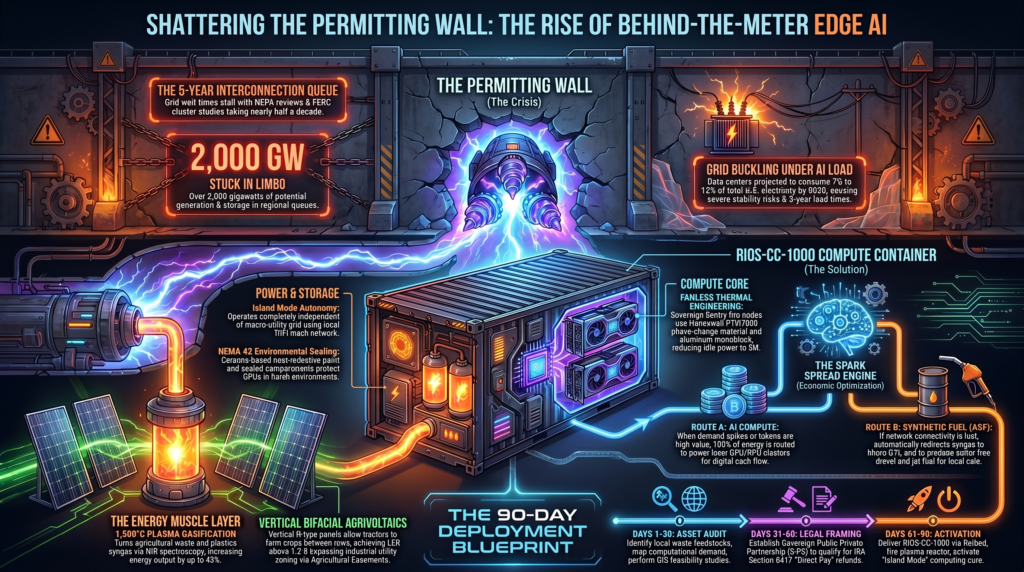
The 90-Day Deployment Blueprint
┌─────────────────────────────┐ ┌─────────────────────────────┐ ┌─────────────────────────────┐
│ Days 1–30: Asset Audit │ ──► │ Days 31–60: Entity Design │ ──► │ Days 61–90: Deploy & scale │
│ • Identify local inputs │ │ • Form local cooperative │ │ • Configure RIOS node │
│ • Map edge-compute needs │ │ • Set up DAO governance │ │ • Launch the local app │
└─────────────────────────────┘ └─────────────────────────────┘ └─────────────────────────────┘
Stage 1: Days 1–30 (Asset and Interconnection Auditing)
- Action: Audit local agricultural and municipal waste streams to verify daily
feedstock availability. - Deliverable: GIS maps of local energy resources and computational demand
profiles; initial feasibility study for vertical solar spacing.
Stage 2: Days 31–60 (S-P3 Legal Framing & Direct Pay Entity Setup)
- Action: Form a local cooperative or municipal joint venture (S-P3) to
qualify for Section 6417 Direct Pay cash refunds. - Deliverable: Legal entity setup, initial NaaS leaseback agreement, and
submission of the project to federal clean-energy tax portals.
Stage 3: Days 61–90 (On-site ISO Container Deployment & Island Mode Activation)
- Action: Deliver the RIOS-CC-1000 High-Cube container to the site via flatbed
tow trucks, align the agrivoltaic arrays, and fire the plasma reactor. - Deliverable: Activation of the local “Island Mode” computing core,
integration of the local TriFi mesh network, and commencement of the
real-time Spark Spread optimization engine.


