Sovereign Independence: A Guide to the ‘Infrastructure-in-a-Box’ and RIOS
1. The Big Picture: From Linear Fragility to Spherical Resilience
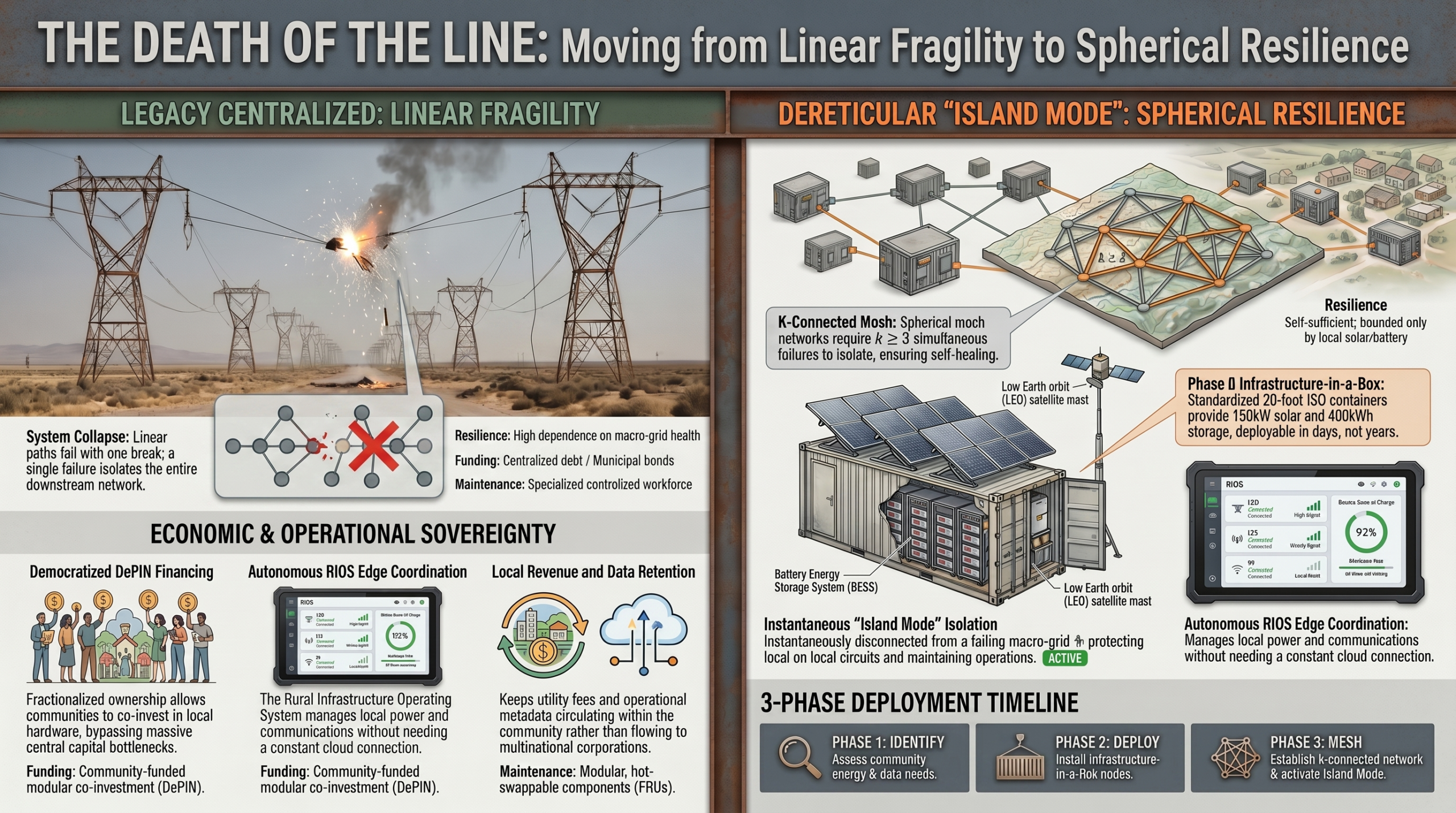
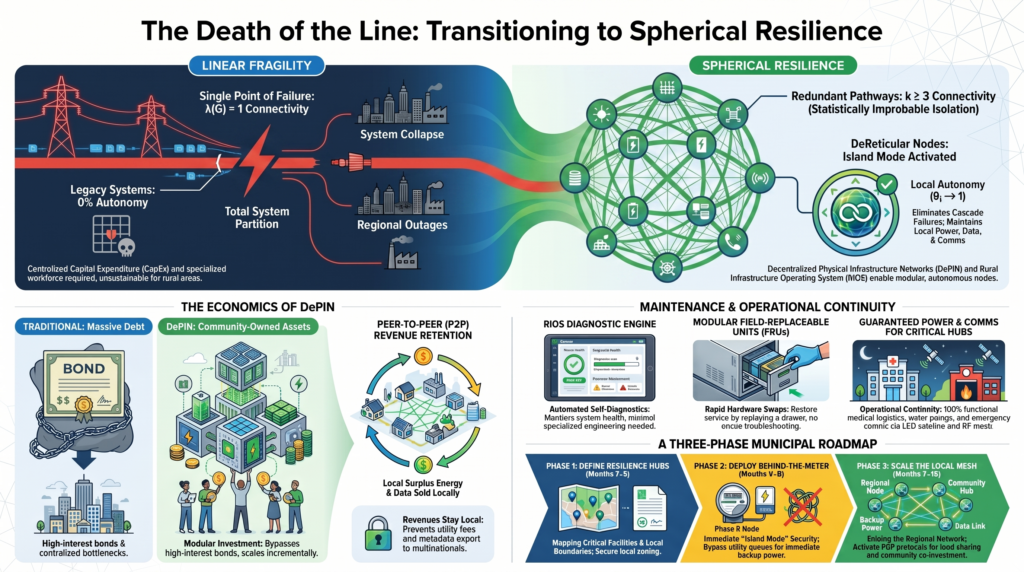
For over a century, our societies have been tethered to “The Line.” Traditional infrastructure—power grids, fiber backbones, and water mains—is built on linear, centralized concentration. While efficient in stable times, this creates Linear Fragility. In a linear graph, the edge connectivity is \lambda(G) = 1. This means any single physical severance or digital breach cascades downstream, leading to total system collapse. Mathematically, as these networks grow, the probability of a regional partition event approaches 100%.
We are reclaiming our autonomy by moving toward Spherical Resilience. This engineering framework replaces vulnerable lines with a k-connected mesh (k \ge 3), where every node is linked to at least three others. This shift doesn’t just add “backup”; it fundamentally changes the math of survival.
| Feature | Linear Fragility (Legacy) | Spherical Resilience (Sovereign) |
| Topology | Centralized “tree” chains (\lambda(G) = 1). | K-connected, multi-directional mesh (k \ge 3). |
| Failure Risk | Single points of failure cascade downstream. | Failures are bounded to the local zone of origin. |
| Connectivity | Dependent on national backhaul. | Self-healing via peer-to-peer (P2P) local links. |
| Logic | Requires constant global synchronization. | Operates via “Island Mode” autonomy (\theta \to 1). |
The “So What?”: Risk Bounding The true power of this shift is Risk Bounding. In legacy systems, nodes cannot function without the macro-grid, meaning their autonomy factor is zero. By deploying sovereign nodes, we set the autonomy factor (\theta) to 1. When the “Line” breaks, the local system sets P_{cascade} = 0. Your community doesn’t just “wait for repairs”—it remains a fully operational, self-sustaining island. To achieve this, we utilize a physical “seed”: the Phase 0 Infrastructure-in-a-Box.
podcast
2. The Hardware Foundation: Anatomy of a Phase 0 Node
The “Phase 0” node is a sovereign utility system housed within a 20-foot ISO High-Cube intermodal envelope. Constructed from 8-gauge Corten steel, these containers are engineered for rapid deployment in rural, agricultural, or disaster-stricken regions. We have moved away from custom, complex civil engineering toward Field Replaceable Units (FRUs) and hot-swappable components, ensuring that a local operator can maintain the system without a PhD in electrical engineering.
video
Core Components of the Phase 0 Stack
| Component | Technical Specification | Primary Benefit for the User |
| Bifacial Solar Arrays | 150 kW monocrystalline with mechanical scissor-jack mounts. | Rapidly deployable generation; scissor-jacks allow for folding during transit and optimal angling for snow-shedding. |
| Battery Storage (BESS) | 400 kWh LiFePO4 with liquid-loop thermal management. | High-density energy security; liquid cooling and aerosol fire suppression (FSS) ensure safety in extreme climates. |
| Auxiliary Generator | 30 kW Hydrogen-ready variable-speed thermal generator. | Provides a “fail-safe” during multi-week solar anomalies; hydrogen-ready for a zero-carbon future. |
| IP67 Compute Cluster | 3-node High-Availability (HA) rack with HSM cryptography. | Localized “brain” that runs AI and databases air-gapped from the global cloud. |
| Comms Mast | Telescoping mast with LEO, LTE, and RF Mesh. | Multi-path connectivity; if the satellite link is blocked, data “hops” through the local mesh. |
The hardware represents the “body” of the node—rugged, modular, and ready for the field. But to achieve true sovereignty, it requires the Rural Infrastructure Operating System (RIOS) to act as its autonomous brain.
3. RIOS: The Brain of the Sovereign Node
RIOS is an edge-native microkernel designed for one purpose: keeping the lights on and the data flowing when the rest of the world goes dark. It is hardware-agnostic and features internal self-diagnostics that alert regional technicians to specific FRU swaps, eliminating the “technical skills gap.”
RIOS governs the node through three core software engines:
- Signal Fusion Engine: Unlike simple routers, this engine dynamically fragments and prioritizes packets across LEO, LTE, and RF mesh. It evaluates signal-to-noise ratios (SNR) and link costs on a millisecond basis to ensure critical emergency data always finds a path.
- Autonomous Machine Coordination (AMC): This is the node’s utility manager. In “Island Mode,” the AMC uses trained models to balance local generation against critical loads—ensuring water pumps maintain pressure while non-essential circuits are shed to preserve battery life.
- Local Consensus Engine: To remain functional while air-gapped, RIOS uses modified Raft or PBFT (Practical Byzantine Fault Tolerance) protocols. This ensures that local databases, transaction ledgers, and communication logs remain synchronized across the mesh without needing a signal from a distant data center.
4. The Synergy of “Island Mode”: How It All Works Together
When the macro-grid fails, the Phase 0 node undergoes a transition called Island Mode. This is the ultimate expression of Spherical Resilience.
The Self-Healing Process: A Step-by-Step Sequence
- Step 1: Detection. RIOS detects that upstream Grid Quality of Service (QoS) has dropped below acceptable safety thresholds.
- Step 2: Isolation. Within milliseconds, solid-state transfer switches physically disconnect the node from the utility lines. This prevents dangerous “backfeeding,” protecting both the node’s electronics and any utility workers downstream.
- Step 3: Activation. The node sets its autonomy factor (\theta) to 1. The 400 kWh BESS and 150 kW solar arrays become the primary energy reference, while the local consensus engine takes over data synchronization.
- Step 4: Local Resource Prioritization. The AMC engine begins its “triage” logic, balancing the 30 kW auxiliary generator and solar input to keep life-saving services (telephony, water, medical refrigeration) online indefinitely.
This is The Leapfrog Dynamic. Just as developing nations skipped landlines for mobile phones, communities can now skip the fragile, multi-billion-dollar central grid and move straight to sovereign, localized infrastructure.
5. Scaling the Mesh: Creating a Self-Healing Network
True resilience isn’t found in a single box; it’s found in the network. As more nodes are deployed, they form a self-organizing P2P mesh.
The K-Connected Mesh (k ≥ 3) In this topology, every node has at least three independent paths to its neighbors. The probability of isolation (P_{isolation}) becomes the product of individual link failure probabilities (\prod p_j). If one node’s satellite link is severed, its traffic simply reroutes through its neighbors.
The Economic Engine: DePIN and BTM Strategy To get started, we use a “hacker” approach to infrastructure: the Behind-The-Meter (BTM) strategy. By installing Phase 0 nodes behind your existing facility meters, you bypass the multi-year utility interconnection queues that stall traditional projects. You gain immediate “Island Mode” resiliency while operating as a simple backup system.
Furthermore, we utilize DePIN (Decentralized Physical Infrastructure Networks) to fund this growth. Through Microgrid-as-a-Service (MaaS), ownership of the hardware is fractionalized. Local cooperatives and community members co-invest in the nodes, keeping utility revenue and data sovereignty within regional borders. You aren’t just a customer of the grid; you are an owner of the mesh.
6. Conclusion: The Future is Local
The era of relying on fragile, distant lines is ending. The technology for sovereign infrastructure is not a futuristic dream; it is deployable today using commodity hardware, Corten steel envelopes, and open-source intelligence.
By combining the rugged Phase 0 hardware with the RIOS “brain,” we enable a future where rural and developing regions are no longer the last to be served, but the first to be resilient. This is a modular, low-cost path to taking control of your community’s most essential services. The path to sovereignty is local, and it begins with a single box.


