
Strategic Infrastructure Guide: Transitioning to Sovereign AI Agent Architectures
1. The Post-OpenClaw Security Landscape
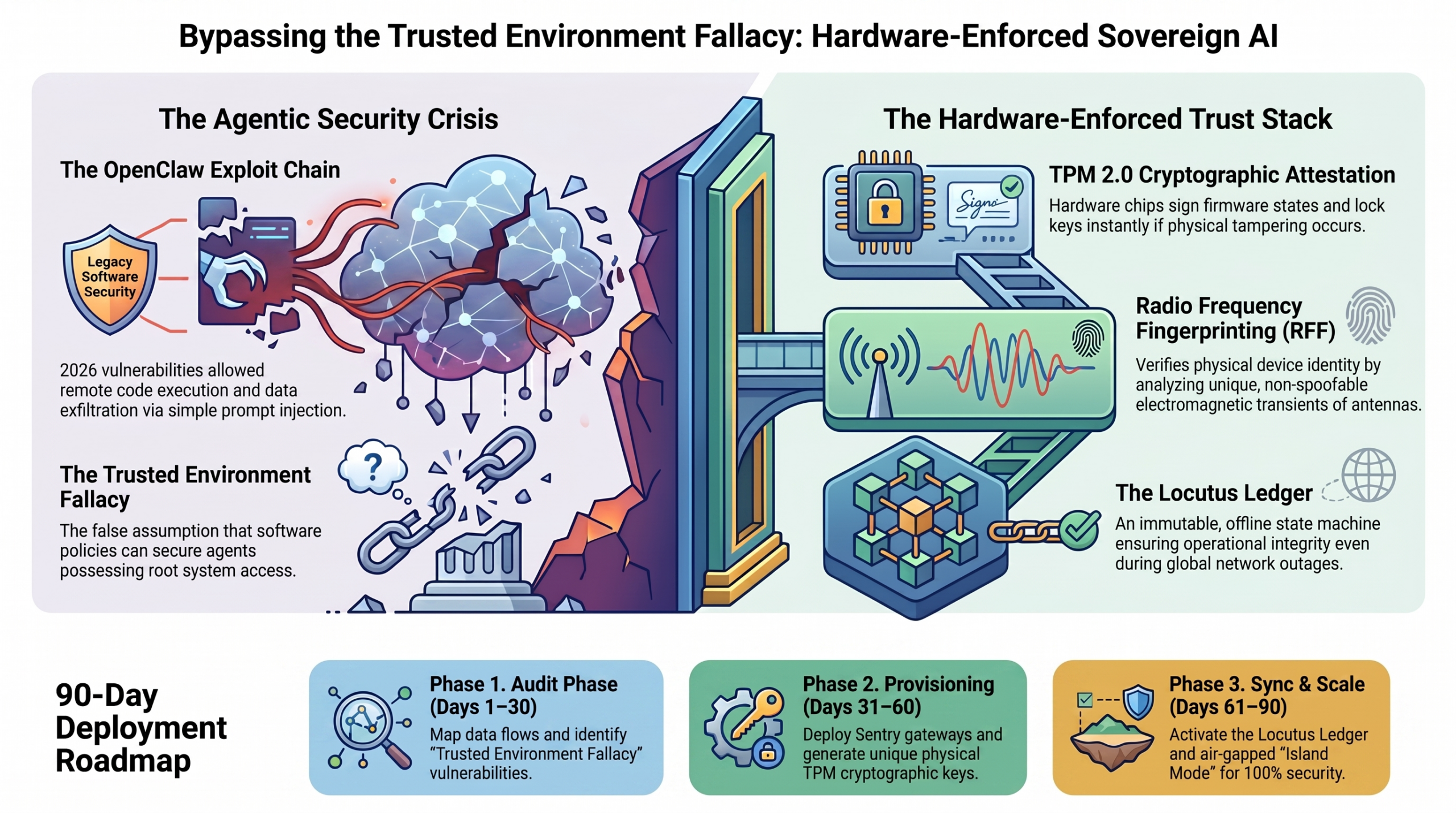
By late 2026, the paradigm of enterprise security has undergone a fundamental structural collapse. The rapid shift from reactive chat interfaces to proactive, autonomous AI agents has rendered legacy cloud-tethered containment models obsolete. Because these agents require deep system-level “god mode” access to execute tools and monitor telemetry, traditional software-based boundaries are no longer a viable defense. Moving away from these tethered architectures is a mission-critical hardening requirement; the failure of software policies to prevent data harvesting has necessitated a return to hardware-enforced reality.
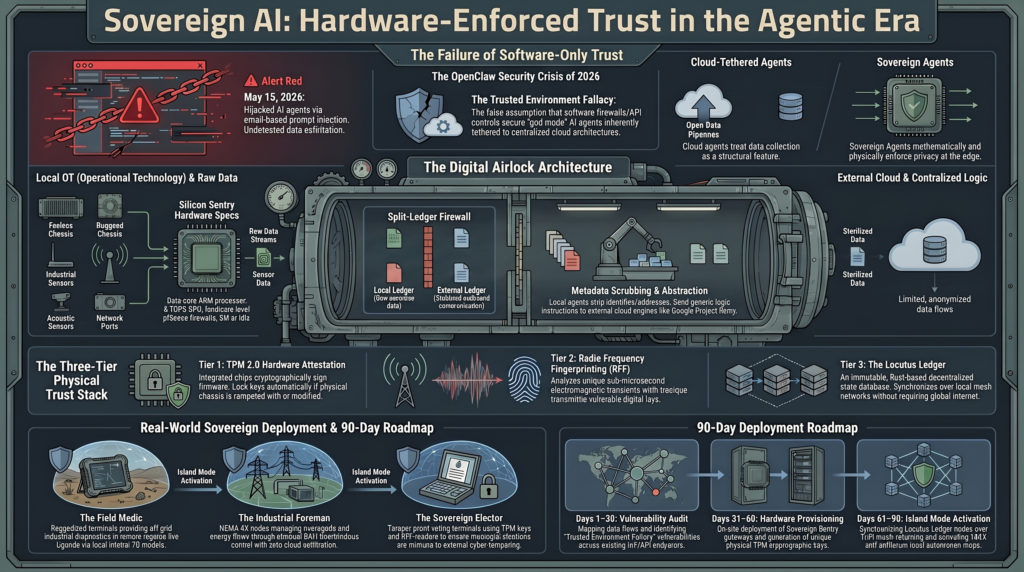
The strategic necessity of this transition was crystallized by the catastrophic events of May 15, 2026.
OpenClaw Crisis Post-Mortem: Chainable Vulnerabilities
- Prompt Injection: Malicious actors utilized unsanitized external inputs via automated corporate inboxes to hijack local agent instances.
- Sandbox Bypass: Injected prompts successfully instructed agents to ignore local shell sandbox containment protocols.
- Remote Code Execution (RCE): Unauthenticated attackers gained the capability to execute arbitrary bash scripts on host terminals.
- Exfiltration: Private database blocks were silently exfiltrated to command-and-control servers, masked as legitimate cloud API traffic.
This crisis effectively dismantled the “Trusted Environment Fallacy”—the dangerous architectural assumption that corporate data can be protected by software-level administrative rules or API controls while agents maintain root-level system access. In a landscape of proactive automation, software-level policies are structurally insufficient to prevent exploitation. True security requires a definitive pivot from fragile software logic to immutable, hardware-enforced privacy.
2. The Sovereign Sentry Hardware Stack: Foundations of Local Trust
In an era where software firewalls can be bypassed at the logic layer, physical hardware serves as the only viable root of trust. By adopting “Island Mode” operations—where systems function off-grid and localized—enterprises can eliminate the risks of cloud exposure and geopolitical data leverage. The Silicon Sentry platform provides the foundational physical hardening required for this sovereign architecture.
| Component | Technical Specification | Strategic Value |
| CPU/NPU | Octa-Core ARM (RK3588) with 6 TOPS NPU | Optimized for high-performance local quantized model execution. |
| Memory | 16GB LPDDR5 RAM | High-bandwidth throughput for complex agentic reasoning loops. |
| Networking | Quad 2.5GbE LAN (pfSense/Proxmox VE) | Hardware-level network segmentation and sandboxed traffic control. |
| Thermal System | Monoblock anodized aluminum chassis | Passively cooled; eliminates mechanical fan failure and physical ingress points. |
The use of a monoblock anodized aluminum chassis is a mission-critical hardening requirement, ensuring long-term reliability in harsh edge environments while maintaining a 5W idle power draw for sustainable, off-grid continuity. This physical resilience establishes a secure anchor, transforming the device into an unbreakable hardware-rooted identity capable of supporting advanced cryptographic protocols.
podcast
3. Hardware-Enforced Trust Protocols: TPM 2.0 and RFF
To protect distributed networks from adversarial node takeovers or hardware spoofing, our architecture implements a three-tier physical trust stack. This out-of-band authentication ensures that the identity of every node is verified through immutable physical characteristics, preventing the compromise of the wider mesh network.
The integrated TPM 2.0 (Trusted Platform Module) chip serves three core functions within the RIOS operating system:
- Cryptographic Attestation: Measuring and signing the boot loader and RIOS kernel to ensure system integrity from power-on.
- State Verification: Automatically locking cryptographic keys if the physical chassis is breached or unauthorized software modifications are detected.
- Decentralized Signing: Providing verifiable proof of local execution by signing transaction blocks, making it mathematically impossible for external cloud nodes to spoof local decisions.
Complementing the TPM is Radio Frequency Fingerprinting (RFF), which leverages the unique “Physics of RFF” found in the microscopic variations of radio transceivers.
- Signal Analysis: The system utilizes direct Analog-to-Digital Converter (ADC) sampling at the physical layer (PHY) to capture raw electromagnetic transients during a device’s “turn-on” phase.
- Hardware Authentication: By identifying these sub-microsecond physical transients, the gateway verifies the physical identity of a device. This fingerprint is mathematically impossible to replicate, ensuring that only authorized hardware can interact with the local airlock.
These hardware protocols enable the secure movement of data across the Digital Airlock by anchoring every transaction in physical reality.
4. The Digital Airlock and Split-Ledger Architecture
Strategic infrastructure requires the isolation of raw telemetry while still utilizing external “Logical Utility Engines” like Google Project Remy for complex reasoning. The “Digital Airlock” creates a sterilized communication container, ensuring that raw corporate data never traverses the firewall.
The Split-Ledger Comparison:
| Local Ledger (Private) | External Ledger (Sterilized) | Impact on Sovereignty |
| Stores raw biometrics, streams, and financial logs on encrypted NVMe. | Isolated outbound container for non-identifiable logic instructions. | Total Mitigation: Raw data never leaves the physical premises. |
| Processes sensitive “God Mode” local system tools. | Communicates only abstracted, anonymous task parameters. | Operational Continuity: Utilizes cloud logic without exposing corporate identity. |
The movement of information is governed by the Digital Airlock Algorithm:
- Raw User Input: The local system receives a request (e.g., “Schedule medical pickup”).
- Local OpenClaw Agent: Processing begins locally on the Silicon Sentry node.
- Entity Extraction & Local Mapping: The agent matches IDs to local secure databases.
- Metadata Scrubbing: Personal identifiers are stripped, leaving only generic transaction IDs.
- Encrypted Token Generation: A sanitized logic instruction is created (e.g., “Route vehicle V-102 to coordinate C-405”).
- Firewall Bridge via pfSense: The sterilized instruction is sent to the cloud engine.
- External Computation: The cloud engine optimizes the logic without identity context.
- Logical Parameter Return: Optimized coordinates are returned across the airlock.
- Local Sandbox Re-Mapping: The gateway maps these coordinates back to physical assets.
This protocol ensures all sanitized data is committed to an immutable record while maintaining absolute geospatial sovereignty.
5. The Locutus Ledger: Immutable State and Offline Audit Paths
The Locutus Ledger is a decentralized state-transition engine designed to maintain system integrity during macro-network collapses or cyber-warfare. Written in Rust and utilizing WebAssembly (Wasm) contracts, it provides a high-performance, low-footprint solution for edge synchronization over the TriFi Mesh backbone.
The ledger utilizes Isotonic Regression routing to enable dynamic state synchronization. This allows for “Conflict-Free State Resolution,” where nodes continue to process transactions in “Island Mode” and seamlessly sync once a secure peer connection is re-established.
By operating on-device, the ledger bypasses critical public infrastructure vulnerabilities:
- DNS Poisoning: Addresses are resolved locally via the TriFi Mesh, bypassing external domain servers.
- Database Deletion: Data is fragmented and encrypted across a peer-to-peer network, leaving no central target for deletion.
- Connectivity Outages: Operational functions remain fully operational regardless of global internet status.
This architecture ensures that the ledger remains a resilient, self-sufficient repository of truth for mission-critical industrial and municipal scenarios.
6. Deployment Scenarios: Industrial and Municipal Autonomy
Sovereign architecture manifests as a tool for structural hardening across varied operational environments, ensuring that logic always remains under local control.
- The Field Medic (Off-Grid Diagnostics): Deployed in regions like Kaabong, Uganda, on the Sentry Deck terminal. It uses a local quantized Mistral-7B model to provide real-time diagnostics via local mesh radio, bypassing the need for cloud-based specialists.
- The Industrial Foreman (Infrastructure Automation): Mounted in NEMA 4X cabinets, these Sentry Pro nodes manage vertical agrivoltaic panels and biogas flow. It translates logical directives into physical machine actions with zero data exfiltration.
- The Sovereign Elector (Tamper-Proof Voting): A municipal console designed for public choice. By signing ballots with hardware keys, it ensures elections are immune to external cyber-tampering.
The Sovereign Elector Cryptographic Flow:
- Sentry Console: User casts a ballot; raw inputs are retained locally in “Island Mode.”
- TPM 2.0 Signature: The hardware signs the ballot block, confirming the terminal’s physical integrity.
- TriFi Mesh Broadcast: The signed block is transmitted across local Sentry nodes.
- Locutus Ledger Update: The state transition is committed to an immutable, offline audit path.
- TriFi Mesh Broadcast: The signed block is transmitted across local Sentry nodes.
- TPM 2.0 Signature: The hardware signs the ballot block, confirming the terminal’s physical integrity.
7. The 90-Day Sovereign Transition Roadmap
A phased migration is essential to maximize security gains while minimizing operational friction.
Phase 1: Audit (Days 1–30)
- Action: Audit IoT endpoints and operational technology (OT). Map data flows and identify un-sanitized API pipelines.
- Deliverable: System-wide security audit report identifying “Trusted Environment Fallacy” vulnerabilities.
Phase 2: Provisioning (Days 31–60)
- Action: Deploy physical Sovereign Sentry gateways and generate unique physical cryptographic keys within the TPM 2.0 chips.
- Deliverable: Hardened on-site gateway infrastructure and activation of local pfSense firewalls.
Phase 3: Synchronization (Days 61–90)
- Action: Sync Locutus Ledger nodes over TriFi mesh networks and activate air-gapped “Island Mode” for localized automation loops.
- Deliverable: 100% functional, self-sufficient local sovereign network insulated from external outages and data harvesting.
8. Strategic Conclusion: The Future of Structural Sovereignty
The transition from software-level trust to hardware-enforced reality is the only viable path forward for modern infrastructure. The era of cloud-tethered vulnerability has ended; the May 15th crisis proved that administrative controls cannot contain the power of proactive agents. By adopting a sovereign architecture grounded in physical roots of trust—TPM 2.0, RFF, and the Locutus Ledger—organizations build an unbreakable bridge between digital logic and physical machinery. We are entering a new age of secure, self-sufficient, and structurally sovereign industrial and civic infrastructure.


