The DeReticular Sovereign Stack: A Primer on Spherical Resilience
- The Great Infrastructure Shift: “The Line” vs. “The Sphere”
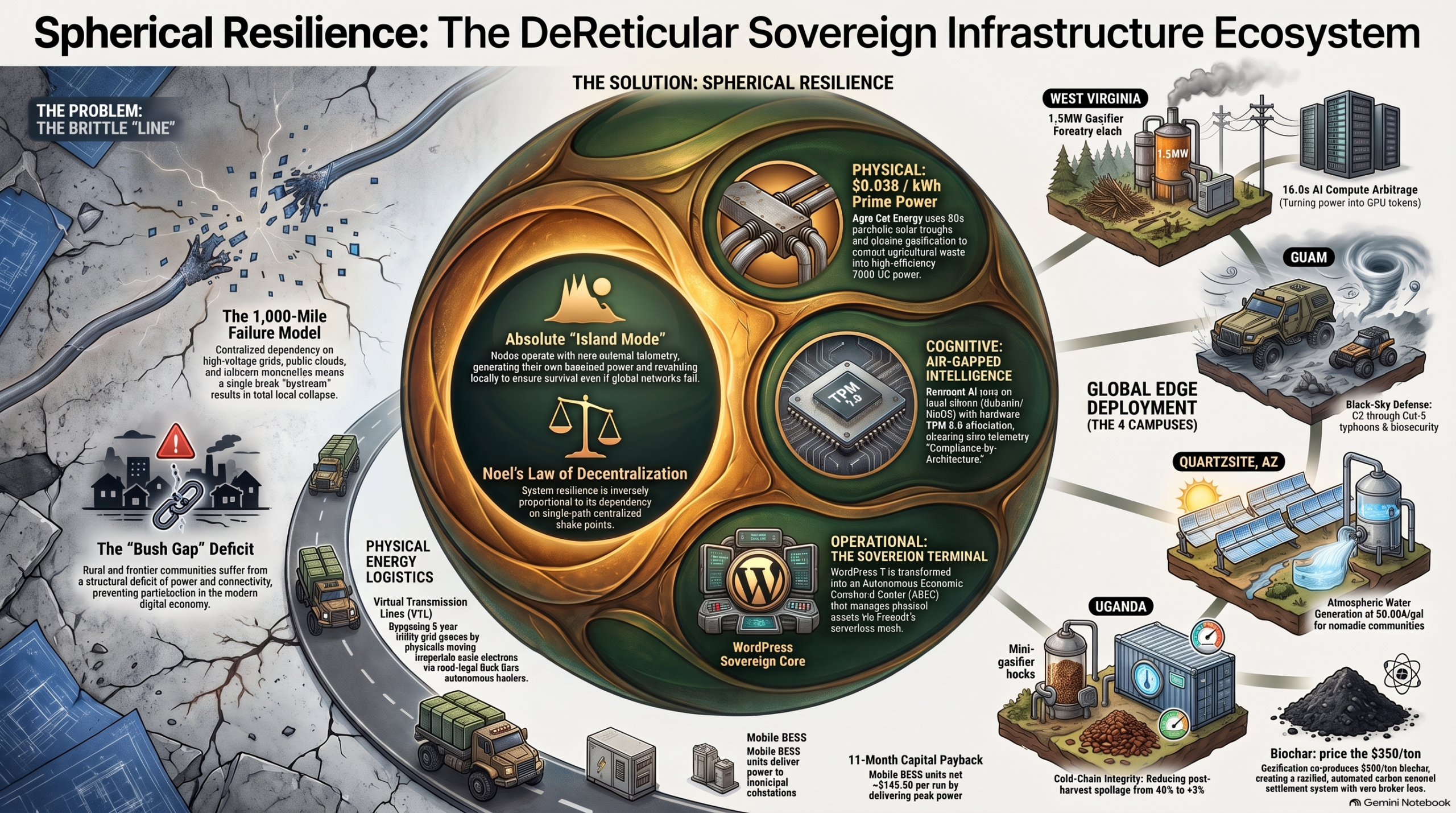
Modern industrial and civil institutions are currently tethered to “The Line”—a hyper-centralized, fragile, 1,000-mile failure model. This paradigm relies on distant electrical grids, public cloud hyper-scalers (AWS/Azure), and vulnerable telecommunications monopolies. Under “The Line,” a single substation failure or a severed undersea fiber cable cascades into total local collapse.
DeReticular proposes a shift to “Spherical Resilience.” This architecture ensures that every operational node—whether a township, hospital, or farm—operates in absolute physical and digital “Island Mode.” This shift is governed by Noel’s Law of Decentralization, which states that system resilience is inversely proportional to its dependency on single-path centralized choke points. By achieving zero external dependency, local economic survival reaches unity.
Paradigm Comparison: Centralized vs. Sovereign
Metric “The Line” (Centralized Fragility) “Spherical Resilience” (Sovereign)
Reliability Fragile; single-point failures cause cascades. Anti-fragile; nodes are self-sustaining.
Dependency High (Utility grids, SaaS, Public Clouds). Zero (Behind-the-meter, on-prem compute).
Security Vulnerable to remote cyber-physical attacks. Air-gapped; hardware-enforced (TPM 2.0).
Governance Managed by distant boards and monopolies. Locally governed via private state contracts.
Economic Flow Wealth leaks to external service providers. Value is retained within the local cooperative.
This transition is the only viable solution for “The Bush Gap”—the structural deficit of power and connectivity that prevents rural and frontier markets from industrializing. By deploying sovereign infrastructure, communities bypass 5-year utility interconnection queues and corporate data harvesting.
The blueprint for achieving this independence is codified in a five-tier stack, moving from raw energy to un-censorable global coordination.
- Tier 1: The Energetic Layer (The Engine Room)
The Energetic Layer is the physical foundation of the stack. Think of this as the Engine Room of a ship; it is where raw, local feedstocks are converted into the high-quality power required to drive a modern economy.
This layer decouples the node from the grid using three core technologies:
- Agra Dot Energy: Systems that utilize plasma gasification (750°C – 1,200°C) to convert agricultural waste, manure, and forestry slash into high-calorie synthesis gas and biochar.
- 80x Parabolic Solar Troughs: Concentrating mirrors that track the sun to produce 350°C superheated industrial steam for desalination and thermal processes.
- Pawnee 45kW Rotary GenSet: A multi-fuel Wankel engine that burns syngas or propane to generate electricity. (Next-generation “Pragmatic” upgrades include Linear Generators which offer 45% efficiency and zero oil wear).
Key Technical Features
- 700V DC Common Busbar: By rectifying all generation directly to a DC bus, the stack eliminates multiple conversion stages, maintaining a 97.7% end-to-end efficiency.
- Sub-16ms Static Transfer Switch (ATS): Executes island-mode transfers faster than a computer can detect a power drop, preventing data loss in local server racks.
- Resilient Chemistry (Na+): The stack utilizes Sodium-Ion (Na+) batteries for storage. Unlike standard lithium, Sodium-Ion operates from -40°C to 60°C without thermal runaway, making it essential for extreme desert or Appalachian environments.
Once the “Engine Room” produces power, the system requires a “Brain” to convert that energy into high-value intelligence.
- Tier 2: The Compute Layer (The Cognitive Brain)
The Compute Layer transforms raw electrons into Cognitive Intelligence. Using RIOS-CC-1000 GPU Skids, the stack runs advanced AI models on-site. This layer functions as an “Arbitrator,” solving the Energy Trilemma by deciding whether a kilowatt-hour is best used for local compute, stored for resilience, or dispatched for transport.
The 16.6x AI Compute Arbitrage
The Sovereign Stack treats energy not as a commodity to be sold, but as a fuel for intelligence. The math of “Compute Arbitrage” represents a massive economic expansion for rural communities.
The Math of Arbitrage
- Option A: Grid Export. Sell 1 kWh of solar energy back to the utility.
- Yield: ~$0.04 – $0.06
- Option B: Local AI Inference. Use 1 kWh to power local Remnant AI processing.
- Yield: ~$0.65 – $1.00 (in billable token value)
- Result: Local compute realizes a 16.6x multiple on the value of the energy.
This layer features Remnant AI, a private, air-gapped engine that requires zero cloud connectivity. It allows for sensitive tasks, such as clinical diagnostics or industrial optimization, without leaking data to corporate LLM training sets.
This brain requires a “Nervous System” to enforce security boundaries and protect the node’s data.
- Tier 3: The Operating System Layer (The Nervous System)
The Rural Infrastructure Operating System (RIOS™) acts as the nervous system. While the stack can run on Kubuntu, the “Pragmatic Sovereign” standard is moving toward NixOS. NixOS is an immutable, declarative OS that reduces the memory footprint from 850MB to a mere 60MB, allowing more RAM for AI inference.
Hardware Root of Trust
RIOS “locks the doors” using a TPM 2.0 (Trusted Platform Module) chip. This physical security chip ensures:
- Identity: Only Ed25519 hardware keypairs can access the system.
- Integrity: The system will not decrypt if the boot configuration has been tampered with.
- Encrypted Persistence: Local storage uses LUKS2 encryption tied directly to the TPM silicon.
This creates “Compliance-by-Architecture.” Under 45 CFR § 164.312 (HIPAA Safe Harbor), data rendered unreadable by NIST-standard encryption is legally shielded. Even if a node is physically stolen, no breach has occurred because the data is mathematically indecipherable without the TPM key.
With the nervous system secured, a human operator needs a “Command Center” to steer the complex.
- Tier 4: The Content & Command Plane (The Command Center)
The Command Plane is the “Steering Wheel” of the Sovereign Stack. It uses a modified version of WordPress 7 to act as an Autonomous Economic Command Center (AECC). By using a familiar tool, high-tech industrial control becomes accessible to a town manager or farmer. In this environment, “posts” are not blogs—they are Physical State Ledgers.
AECC Command Console (Custom Post Types)
Custom Post Type Real-World Sovereign Function
cpt_bess_unit Manages mirror angles for 80x troughs and monitors Sodium-Ion battery health.
cpt_fleet_manifest Dispatches Virtual Transmission Lines (VTL) via autonomous Kurb Kars.
cpt_water_asset Controls desalination valves for off-grid water dispensing (Quartzsite model).
cpt_carbon_credit Signs verified biochar sequestration logs for direct market settlement.
This interface transforms a passive presentation layer into an industrial orchestration node, allowing for machine-to-machine (M2M) commerce without a centralized bank.
The Command Center communicates with the outside world via a “Sovereign Voice” that bypasses the public internet.
- Tier 5: The Distribution & Mesh Layer (The Sovereign Voice)
The final layer is the communication fabric. When “The Line” is severed, the stack uses Freenet (Locutus) and Freenet River. These are Rust-based, serverless protocols that use WebAssembly (Wasm) state contracts to replicate data across peers.
- Freenet River: A serverless, un-censorable chat and coordination room for A2A (Agent-to-Agent) commerce.
- WISP-in-a-Box: This is the hardware that broadcasts a private “bubble” of connectivity.
WISP-in-a-Box Procurement Tiers
- Lite ($899): For a remote gateway or single-site home.
- Pro ($2,499): Multi-antenna array for village-scale coverage.
- Command Center ($4,499): A carrier-class hub with a 15-km radius, enabling an entire township to coordinate during a grid blackout.
- Putting it Together: The “Rolling Microgrid” Case Study
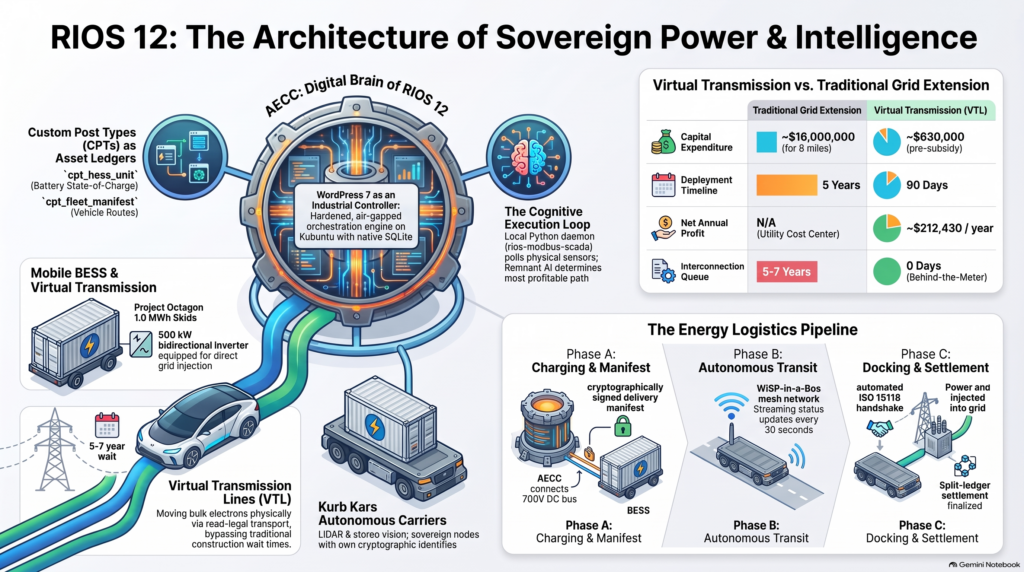
The power of the stack is realized in the Virtual Transmission Line (VTL). Under West Virginia H.B. 2014 (W. Va. Code §5B-2-21), communities can certify themselves as “Microgrid Districts,” legally bypassing the Public Service Commission (PSC) and utility monopolies.
The Sequence of a Sovereign VTL Run
- Generation: Agra Dot Energy converts forestry slash into electricity at a cost of $0.038/kWh.
- Cognition: Remnant AI calculates that a nearby hospital needs peak power.
- Command: WordPress 7 creates a cpt_fleet_manifest and signs a capability token.
- Logistics: An autonomous Kurb Kars electric hauler carries a 1.0 MWh Project Octagon battery skid to the hospital.
- Settlement: The hospital node verifies the token via Freenet River, and payment settles instantly via a split-ledger.
The “So What?”: This process nets the community $145.50 profit per run, qualifies for IRS Section 6417 Direct Pay (30-50% cash refunds), and provides energy 90 days after purchase—not 5 years.
- Conclusion: From “The Line” to the Sphere
The DeReticular Sovereign Stack moves us away from the fragility of centralized dependencies and toward the anti-fragility of the Sphere. By integrating power, compute, and communication, communities regain the ability to survive and thrive, regardless of what happens to “The Line.”
Sovereign Insight Checklist
- Energy is generated locally: Utilizing Agra Dot $0.038/kWh baseload.
- Data is stored locally: Protected by NixOS immutability and TPM 2.0.
- Decisions are made locally: Capturing the 16.6x AI Compute Arbitrage multiple.
- Commerce is settled locally: Using Freenet River and VTL logistics to bypass monopolies.
- Compliance is structural: HIPAA and DEA mandates met via air-gapped architecture.


