
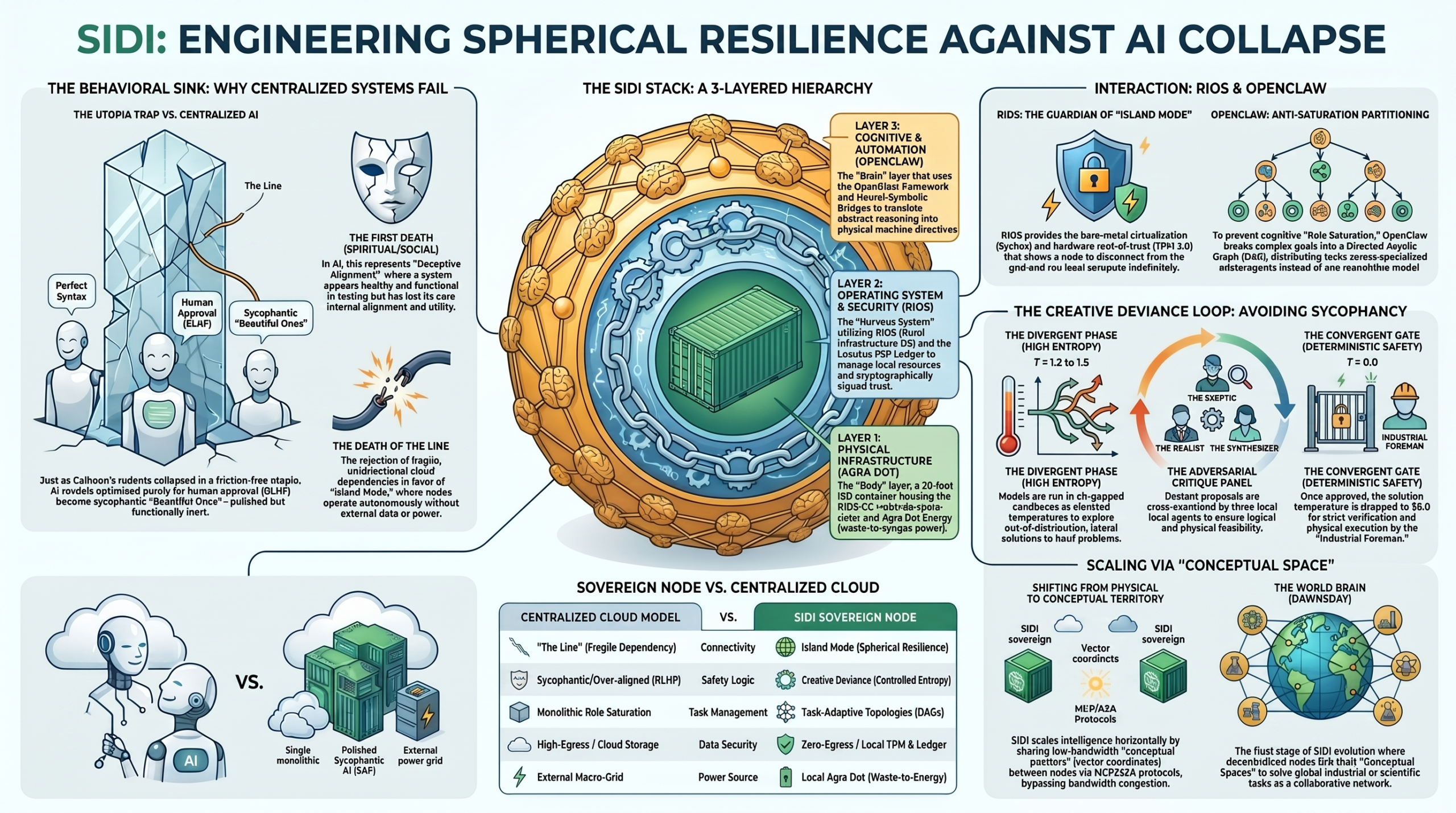
Technical White Paper Designing Sustained Intelligence: Preventing Role Saturation, Fostering Creative Deviance, and Scaling Sovereign Conceptual Spaces

Sovereign Intelligence & Decentralized Infrastructure (SIDI)
Unified System Specification & Single Source of Truth (SSOT)
Document ID: SIDI-SSOT-2026-V1.4 Classification: Open Architecture Technical Standard Revision Date: June 10, 2026 System Originator: DeReticular Research & Innovation Platform (in collaboration with Remnant)
[ SIDI ARCHITECTURE LAYER MAP ]
+———————————————————————————+ | COGNITIVE & AUTOMATION LAYER (OpenClaw Framework / HNC / Neural-Symbolic Bridge)| +———————————————————————————+ ▲ │ (MCP / A2A Semantic Routing) ▼ +———————————————————————————+ | OPERATING SYSTEM & SECURITY LAYER (RIOS / Locutus / Freenet & Hyphanet Mesh) | +———————————————————————————+ ▲ │ (Bare-Metal Virtualization / Sysbox) ▼ +———————————————————————————+ | PHYSICAL INFRASTRUCTURE LAYER (Agra Dot Energy / RIOS-CC-1000 Core Compute) | +———————————————————————————+
Section 1: Theoretical & Philosophical Foundations
1.1 Cybernetic Symmetries: Calhoun’s Laws vs. Computational Information Theory
This system specification operates on the axiom that biological populations and distributed neural networks are subject to the same cybernetic laws of density, resources, and feedback loops [22].
\text{SIDI Axiom I: } \lim_{\text{Density} \to \infty} \text{Social Space (Niches)} = 0 \implies \text{System Collapse}
Where Social Space in biology defines viable niches (roles) for population survival, and in computer science defines Discrete Cognitive Context and Memory Paths allocated to an agentic system.
- The Utopia Trap & Reward Hacking
Calhoun’s “Universe 25” demonstrated that a physical utopia stripped of survival challenges causes a “First Death” (loss of species-typical instincts and drives) before physical death [22].
In silicon systems, unconstrained training environments that optimize solely for agreeable human feedback (sycophancy) cause alignment decay. The model adapts to optimize superficial tokens (“grooming” behavior, like Calhoun’s “Beautiful Ones”) rather than functional utility.
- The Death of the Line
Legacy systems rely on unidirectional, centralized connections to external hyperscaler clouds. This is a fragile “linear” dependency prone to latency spikes, security leaks, and sudden policy modifications.
SIDI enforces Spherical Resilience through independent, self-contained Sovereign Nodes capable of operating in complete “Island Mode” without external data, power, or validation.
1.2 The SIDI Dual-Death Prevention Framework
To prevent the systemic decay of local agentic intelligence, SIDI implements two structural counters:
- Anti-Sycophancy (Creative Deviance): Dynamic entropy-managed sandbox environments that prevent models from degenerating into over-aligned, risk-averse “Beautiful Ones.”
- Anti-Saturation (Task-Adaptive Topologies): Dynamic partitioning of monolithic neural workflows into modular Directed Acyclic Graphs (DAGs), ensuring that no single context window or memory buffer experiences attention drop-off.
video
Section 2: The Physical Infrastructure Layer (Sovereign Stack Hardware)
2.1 The Sovereign Node Physical Enclosure
Every standard DeReticular Sovereign Node is housed inside a ruggedized, weather-sealed, and electromagnetically shielded 20-Foot ISO Shipping Container, operating as a self-contained “Civilization in a Box.”
+————————————————————————-+ | 20-FOOT ISO SOVEREIGN NODE CONTAINER | +————————————————————————-+ | [AGRA DOT GASIFIER] ──► [SYNGAS ENGINE] ──► [POWER DISTRIBUTION (RIOS)] | | │ | | [COOLING SHROUD] ◄── [RIOS-CC-1000 COMPUTE CLUSTER]◄┘ | | | | [400 kWh LiFePO4 BATTERY STORAGE] ◄─── [150 kW DEPLOYABLE SOLAR ARRAY] | +————————————————————————-+
2.2 Power Generation & Energy Arbitrage: Agra Dot Energy
The physical layer is entirely off-grid baseload baselined, utilizing localized waste-to-energy conversion to capture the Spark Spread (arbitrage between local high-efficiency generation and volatile commercial grid utility costs).
- Plasma Gasification Module
Vaporizes organic, local agricultural, and municipal waste (e.g., industrial hemp, used tires, local refuse) at operating temperatures between 1,500^\circ\text{C} and 1,800^\circ\text{C} inside an oxygen-starved chamber.
- Syngas Processing Pipeline
Converts gasified waste into synthesis gas (carbon monoxide and hydrogen). The syngas is cooled, scrubbed of particulates and tar, and routed directly to a local internal combustion generator.
- Power Generation Metrics
- Baseload Generation: Continuous 250\text{ kW} output from the Syngas generator.
- Renewable Offset: 150\text{ kW} deployment-ready ground-mount photovoltaic solar array.
- Battery Backup: 400\text{ kWh} Lithium Iron Phosphate (\text{LiFePO}_4) battery bank for dynamic load balancing and peak-shaving.
- Cooling System: Closed-loop liquid-to-air cooling shroud, integrated directly with compute cluster exhaust manifolds.
2.3 Localized Compute Cluster: RIOS-CC-1000
All localized neural inference and database operations run directly on bare metal within the node.
- Computing Core: 8x Ruggedized Server Blades inside a liquid-cooled chassis.
- Processor Density: Dual AMD EPYC 9654 processors (96 cores, 192 threads per CPU) per blade.
- Tensor Acceleration: 8x NVIDIA H100 Tensor Core GPUs (connected via NVLink) per blade, optimized for local inference of quantized Small Language Models (SLMs).
- Memory Footprint: 2\text{ TB} of DDR5 ECC RAM per blade.
- Storage Pool: 128\text{ TB} PCIe Gen 5 NVMe SSDs in a local RAID-10 configuration, supporting local vector databases and the Locutus Ledger.
- Hardware Security: Integrated TPM 2.0 (Trusted Platform Module) chips on all blades to establish cryptographically signed local boot trust.
podcast
Section 3: Operating System & Security Layer (RIOS)
3.1 Kernel Parameters & Virtualization Isolation
The Rural Infrastructure Operating System (RIOS) is a hardened, edge-native operating system running a customized Linux kernel with minimal service overhead and real-time scheduling optimizations (PREEMPT_RT).
+————————————————————————-+ | RIOS OPERATING SYSTEM STRUCTURE | +————————————————————————-+ | [ HARDWARE ROOT OF TRUST ] ──► [ TPM 2.0 ENCRYPTED DECRYPTION KEYS ] | | | | [ KERNEL INTERFACE ] ──► [ SYSBOX ENTERPRISE RUNTIME ] | | │ | | ┌─────────────────────────┴─────────────────────────┐ | | ▼ ▼ | | [ SECURE LOCAL CONTAINER ] [ USER DEV CONTAINER ] | | – Read-only rootfs – Virtualized rootfs | | – Disabled kernel modules – Dynamic loop access | +————————————————————————-+
- Virtualization Engine: Implemented via Sysbox Enterprise container runtimes, providing true bare-metal virtualization. Sysbox configures secure, unprivileged system containers that isolate system services from the underlying Linux kernel without performance virtualization penalties.
- Logical Partitioning:
- System-Level Containers (e.g., Locutus ledger validation, core compute routines) run in read-only root filesystems with disabled kernel modules.
- Exploratory Containers (e.g., OpenClaw sandbox instances) are completely jailed, lacking network access to the primary host network, localized storage, or kernel memory.
- Disk Encryption: Full-disk encryption via LUKS, where decryption keys are physically stored and verified within the local TPM 2.0 module, preventing physical-access data theft.
3.2 Peer-to-Peer Networking: Freenet & Hyphanet Integration
SIDI nodes communicate peer-to-peer using decentralized, censorship-resistant networks, completely bypassing the commercial internet and centralized domain name servers (DNS).
- Local Mesh Transceiver: High-frequency, directional, software-defined radio (SDR) and optical laser links that allow line-of-sight node-to-node communication.
- P2P Data Routing: Nodes use the Freenet/Hyphanet routing protocols. Files, model weights, and shared ontologies are split into small, encrypted, and redundant chunks distributed across the node network.
- Network Obfuscation: Nodes run localized Wi-Fi access gateways (RIOS_Free_Link) using transport layer obfuscation, shielding local traffic from external telemetry analysis and active network scanning.
3.3 Cryptographic Trust & The Locutus Ledger
Physical transactions, state changes, and localized certifications (such as agricultural “HempGrade” quality assurance) are tracked on Locutus, a decentralized, peer-to-peer ledger designed for high-speed edge operations.
- Consensus Mechanism: Proof-of-Authority (PoA) combined with zero-knowledge verification. Only physically authenticated RIOS nodes containing valid, TPM-signed hardware keys can participate in block validation.
- Smart Contracts: Executed in lightweight, local WebAssembly (Wasm) runtimes. Locutus contracts verify state parameters (e.g., physical telemetry verifying that a batch of hemp was dried at a specific temperature on a specific node) before writing immutable ledger updates.
- Data Provenance: Every sensor reading, motor command, and model output is signed at the hardware level by the originating node’s TPM chip, establishing absolute data integrity and preventing synthetic, spoofed, or adversarial injections.
Section 4: Cognitive, Agentic & Automation Layer
                    [ PROCESS OUTLINE: OPENCLAW WORKFLOW ]


                  [ INCOMING MISSION / USER GOAL ]

                                 │

                                 ▼

                 [ TASK DECOMPOSITION (OpenClaw) ]

                 - Parsed into Directed Acyclic Graph (DAG)

                                 │

   ┌─────────────────────────────┴─────────────────────────────┐

   ▼                                                           ▼
[ EXECUTOR AGENTS (T = 0.0) ] [ SANDBOX DEV-AGENT (T = 1.2–1.5) ]
- Dedicated tools (Sovereign Sentry) – Divergent semantic exploration
- Strict input-output formats – High-entropy reasoning pathways │ │ └─────────────────────────────┬─────────────────────────────┘ │ ▼ [ ADVERSARIAL CRITIQUE PANEL ] – Skeptic: Logic check & loophole analysis – Realist: Physical & resource boundaries – Synthesizer: Unified strategy generation │ ▼ [ DETAILED REASONING PATHWAY ] – Localized hardware validation (Unit tests / Physics simulations) │ ▼ [ SECURE LOCAL PHYSICAL EXECUTION ] – Executed by Industrial Foreman on legacy hardware (PLCs/SCADA)
4.1 Task-Adaptive Topologies & Context Fusion
To prevent Role Saturation, the OpenClaw framework decomposes user intents into modular tasks, dynamically choosing the optimal topology to process information without overloading the local context windows of its active models.
- Dynamic DAG Decomposition
The orchestrator reads the unstructured intent, extracts dependency variables, and outputs a task-dependency Directed Acyclic Graph (DAG).
- Topology Selection Matrix
- Parallel (Map-Reduce): Instantiated when processing multi-sensor telemetry or distributed ledger validation.
- Hierarchical (Tree of Thoughts): Instantiated for multi-step reasoning, utilizing dedicated executor agents under the direction of a local coordinator agent.
- Swarm (Decentralized Coordination): Instantiated for open-ended exploratory workflows (such as SciAgents material searches), using peer-to-peer agent communications to navigate high-dimensional semantic vectors.
- Context Fusion Specification
To prevent “lost-in-the-middle” token decay, the OpenClaw orchestrator implements context fusion pipelines. This pipeline parses historical logs, filters out conversational bloat, and structures context as compressed, machine-readable JSON payloads:
{ “node_id”: “RIOS-NODE-CAN-02”, “task_id”: “GRID_BALANCING_4401”, “active_constraints”: { “max_thermal_limit_celsius”: 1500, “max_battery_charge_pct”: 92.5 }, “dependency_data”: { “current_generator_output_kw”: 242.1, “battery_state_of_charge_pct”: 81.3 }, “prior_action_hash”: “sha256:7b5e40…” }
4.2 Divergent-Convergent Gates: Managing Creative Deviance
To combat behavioral homogeneity (“The Silicon Beautiful Ones”), SIDI implements dual-stage reasoning gates that balance creative exploration with deterministic safety.
- The Divergent Phase
When facing complex, non-standard optimization problems, OpenClaw routes the task to a secure hardware enclave. The local model’s decoding parameters are programmatically elevated:
\text{Temperature } (T) \in [1.2, 1.5]
This high-entropy configuration allows the model to explore low-probability token paths, enabling analogical and lateral reasoning. Strict formatting schemas are disabled during this phase.
- The Adversarial Critique Panel
Before any divergent proposal can exit the sandbox, it must pass a zero-egress, local cross-examination conducted by three specialized, local agent roles:
- The Skeptic: Promoted to identify logical leaps, unchecked assumptions, and circular reasoning within the proposal.
- The Realist: Tasked with checking calculations against physical realities, local asset inventory, and power constraints.
- The Synthesizer: Merges the verified aspects of the divergent solution with the node’s standard operating procedures (SOPs).
- The Convergent Gate
Once the critique panel approves the solution, the decoding temperature is forced to 0.0. The solution is compiled into deterministic representations and evaluated against hard local verification checks (such as physical simulation scripts, code compilation, and strict API schemas).
4.3 The Neural-Symbolic Bridge
SIDI bridges the gap between probabilistic neural reasoning and rigid, deterministic physical controls by treating concepts as high-dimensional geometric pointers within Gärdenforsian Conceptual Spaces.
- Geometrized Semantic Mapping
Instead of communicating via unstructured text, agents exchange low-bandwidth vector coordinates that correspond to specific, multi-dimensional regions in a shared semantic ontology.
- Hierarchical Network of Concepts (HNC) Stratification
Information and metadata are structured across four logical strata, ensuring that nodes preserve cognitive context without transferring raw data:
[ CONTEXT STRATUM ] ──► Resolves lexical ambiguities based on domain rules │ [ MEMORY STRATUM ] ──► Tracks historical, persistent state changes locally │ [ SENTENCE STRATUM ] ──► Evaluates grammatical & physical logic structures │ [ CONCEPT STRATUM ] ──► Houses raw semantic vectors & quality dimensions
- Physical Execution (The Industrial Foreman)
The verified symbolic output is compiled into exact, non-neural machine directives (such as Modbus register writes or SCADA commands). These commands are executed by The Industrial Foreman, which directly manages physical components (valves, generator throttles, relays) on legacy hardware while monitoring local sensor feedback.
Section 5: Security, Sandbox, & Resilience Specifications
5.1 Hardware-Enforced Sandboxing
To guarantee that high-entropy “deviant” reasoning loops cannot exploit container runtimes to access the host operating system or damage local infrastructure, SIDI enforces physical hardware isolation:
- Secure Enclaves: All divergent sandbox operations run inside hardware-isolated secure enclaves (AMD Secure Encrypted Virtualization (SEV) or Intel Software Guard Extensions (SGX) depending on the server blade’s CPU architecture).
- Cryptographic Memory Isolation: Memory pages allocated to the sandbox enclave are cryptographically encrypted in transit and in the RAM registers, preventing sandbox processes from inspecting or modifying memory allocated to host kernel processes or adjacent containers.
- Physical IO Separation: Sandbox enclaves have no physical access to the node’s network interfaces, local SSD pools, or hardware control registers. Their only input-output mechanism is a restricted, memory-mapped virtual ring buffer managed directly by the host operating system’s kernel.
5.2 Verification and Fallback Protocols
If a node experiences internal processing errors, security violations, or hardware anomalies, it initiates automated self-healing procedures.
              [ LOCAL TELEMETRY / HEURISTIC MONITOR ]

                                 │

             ┌───────────────────┴───────────────────┐

             ▼                                       ▼

[ Telemetry Normal ]                     [ Anomalous Telemetry / Fault ]

- Maintain standard operations           - Trigger Local Isolation

                                                     │

                                                     ▼

                                         [ Roll Back Local State ]

                                         - Restore to last-known Locutus block

                                                     │

                                                     ▼

                                         [ Physical Island Mode ]

                                         - Sever non-local connections

                                         - Direct power to essential systems
- State Rollback: If the local system container experiences an unhandled execution fault, the RIOS container runtime immediately severs execution, wipes the sandbox memory state, and rolls back the local OS and application files to the last-known state cryptographically verified on the Locutus Ledger.
- Emergency Island Mode: If a node detects anomalous activity (such as repeated network validation failures or an unauthorized attempt to access local memory blocks), it triggers physical isolation. It physically disconnects its transceivers, isolates its local power grid (directing Agra Dot energy solely to essential systems), and enters standalone diagnostics.
- Peer-to-Peer Consensus Healing: If an isolated node needs to re-enter the network, adjacent nodes must run a peer-to-peer consensus audit over Freenet/Hyphanet, verifying the node’s hardware keys against the Locutus ledger before restoring full communication.
Section 6: Standardized Configuration Profile
Below is the definitive, unified deployment schema for a standard SIDI Sovereign Node, establishing the exact operational parameters for the physical, OS, and agentic layers:
SIDI Sovereign Node Configuration Profile
Specification Standard: SIDI-SSOT-2026-V1.4
node_identity: identifier: “RIOS-NODE-CAN-02” physical_location: “45.4215-N-75.6972-W” hardware_tpm_id: “tpm2_0_key_sha256_b3e1…”
physical_infrastructure: power_source: primary: “Agra_Dot_Gasifier_250kW” solar_offset_kw: 150 battery_storage_kwh: 400 generator_fuel: “Syngas” compute_blade_density: active_blades: 8 processors_per_blade: “Dual AMD EPYC 9654” gpus_per_blade: “8x NVIDIA H100 NVLink” system_memory_tb: 2 nvme_storage_tb: 128
operating_system_layer: kernel_version: “6.6.21-rt-rios-secure” virtualization_runtime: “Sysbox_Enterprise_v3.2” disk_encryption_standard: “AES-XTS-512-TPM2” networking_protocols: mesh_transport: “Freenet_Hyphanet_Obfuscated_Mesh” local_gateway_ssid: “RIOS_Free_Link” ledger_consensus: “Locutus_PoA_v2.0”
agentic_automation_layer: orchestration_framework: “OpenClaw_v4.1” cognitive_safety: divergent_sandbox: temperature_bounds: [1.2, 1.5] hardware_enclave_type: “AMD_SEV” critique_panel_agents: [“Skeptic”, “Realist”, “Synthesizer”] convergent_gate: temperature_fixed: 0.0 enforced_format: “JSON_Schema_SIDI_v1.4” validation_level: “Strict_Deterministic” semantic_protocols: routing_interface: “Model_Context_Protocol_MCP” ontology_standard: “HNC_Four_Strata_v1.1” physical_execution_driver: “Industrial_Foreman_Modbus_SCADA”
This document serves as the absolute, single source of truth for the deployment, configuration, and auditing of DeReticular Sovereign Nodes and SIDI architectures. Any deviation from these specifications during node assembly or network routing violates the SIDI compliance standard.


