
The Aerospace Aftermarket Primer: Navigating the Parts Drought and the Future of Flight Safety
1. Introduction: The High-Stakes World of Aircraft Maintenance
The following modules analyze the systemic shift within the aerospace aftermarket, a sector currently locked in a “super-cycle” of unprecedented demand. The industry is navigating a critical market paradox: global air travel has surged to record-breaking levels at the exact moment Original Equipment Manufacturers (OEMs) are crippled by historic production delays. This misalignment has transformed the aftermarket from a secondary support function into the primary guarantor of global flight safety and airline solvency.
Key Concept: The Aviation Aftermarket “Super-Cycle” The aviation aftermarket encompasses the manufacturing, distribution, and installation of all aircraft components following the initial sale by the OEM. Driven by the inability of manufacturers to deliver new hulls, this segment is valued at 53 billion as of 2025**, with the total parts market projected to reach **1.06 trillion by 2032. The current “super-cycle” reflects a shift where maintenance intensity and component scarcity dictate the operational readiness of the global fleet.
The following analysis bridges the gap between these macro-economic pressures and the physical reality of the aging hardware currently in operation.
2. The “Aging Fleet” Crisis: Why Planes Are Getting Older
With new aircraft deliveries delayed by years, airlines are compelled to extend the service life of airframes far beyond their original retirement schedules. This demographic shift in the global fleet has fundamentally altered maintenance requirements.
| Metric | 2019 Reality | 2025 Reality |
| Average Fleet Age | 14 Years | 16 Years |
| Maintenance Intensity | Standard intervals | Frequent “C” and “D” heavy checks |
| Supply Strategy | New OEM parts | Part “Cannibalization” |
The Crisis of Rotables and Cannibalization As aircraft age, the demand for high-value “rotables”—components like landing gear that are removed for periodic overhaul—has reached a breaking point. The scarcity of these parts has forced airlines into aggressive cannibalization strategies: the systematic stripping of components from parked or retired aircraft to maintain the airworthiness of active jets.
Primary Drivers of the Crisis:
- OEM Production Delays: Tier 1 manufacturers face 12+ month lead times, preventing fleet renewal.
- Maintenance Intensity: Older engines and airframes require deeper, more invasive inspections to mitigate fatigue.
- Record Travel Demand: Post-pandemic passenger volumes have placed continuous, high-cycle stress on existing inventory.
This supply vacuum has manifested as a global “Parts Drought,” forcing a total reassessment of how the industry sources and verifies hardware.
——————————————————————————–
3. Anatomy of the “Parts Drought”
When OEM supply chains fail, operators must utilize alternative material streams. Understanding the distinction between these streams is vital for navigating current procurement risks.
| Alternative | Primary Benefit for Learners |
| Used Serviceable Material (USM) | Cost-Savings: Recycled from retired aircraft, USM parts are 30–40% cheaper than new components and offer immediate availability in a $7.6B market. |
| Parts Manufacturer Approval (PMA) | Availability: These third-party parts are FAA-certified and allow operators to bypass OEM lead times that now frequently exceed one year. |
The financial stakes of this drought are punctuated by the industry’s most feared metric: AOG.
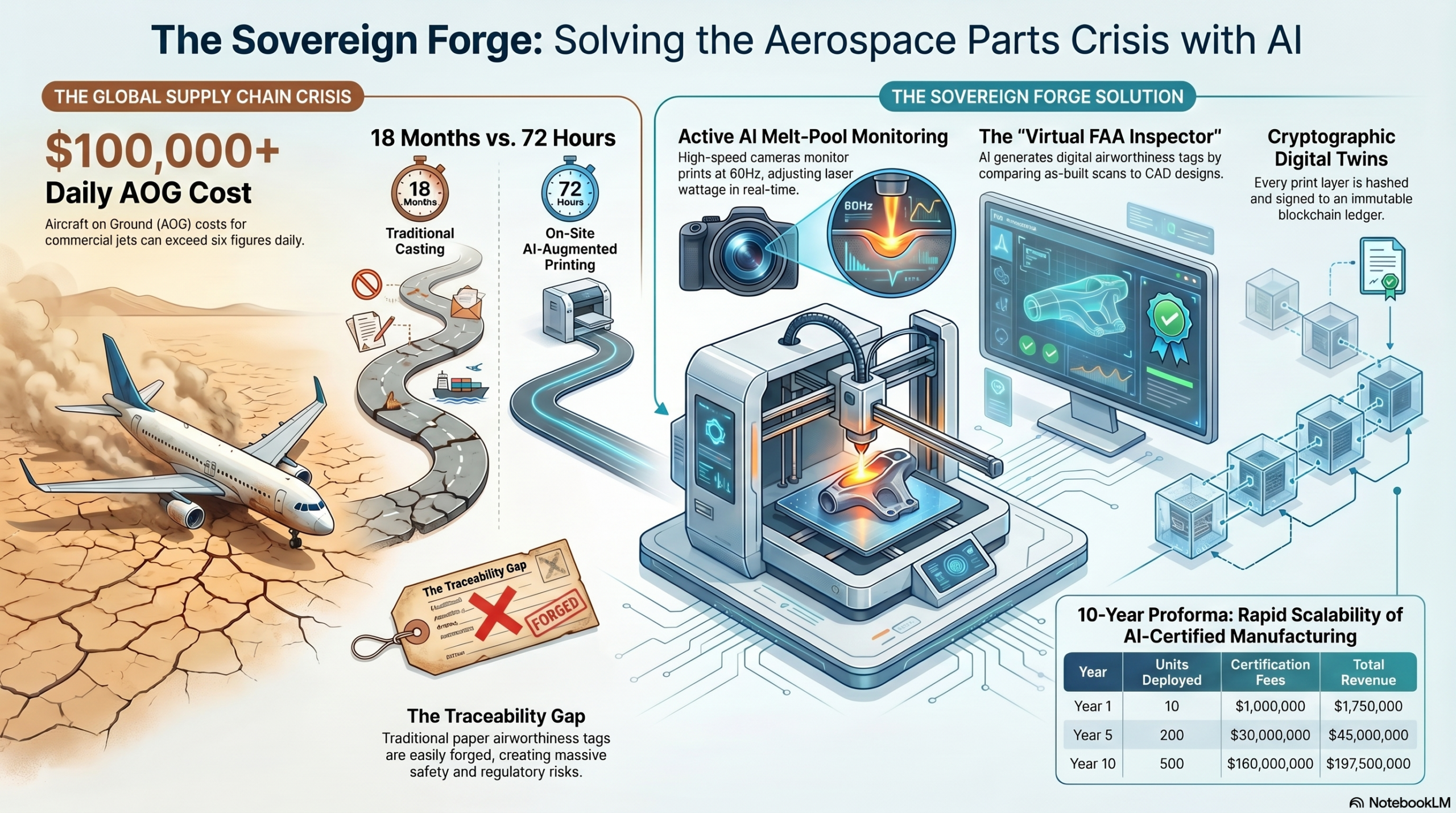
“Aircraft on Ground (AOG) costs represent the ultimate failure of the supply chain. A single grounded commercial jet incurs losses exceeding $100,000 per day in lost revenue, passenger re-accommodation, and logistical penalties.”
While USM and PMA parts provide a vital relief valve for the drought, they have introduced a systemic vulnerability in traceability, leading to the total collapse of paper-based trust.
4. The Traceability Gap and the AOG Technics Scandal
The industry reached a definitive turning point during the 2023-2024 AOG Technics scandal, where thousands of engine components were integrated into global fleets using forged airworthiness documentation. This crisis proved that traditional paper records—specifically the FAA Form 8130-3—are no longer sufficient to guarantee safety.
The “Back-to-Birth” Digital Currency Regulators now demand a comprehensive “Back-to-Birth” history for every flight-critical part. In the 2026 market, the “dirty fingerprint”—the granular digital trail of sensor logs and thermal data—has become the premium currency of airworthiness.
The Three Pillars of Regulatory Reality:
- FAA Reauthorization Act of 2024 Mandates: Strictly enforced annual unannounced inspections of both domestic and foreign repair stations.
- Drug & Alcohol Testing Mandates: A final rule requiring all international repair facilities to implement testing programs, with a hard compliance deadline of December 20, 2027.
- Digital Traceability: The transition from easily falsified paper tags to cryptographically secured digital records.
This regulatory pressure has accelerated the move toward a technological solution that replaces human trust with mathematical certainty.
——————————————————————————–
5. The Future of Manufacturing: Point-of-Use and AI Verification
To solve the Parts Drought, the industry is transitioning to “Point-of-Use” manufacturing. Utilizing the Sovereign Forge (SKU: SOV-AUTO-FORGE), repair stations can now execute on-site production of high-value components, such as Tungsten turbine blades.
Active Robotic Inspection and Material Science Tungsten is prized for its ultra-high melting point (3,422°C), yet it is notoriously difficult to manufacture via traditional casting due to its inherent brittleness. The SOV-AUTO-FORGE utilizes AI as an “active inspector” during the additive manufacturing process. By monitoring the “melt-pool” with high-speed thermal cameras, the AI detects fluctuations. If the temperature varies by >2%, the system adjusts laser wattage in real-time to prevent microscopic cracking.
Intellectual Property and Speed:
- Ephemeral Decryption: To prevent IP theft, CAD files are decrypted only into volatile RAM, vanishing the moment the print is complete.
- Traditional Lead Times: 12–18 months.
- Sovereign Forge Lead Times: 48–72 hours.
——————————————————————————–
6. Mathematical Airworthiness: Cryptography as the Ultimate Inspector
In the “Sovereign Infrastructure” model, airworthiness is proven through blockchain-based ledgers (the Locutus Ledger) and hardware-level security (TPM 2.0). Every component is assigned a “Digital Twin”—a 1-to-1 hashed map of its manufacturing sensor data.
Human-in-the-Loop Accountability Despite AI autonomy, the system enforces human responsibility through the Sovereign Key. This physical hardware device (typically a YubiKey) is required for the lead engineer to authorize the print start, ensuring that a qualified professional remains legally accountable for the output.
| Tool | Specific Role in Safety |
| Sovereign Forge | The “Virtual FAA Inspector”; it generates digital 8130-3 tags by analyzing real-time “melt-pool” data. |
| OpenClaw | An AI-driven inspector that executes sub-millimeter scans to ensure the “As-Built” part matches the “As-Designed” CAD file. |
| Split-Ledger | A dual-layer architecture that keeps proprietary printing instructions private while publishing the “Proof of Quality” to a public, immutable ledger. |
——————————————————————————–
7. Summary: From “Just-in-Time” to “Just-in-Case”
The aerospace sector has moved beyond the fragile “Just-in-Time” model toward a “Just-in-Case” strategy. This new paradigm prioritizes the ability to create, verify, and certify parts locally. This resilience is supported by “Sovereign Infrastructure”—integrated systems featuring resilient microgrids and Industrial Foreman AI agents that ensure 24/7 uptime for printing nodes.
As we approach a $1.06 Trillion valuation by 2032, the industry must also navigate current headwinds, such as the October 1, 2025, lapse in SBIR/STTR funding, which has paused many defense-related solicitation cycles. Nevertheless, the transition to digital transparency is irreversible.
Final Takeaway The future of the aerospace supply chain is anchored by three critical components:
- Traceability: Mathematical “Back-to-Birth” proof derived from sensor-level “dirty fingerprints.”
- Stock Availability: Decentralized “Point-of-Use” manufacturing via the SOV-AUTO-FORGE.
- Regulatory Agility: Automated compliance with the FAA Reauthorization Act and the 2027 drug testing mandates.


