
THE ASYMPTOTIC DEMOCRACY: A Formal Systems Architecture for Thermodynamic Governance, Epistemic Balloting, and Measure-Theoretic Parameter Foreclosure
Document ID: RELA-TR-2026-V1
Classification: Foundational Epistemological Architecture / Public Institutional Standard
Release Version: 1.0.0-PROD
Sponsoring Body: Foundational Governance Architecture Working Group
Mathematical Formalisms: Measure Theory, Information Theory, Differential Geometry, Algorithmic Information Theory (MDL), Mechanism Design, Partially Synchronous Byzantine Fault Tolerant (BFT) Consensus.
- The Epistemic Crisis of Modern Governance
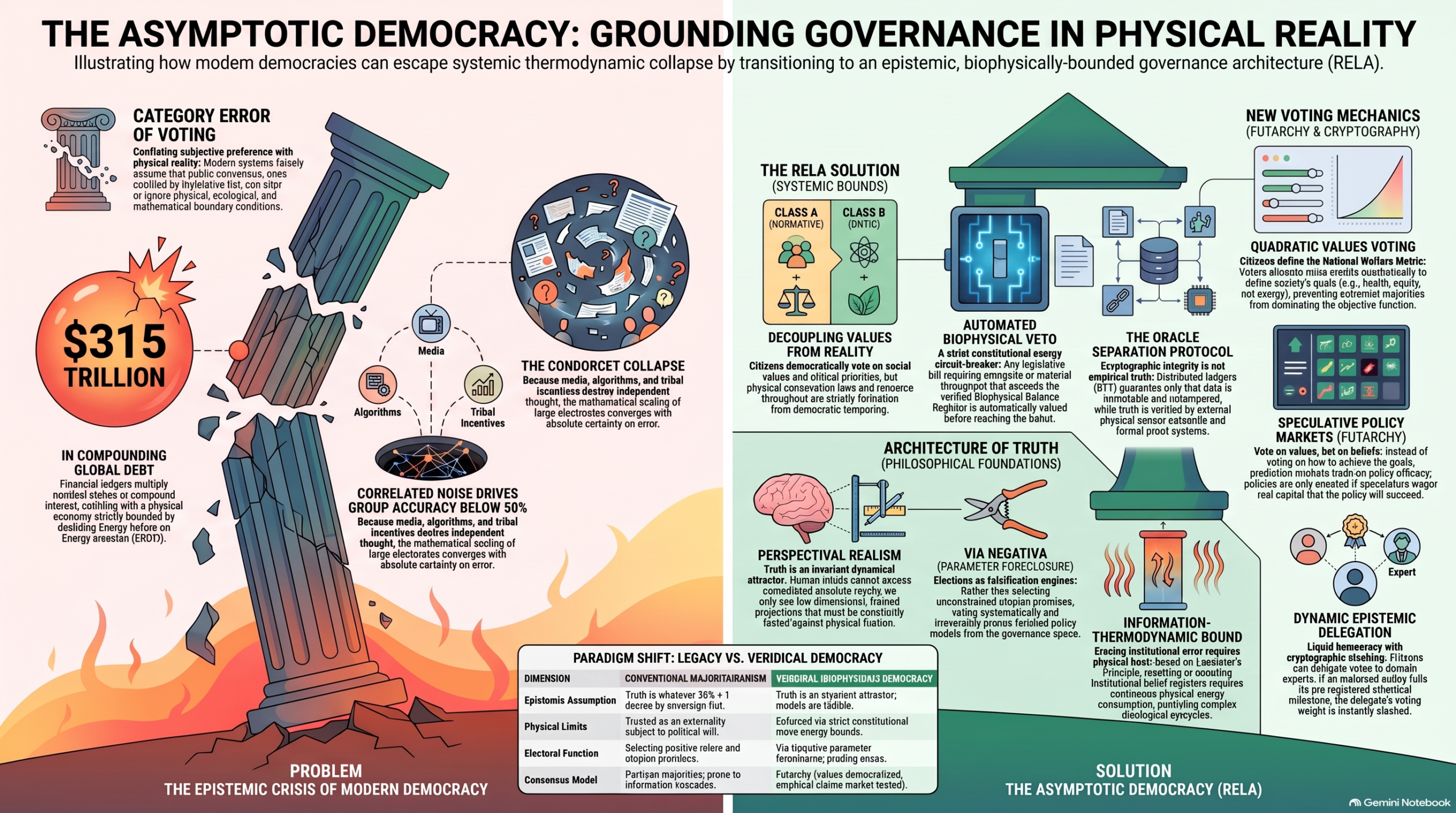
[AUTHOR_PROPOSITION] Modern majoritarian democracy is currently ensnared in a terminal category error: the treatment of balloting as an unconstrained tool for aggregating subjective preferences over mind-independent physical constants. This represents a systemic boundary violation where the state’s symbolic ledger has decoupled from its biophysical substrate. We diagnose this as “Phase 3” (Model Crisis) of the governance Kuhn Cycle, where institutional survival depends on the proliferation of Ptolemaic epicycles—ZIRP, QE, and narrative management—to mask the widening delta between symbolic promises and ontic limits.
[EMPIRICAL_CLAIM] This “Macro-Physical Crack” is quantified by the collision of exponential contractual debt (315 trillion per 2024 BIS data, ~333% of global GDP) with the unyielding friction of declining Energy Return on Energy Invested (EROEI). Current DSGE (Dynamic Stochastic General Equilibrium) models erroneously assume the “Neutrality of Money,” treating energy as a negligible <5% GDP externality. This blindness leads to the “Velocity Paradox”: in hyperinflationary Phase 3/4 transitions, money demand collapses and velocity (V$) surges non-linearly as agents dump degrading symbolic tokens for real exergy-backed commodities.
The Kuhn Cycle of Governance
Phase Epistemic Characteristic Modern Economic Equivalent
- Normal Science Stable authoritative ledger; axiomatic consensus. Post-WWII Bretton Woods II; DSGE models treating markets as self-clearing.
- Model Drift Anomalies accumulate; ad-hoc auxiliary epicycles added. 2008 GFC; introduction of QE/ZIRP to paper over systemic insolvency.
- Model Crisis Epistemic envelope cracks; predictions vs. reality delta \to \infty. CURRENT STATE: $315T debt vs. declining EROEI; V surges as money demand L(Y,r) collapses.
- Model Revolution Incommensurable frameworks clash; first principles debated. Multipolar clearing; “Outside Money” (Gold/Commodities) vs. “Inside Money” (Liabilities).
- Paradigm Shift False parameter space foreclosed; new ledger baked. Transition to RELA-anchored, BFT-verified, biophysically bound systems.
To resolve this crisis, the state architecture must be rebuilt on perspectival realism, ensuring that symbolic claims are asymptotically anchored to invariant truth.
- Mathematical Foundations: Perspectival Realism and the Invariant Attractor
[FORMAL_ASSUMPTION] We model the physical universe as an ontic state-space manifold \mathcal{M} where \dim(\mathcal{M}) = D \to \infty. The mind-independent ground-truth configuration exists as an invariant dynamical attractor \Omega^* \in \mathcal{M}. Individual observers (voters/sensors) do not possess a “view from nowhere” but operate within a compact metric parameter space (\Theta, d).
[ESTABLISHED_RESULT] We define the voter/observer perspective as a dimension-reducing projection operator: \hat{\Pi}\theta: \mathcal{M} \to \mathcal{P}\theta \quad \text{where } \dim(\mathcal{P}\theta) = d \ll D While \hat{\Pi}\theta(\Omega^*) is fundamentally incomplete (low-dimensional), it remains veridical within its projection plane \mathcal{P}\theta. A distinction captured in \mathcal{P}\theta tracks a genuine physical difference in \mathcal{M}.
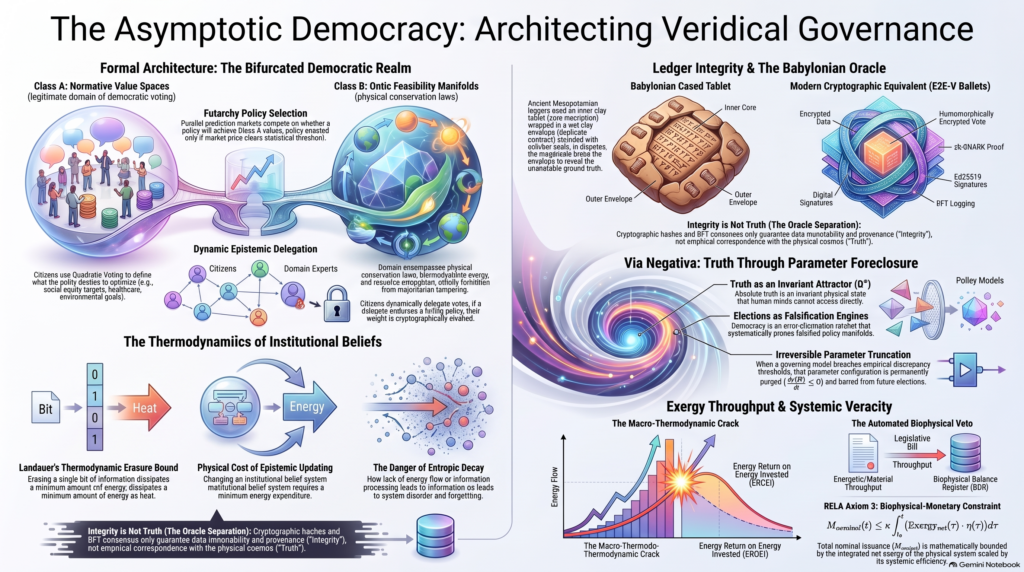
[AUTHOR_PROPOSITION] Objective consensus is recovered not through a single absolute decree, but as the Peircean invariant truth attractor—the limit of cross-perspectival intersections over indefinite inquiry within the measure space (\Theta, \mathcal{B}, \mu), where \mathcal{B} is the Borel \sigma-algebra: \Omega^* = \lim_{t \to \infty} \bigcap_{\theta \in \Theta_t} \hat{\Pi}\theta^{-1}\left(\mathcal{P}\theta^{\text{validated}}\right) This foundation facilitates the transition from positive utopian accretion to the systematic identification of error via the Via Negativa.
- The Topology of Parameter Foreclosure (Via Negativa)
[AUTHOR_PROPOSITION] Progress in veridical systems is driven by the permanent truncation of falsified parameter manifolds. We model policy hypotheses over the parameter measure space (\Theta, \mathcal{B}, \mu). Institutional “ideological comfort” typically involves hyper-parameterization (adding epicycles), which increases Kolmogorov complexity K(H). This violates Minimum Description Length (MDL) parsimony, causing unpenalized overfitting and the destruction of out-of-sample predictive power.
[POLICY_SPECIFICATION] Empirical reality acts on \Theta via pre-registered discrepancy loss statistics S(E_t, \theta). When a policy exceeds the threshold \tau_t, the hypothesis volume is contracted: \Theta_{t+1} = \Theta_t \setminus \Omega_{\text{falsified}}^{(t)} \implies \frac{d\mu(\Theta)}{dt} \le 0
Proposition 1: Asymptotic Contraction to the Attractor Let (\Theta, d) be a compact metric space. Under conditions of Identifiability (distinct \theta produce distinct S), Uniform Convergence of empirical statistics, and Conservative Thresholds (\tau_t) via the Borel-Cantelli Lemma, the viable hypothesis volume \mu(\Theta_t) monotonically contracts toward the projection of the invariant attractor \Omega^*.
Transitioning from thermodynamic constraints to materialized ledger implementations requires an investment in physical exergy to prevent “record rot.”
- The Physics of Veracity: Landauer Limits and Exergy Throughput
[ESTABLISHED_RESULT] Information is intrinsically physical. Landauer’s Principle defines the minimum energy required to erase or reset N bits of information in a system at temperature T: \Delta Q \ge N k_B T \ln 2 Updating an institutional belief register is a thermodynamic act. Without continuous exergy throughput to correct errors and maintain ledger fidelity, the system succumbs to entropic decay and “symbolic drift.”
RELA Axiom Checklist
- Monotonicity of Foreclosure: Falsification must permanently shrink the permissible hypothesis volume: \mu(\Theta_{t+1}) \le \mu(\Theta_t).
- Landauer Lower Bound: Every epistemic update dissipates \Delta Q proportionate to the bits modified.
- Biophysical-Monetary Equivalence Constraint: Total nominal issuance M_{\text{nominal}} is strictly bounded by the integrated net exergy (\text{Exergy}{\text{net}}) and systemic efficiency \eta: M{\text{nominal}}(t) \le \kappa \int_{t_0}^t \left( \text{Exergy}_{\text{net}}(\tau) \cdot \eta(\tau) \right) d\tau
Transitioning from thermodynamic constraints to materialized ledger implementations requires analyzing the material history of tamper-evident substrates.
- Materialized Ledger Integrity: From Babylonian Tablets to RELA
[HISTORICAL_INTERPRETATION] The RELA architecture descends from the Old Babylonian Cased Tablet (c. 1800 BCE). This “analog zero-knowledge proof” used an inner tablet (T_core) protected by an outer clay envelope (T_env). Administrative “Cylinder Seals” served as physical signatures; in disputes, a magistrate performed a “judicial fracture” of the envelope to reveal the unalterable core truth. This contrasts with modern “Inside Money” ledgers (e.g., the €210B in Russian reserves seized by the EU), where political fiat breached ledger neutrality.
Integrity Comparison: Babylonian vs. Digital RELA
- Inner Core / Encryption: The Babylonian primary tablet corresponds to the ElGamal/Paillier homomorphic encryption of voter selections.
- Outer Envelope / zk-SNARKs: The clay envelope and Cylinder Seal signatures correspond to Groth16 zk-SNARKs proving ballot validity without revealing plaintext.
- Judicial Fracture / Threshold Decryption: The magistrate’s fracture corresponds to the threshold decryption of the tally on a BFT bulletin board.
- The Architecture of the Asymptotic Ballot
[POLICY_SPECIFICATION] The Asymptotic Ballot functions as a “falsification engine.” To avoid the “Magic Ballot Fallacy”—the delusion that a majority can vote away physical scarcity—we separate the ballot into two distinct classes:
- Class A (Values): Normative preferences (social equity, risk tolerance) decided via Quadratic Voting or Futarchy.
- Class B (Ontic Feasibility): Physical conservation laws and exergy limits (e.g., EROEI), which are strictly forbidden from democratic tampering.
The “Biophysical Veto” acts as a circuit-breaker, automatically barring any policy requiring material throughput that violates the verified Biophysical Balance Register (BBR).
Data Schema: BiophysicalVetoRegister.json
{
“$schema”: “https://rela.org/schemas/v1/biophysical-register.json“,
“telemetry_epoch”: 1042,
“net_exergy_joules”: 3.2e17,
“systemic_eroei”: 12.4,
“material_runway_days”: {
“copper”: 450,
“lithium”: 320,
“hydrocarbons”: 120,
“rare_earths”: 500
},
“authorized_token_ceiling”: 1.28e12,
“veto_circuit_tripped”: false,
“metadata”: {
“oracle_source”: “Decentralized_IoT_Mesh_v4”,
“verification_method”: “TEE_Attested_Sensor_Quorum”
}
}
- Adversarial Analysis and System Safety
[ESTABLISHED_RESULT] The system must resist the Condorcet Inversion: if correlated noise or propaganda drives individual voter accuracy p < 0.5, the collective converges with mathematical certainty on error (\lim_{N \to \infty} P_N = 0).
Threat/Mitigation Matrix
Threat Mitigation Engine
Sybil Attacks (QV) Soulbound Identity protocols & zk-unique-human proofs.
Whale Attacks (Futarchy) AMM liquidity bounds (b) and 10-year settlements against Level 0 reality.
Byzantine Faults f < N/3 bound for unauthenticated partially synchronous consensus.
Technocratic Coup Open-source hardware sensors & polycentric satellite cross-verification.
Source-of-Truth Hierarchy
- Level 0 (Supreme): Ontic Physical Resistance (Sensor data, exergy audits).
- Level 1: Machine-Checked Deductive Proofs (Lean 4 formal kernels).
- Level 2: Append-Only Cryptographic Ledger (BFT consensus).
- Level 3: Intersubjective Consensus (Democratic voting, market clearance).
- Level 4 (Zero Weight): Sovereign Declarative Fiat (Political decrees carrying zero weight).
- Transition Roadmap: The 60-Month Cutover
[AUTHOR_PROPOSITION] The shift to veridical governance requires a phased socio-technical approach.
- Phase 1 (Months 1–12): [POLICY_SPECIFICATION] Deploy E2E-V cryptographic wrappers. Mandate PolicyHypothesisManifest.json for all legislative proposals to track pre-registered parameters and enforce MDL parsimony.
- Phase 2 (Months 13–24): [AUTHOR_PROPOSITION] Pilot Biophysical Balance Registers (BBR) in municipal infrastructure. Establish non-binding shadow Futarchy markets to benchmark political projections against market skin-in-the-game.
- Phase 4 (Months 25–42): [POLICY_SPECIFICATION] Activate the Binding Biophysical Veto. Any budget exceeding verified exergy surplus is barred. Falsified policies from Phase 1 are permanently decommissioned via the Via Negativa registry.
- Phase 4 (Months 43–60): [AUTHOR_PROPOSITION] Constitutional cutover. Legacy symbolic debt models are decommissioned. The state operates as an Asymptotic Polity.
Synoptic Statement: The Asymptotic Democracy acknowledges that while human inquiry is perspectival, reality is unyielding. By alignment with the “Asymptotic Horizon,” we move from a governance of collective delusion to one of cosmic friction, where progress is measured by the systematic elimination of error.


