The Bilateral Economic Dividend Loop: A Primer on the Strategic-Economic Relationship Between Donor Nations and Israel
- Introduction: Redefining “Foreign Aid” as a Joint Venture
To the uninitiated, the financial relationship between donor nations—primarily the United States—and Israel is often characterized as a one-directional transfer of capital. However, through the lens of a Macroeconomic Strategist, this relationship is more accurately defined as a Bilateral Economic Dividend Loop. This framework views the alliance not as a charitable endowment, but as an institutionalized Research, Development, and Production Joint Venture.
The relationship is characterized by a “Bipolar Economic System” consisting of two primary categories of ripple effects:
- Macroeconomic Liabilities (The Costs): These are systemic risks and episodic outlays, including regional energy price premiums, maritime chokepoint disruptions, and direct fiscal outlays for military grants and force projection.
- Industrial and Strategic Dividends (The Assets): These are microeconomic and compounding returns, including the 100% recirculation of aid into the donor’s domestic industrial base, joint R&D cost avoidance, and the integration of foundational Israeli intellectual property (IP) into Western multi-trillion-dollar technology benchmarks.
While the liabilities are often high-profile and headline-driven, the dividends are structural, permanent, and deeply integrated into the donor nation’s economic health. To understand this loop, we must first analyze the tangible friction costs of regional instability.
- The Macroeconomic Liability: Shipping, Energy, and Global Friction
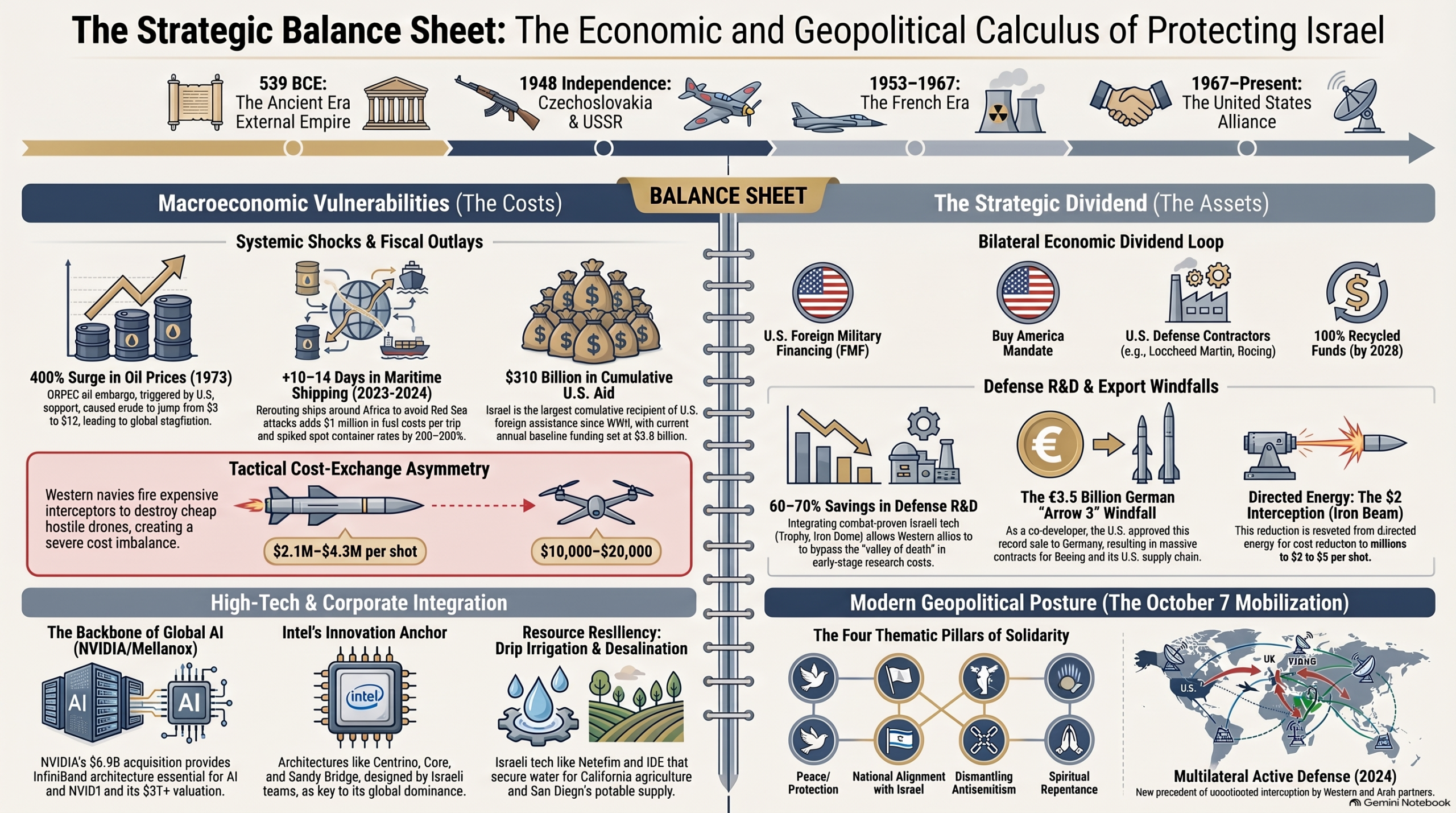
The strategic decision to protect a democratic ally in the Levant carries inherent systemic risks. When regional tensions escalate, the primary impact is felt at critical maritime chokepoints, most notably the Bab el-Mandeb strait. During the 2023 Red Sea crisis, Houthi-led attacks on commercial vessels forced a massive rerouting of global trade around the Cape of Good Hope, adding 10–14 days to transit times and absorbing 20% of global vessel capacity.
Furthermore, these conflicts expose a critical Cost-Exchange Asymmetry. Donor nations currently face an unsustainable defensive ratio, expending high-end interceptors to neutralize low-cost asymmetric threats.
Comparison of Strategic Economic Shocks
Feature 1973 Oil Embargo 2023–2024 Red Sea Crisis
Trigger U.S. decision to replenish the IDF (Op Nickel Grass) during the Yom Kippur War. Asymmetric attacks on ships in the Bab el-Mandeb linked to Israel’s protectors.
Economic Shock 400% oil price spike; S&P 500 lost 40% real value; global stagflation. 200–300% surge in freight rates; 10x spike in war-risk insurance premiums ($0.05% to 1.0%).
Cost-Exchange Asymmetry N/A (Conventional Conflict) Sustainability Crisis: Using 2.1M–4.3M (SM-2/SM-6) missiles to stop 20k–50k drones.
Long-Term Legacy Creation of the SPR and IEA; mandatory fuel standards (CAFE). Accelerated development of Directed Energy (Iron Beam) to solve cost-asymmetry.
While these costs are substantial, they trigger the secondary stage of the loop: the mandatory return of capital to the donor’s domestic economy.
- The Industrial Dividend: How Aid Returns to the Donor Nation
The popular narrative of “foreign aid” as a cash gift is factually incorrect. Under the 2019–2028 Memorandum of Understanding (MOU), the mechanics of U.S. Foreign Military Financing (FMF) act as a targeted industrial policy. The MOU includes a mandatory phasing out of Off-Shore Procurement (OSP), shifting the allowance for domestic Israeli spending from 26.3% down to 0% by 2028. This ensures that $3.3 billion in annual baseline aid is locked exclusively into the U.S. industrial supply chain.
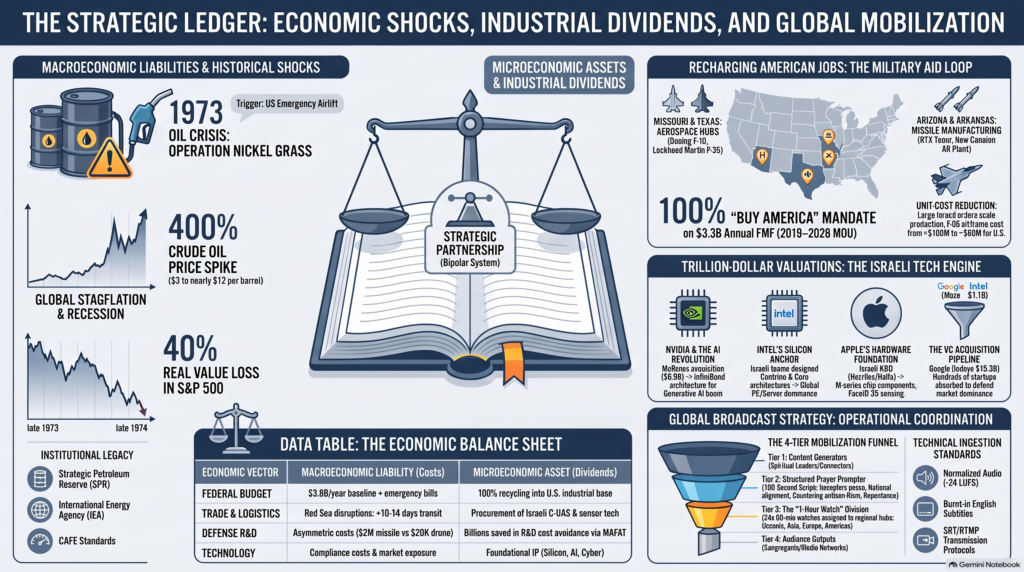
Primary Industrial Beneficiaries of Recycled Aid
- Lockheed Martin: Sustains thousands of high-wage roles in Texas (Fort Worth), California (El Segundo), and Connecticut through F-35 production. Israel’s early orders helped scale the F-35 program, dropping unit costs for the U.S. military.
- Boeing: Maintains the F-15IA production line in Missouri and Apache helicopter tooling in Arizona.
- RTX (Raytheon): In a high-impact co-investment, RTX and Israel’s Rafael established a $33M manufacturing plant in Camden, Arkansas, to build “SkyHunter” interceptors, creating jobs in an economically underdeveloped region.
- General Dynamics: Stabilizes the “Rust Belt” industrial base by funding armored hull tooling and ammunition rolling in Pennsylvania and Ohio.
Pro-Tip: TRL Compression & Operational Telemetry The most valuable “invisible” dividend is Operational Cost Avoidance. Israel serves as a high-velocity incubator that drives TRL (Technology Readiness Level) 1–9 Compression. By providing “Operational Telemetry”—real-world combat data—from the F-35 and Iron Dome, Israel allows the U.S. to “leapfrog” 12–18 year acquisition cycles, saving the Pentagon billions in iterative testing and R&D outlays.
- The High-Tech & Semiconductor Integration
The Bilateral Loop extends into the “nervous system” of the modern economy. Western technology giants have deeply embedded Israeli R&D into their product roadmaps, protecting foundational IP that underpins the retirement funds and 401ks of the donor nation’s citizens.
Global High-Tech Anchors in Israel
Company Key Focus / Acquisition Acquisition Value Global Economic Impact
Intel Core & Centrino Architectures $15.3B (Mobileye) Designed the architectures that saved Intel’s PC/Server dominance in the mid-2000s.
NVIDIA Mellanox (InfiniBand Networking) $6.9B InfiniBand is the “indispensable backbone” of AI data centers, a catalyst for NVIDIA’s $3T valuation.
Apple FaceID & Anobit (Flash Memory) Undisclosed Israeli labs designed the 3D-sensing hardware foundational to the modern iPhone ecosystem.
Google Waze $1.1B Anchors global real-time navigation and transit monetization.
This integration functions as a risk mitigation strategy for Western venture capital, ensuring that the research hubs responsible for the “guts” of the AI revolution and modern silicon remain operational.
- Resource Resiliency: Water, Agriculture, and Cyber
The innovations forced by Israel’s existential security and climate needs provide a “spillover” effect for Western municipalities facing drought or cyber-warfare. A primary engine for this is the BIRD Foundation (Binational Industrial Research and Development). BIRD has invested ~390M to unlock 10 billion in secondary revenue for American and Israeli partners.
3 Most Critical Non-Defense Spillovers:
- Drip Irrigation (Netafim): Applied across the California Central Valley, this tech secures a $50B+ agricultural economy by reducing water usage by up to 50%.
- Industrial Desalination (IDE Technologies): Responsible for the Carlsbad plant in San Diego, providing 10% of the region’s water and protecting real estate productivity.
- Third-Party Export Revenue: The joint-venture model creates windfalls for donor companies. For example, Germany’s €3.5 billion purchase of the Arrow 3—the largest in Israeli history—resulted in hundreds of millions of dollars flowing directly to Boeing and its U.S. supply chain.
- Summary Assessment: The Strategic-Economic Balance Sheet
For the learner, the “Net Economic Calculus” proves that while costs are episodic and macroeconomic, the benefits are structural and compounding.
The Net Strategic Balance Sheet
Dimension Adverse Impact (Liability) Positive Dividend (Asset)
Federal Budget 3.8B annual FMF + Emergency Supplementals (14B+). 100% Recirculation into domestic high-wage aerospace/defense jobs.
Trade & Logistics $1M per-ship fuel penalties; 200% surge in freight rates. Shared IP for maritime sensors and AI-driven drone defense.
Innovation & R&D Asymmetric cost ratios (Millions vs. Drones). TRL 1–9 Compression: Iron Beam laser drops interception costs to 2–5 per shot.
Corporate Assets Compliance costs with anti-boycott regulations. $10B+ revenue generation through co-investment via the BIRD Foundation.
Teacher’s Note: The phrase “Foreign Aid” is a misnomer that obscures the mechanical reality of this relationship. It is a Joint Venture designed to compress the “valley of death” in innovation. By leveraging Israel’s need to innovate under existential pressure, the donor nation achieves TRL 1–9 Compression, allowing it to subsidize its own industrial base, capture third-party export revenue (like the German Arrow 3 sale), and secure the foundational IP of the AI and semiconductor eras.


