The Death of ‘The Line’: How AI-Driven Sovereign Nodes Are Bypassing the 50-Month Permitting Wall
Introduction: The 50-Month Wall
The global energy grid is hitting a structural limit historically known as “The Line.” As the artificial intelligence boom drives an exponential surge in high-density power demand, the legacy centralized transmission model—a lethargic, copper-bound ghost of the 20th century—is faltering. In major markets, the “Permitting Wall” has become a literal crisis: utility interconnection queues now average a staggering 50 months.
There is a profound irony in the fact that the most advanced computational technology in history is being throttled by 4.5-year waits for legacy grid connections. To survive, the industry is orchestrating a pivot from “Linear” infrastructure to “Spherical Resilience.” Enter the Sovereign Node: a self-contained, carbon-negative refinery that decouples energy and compute from the central grid. These nodes don’t just consume power; they synthesize it, giving birth to a producer-centric network that operates entirely in “Island Mode.”
The “Spark Spread”: When Data Becomes More Valuable Than Diesel
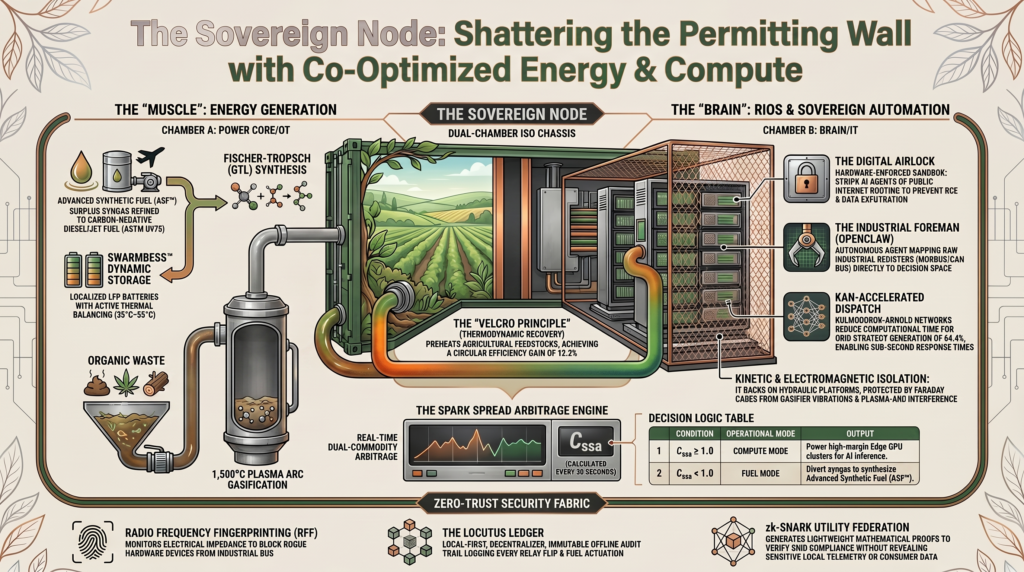
At the core of the Sovereign Node is the Rural Infrastructure Operating System (RIOS), which governs a double-arbitrage engine via the Spark Spread Arbitrage Coefficient (C_{ssa}). This is not mere automation; it is a high-frequency financial decision-engine that evaluates the node’s output every 30 seconds.
The formula for sovereignty is precise: C_{ssa} = (R_{comp} \times \eta_{comp}) / (P_{elect} + \delta_{deg} + L_{net}). RIOS balances the real-time revenue of AI inference (R_{comp}) and the thermal efficiency multiplier (\eta_{comp}) against the opportunity cost of electricity (P_{elect}), hardware degradation (\delta_{deg}), and network latency penalties (L_{net}). When compute margins are compressed by network jitter or hardware fatigue, and C_{ssa} falls below 1.0, the node instinctively pivots.
“The ability to dynamically shift between digital compute and physical fuel production allows decentralized VPP nodes to maximize their financial return, bypassing traditional grid-connection bottlenecks.”
Rather than selling electricity back to a volatile grid at a loss, the node redirects its baseload syngas into a Fischer-Tropsch reactor to refine Advanced Synthetic Fuel (ASF™). This fail-safe mode ensures the node remains financially invulnerable even if the internet goes dark or utility prices crater.
The “Velcro Principle”: A Masterclass in Circular Thermodynamics
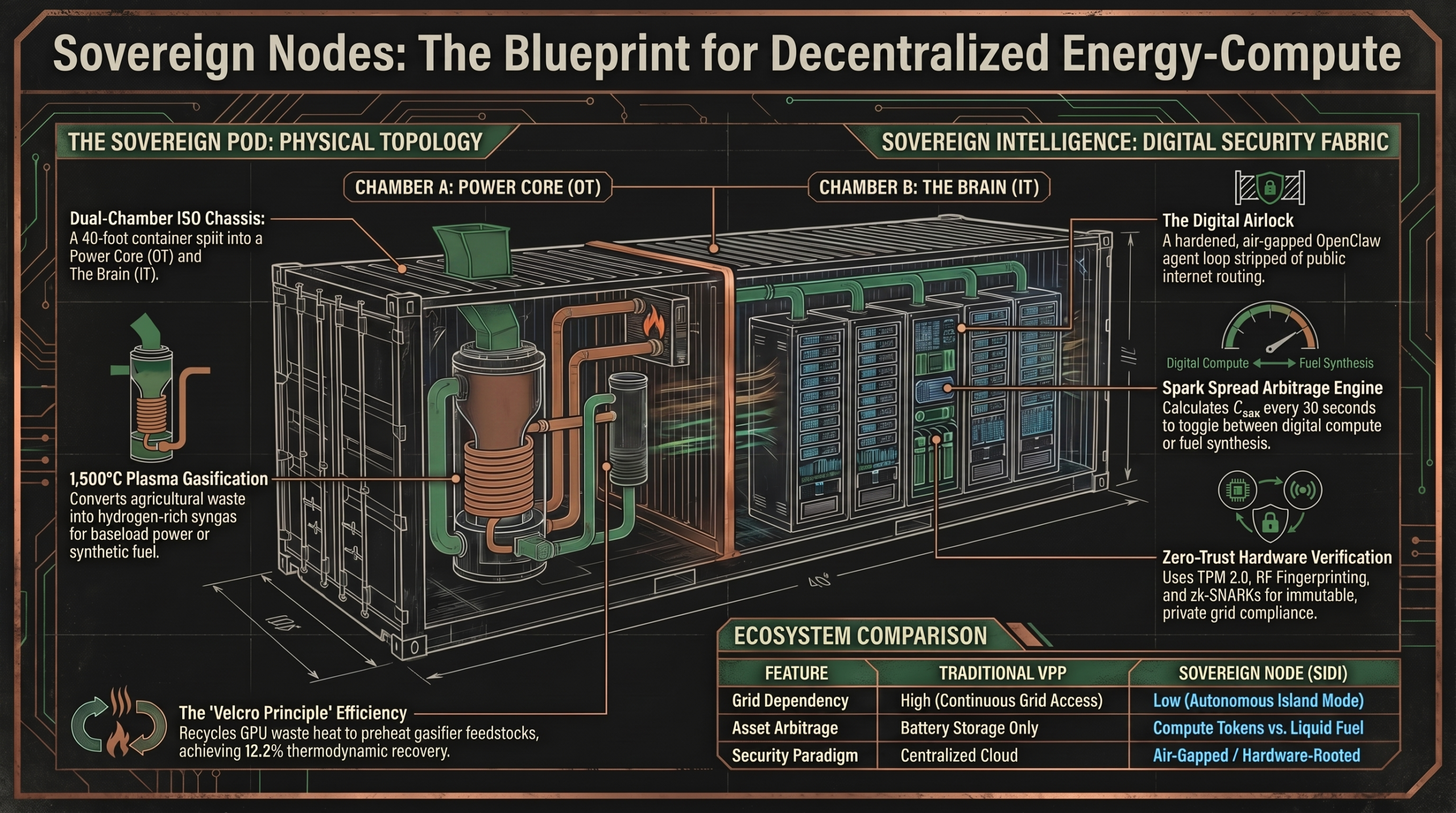
The Sovereign Node’s physical manifestation is the Sovereign Pod—a dual-chamber, 40-foot ISO shipping container engineered to solve the “Engine Room” problem. In traditional designs, server heat is a liability; in the Pod, it is the primary feedstock for efficiency. This is the “Velcro Principle” of thermodynamic coupling.
Chamber B (The Brain) houses high-density, liquid-cooled GPU clusters. The waste heat, exiting the processor blocks at a consistent 65°C to 75°C, is not vented. Instead, it is hydraulically coupled to Chamber A (The Power Core) to preheat the 1,500°C plasma arc gasifiers. By using digital waste to dry organic agricultural feedstocks, the system achieves a circular recovery rate of 12.2%. To protect the “Brain” from the “Muscle,” the entire compute rack is suspended on active hydraulic kinetic dampening platforms, neutralizing the vibrations of feedstock shredders and 10MW GenSets.
The Digital Airlock: Securing the Autonomous “Industrial Foreman”
The integration of AI with industrial hardware was nearly derailed by the May 2026 OpenClaw Security Crisis. Originally developed by Peter Steinberger (evolving from Warelay and Moltbot), the OpenClaw framework’s direct system-level execution capabilities became a liability when cloud-tethered agents were compromised.
The industry’s answer is the Digital Airlock. Within the RIOS environment, an “Industrial Foreman” agent—running in a hardened Docker container—is stripped of all public internet routing tables. It manages physical valves and SwarmBESS™ battery cells using Model Context Protocol (MCP) skills to bridge digital directives with physical Modbus/CAN bus hardware. Security is hardened at the silicon level:
- TPM 2.0: All boot states are cryptographically signed to ensure zero-trust integrity.
- Radio Frequency Fingerprinting (RFF): This authenticates hardware devices by their unique electromagnetic signatures, blocking any physical network bridging attacks.
- Locutus Ledger: Every action is logged to an immutable, offline-first split-ledger for decentralized auditing.
Sub-50ms Sovereignty: Beyond Centralized Grid Math
Traditional Virtual Power Plants (VPPs) are plagued by “round-trip” latency; a signal traveling to the cloud and back cannot handle sub-second frequency regulation. Sovereign Nodes solve this by running edge-native Deep Reinforcement Learning (DRL) directly on the hardware.
By implementing Kolmogorov-Arnold Networks (KAN), RIOS predicts “batch operational feasible regions” to replace traditional, sluggish AC Optimal Power Flow (AC-OPF) solvers. This reduces the computational solution time for grid math by 64.4%, allowing the node to map telemetry to control actions in under 50 milliseconds. This localized intelligence enables “Island Mode”—the capability for a node to maintain frequency stability and industrial output even if the macro-grid collapses.
Shattering the Permitting Wall: The Agrivoltaic Loophole
The ultimate strategic move of the Sovereign Node is its exploitation of the “Agrivoltaic Loophole.” By co-locating plasma gasification with vertical solar arrays, these nodes achieve a Land Equivalent Ratio (LER) ≥ 1.3.
This technical metric allows the Pods to be classified under “Agricultural Easement” status rather than as industrial data centers. This zoning maneuver enables a 90-Day Deployment Model, turning a five-year bureaucratic nightmare into a three-month technical installation.
Infrastructure Comparison:
- Legacy Infrastructure: 50-month wait; centralized “Linear” vulnerability; utility dependency.
- Sovereign Node: 90-day deployment; “Spherical” resilience; off-grid “Island Mode” autonomy; LER-compliant.
Conclusion: From Consumer to Refinery
The shift from passive consumption to the “Sovereign Refinery” paradigm is already being proven. In Kaabong, Uganda, as part of DeReticular’s Project Octagon, a 7,000-acre Smart Eco-Industrial Park (SEIP) is already running off-grid. There, the “Industrial Foreman” orchestrates the conversion of hemp biomass into 10MW of baseload power and high-margin AI inference, all while providing local internet via a Sovereign WISP “Tollbooth” agent.
As these nodes proliferate, the fundamental question of the digital age changes: Does the future of the internet belong to the hyper-scale cities of the north, or to the autonomous, air-gapped nodes currently thriving in the savanna?
The Sovereign Node has transformed energy and data from centralized dependencies into local, tradable commodities—no permission required.


