
The Two Minds of a Machine: Understanding Split-Loop Robotic Control
- The Latency Barrier: Why Robots “Trip”
In the engineering of “Embodied AI,” there is a fundamental conflict between thinking deep thoughts and taking fast steps. This is the trade-off between reasoning depth and control latency.
Modern Vision-Language-Action (VLA) models are essentially the “high-level brains” of robotics. They can understand abstract instructions like “Move the healthiest snack to the bottle,” but they carry a heavy computational tax. Even when optimized on local edge hardware, these models take hundreds of milliseconds to process a single camera frame and decide on an action.
However, the physical world operates on a much tighter schedule. To maintain dynamic balance or compensate for a slip, a robot must calculate motor commands every 10 to 20 milliseconds. If a robot relies solely on its high-level cognitive “brain” to stay standing, the latency gap becomes a literal stumbling block. By the time the VLA finishes “thinking,” the robot has already hit the floor.
The Dilemma of Local AI To run intelligence entirely at the edge—free from the “tethers” of the cloud—engineers face a timing crisis: high-level cognitive models are semantically powerful but slow, while physical stability requires near-instantaneous reactions to the “truth of gravity.”
Furthermore, as researchers like Yann LeCun have noted, current large language models lack a fundamental World Model. They understand syntax, but they don’t understand physics. To bridge this gap, we must look at the human body for the ultimate blueprint of dual-speed control.
- The Biological Blueprint: Prefrontal Cortex vs. Cerebellum
The architecture of Sovereign Embodied AI—designed to operate in “Island Mode” with absolute independence—mimics the human nervous system. We do not use our conscious mind to keep our heart beating or our balance stable; those are delegated to the reflexive systems of the body.
By splitting a robot’s intelligence into two asynchronous loops, we allow it to perform complex tasks without sacrificing stability. The Prefrontal Cortex (Reasoning) decides what to do, while the Cerebellum (Reflex) handles the how of the movement itself.
Biological vs. Robotic Counterparts
Biological Component Robotic Role Operational Speed
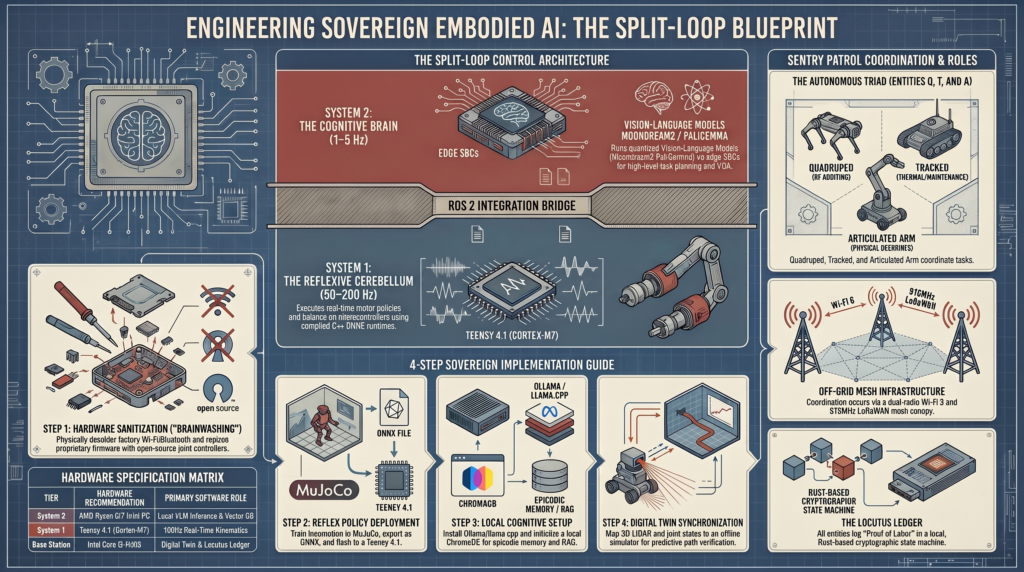
Prefrontal Cortex Cognitive Reasoning (System 2): High-level planning, semantic understanding, and memory retrieval. Slow/Deliberative (1 Hz – 5 Hz)
Cerebellum Physical Reflex (System 1): Real-time balance, gait generation, and motor coordination. Fast/Reactive (50 Hz – 200 Hz)
This biological “split” is the secret to a machine that can both deliberate on a complex mission and navigate a rocky path simultaneously.
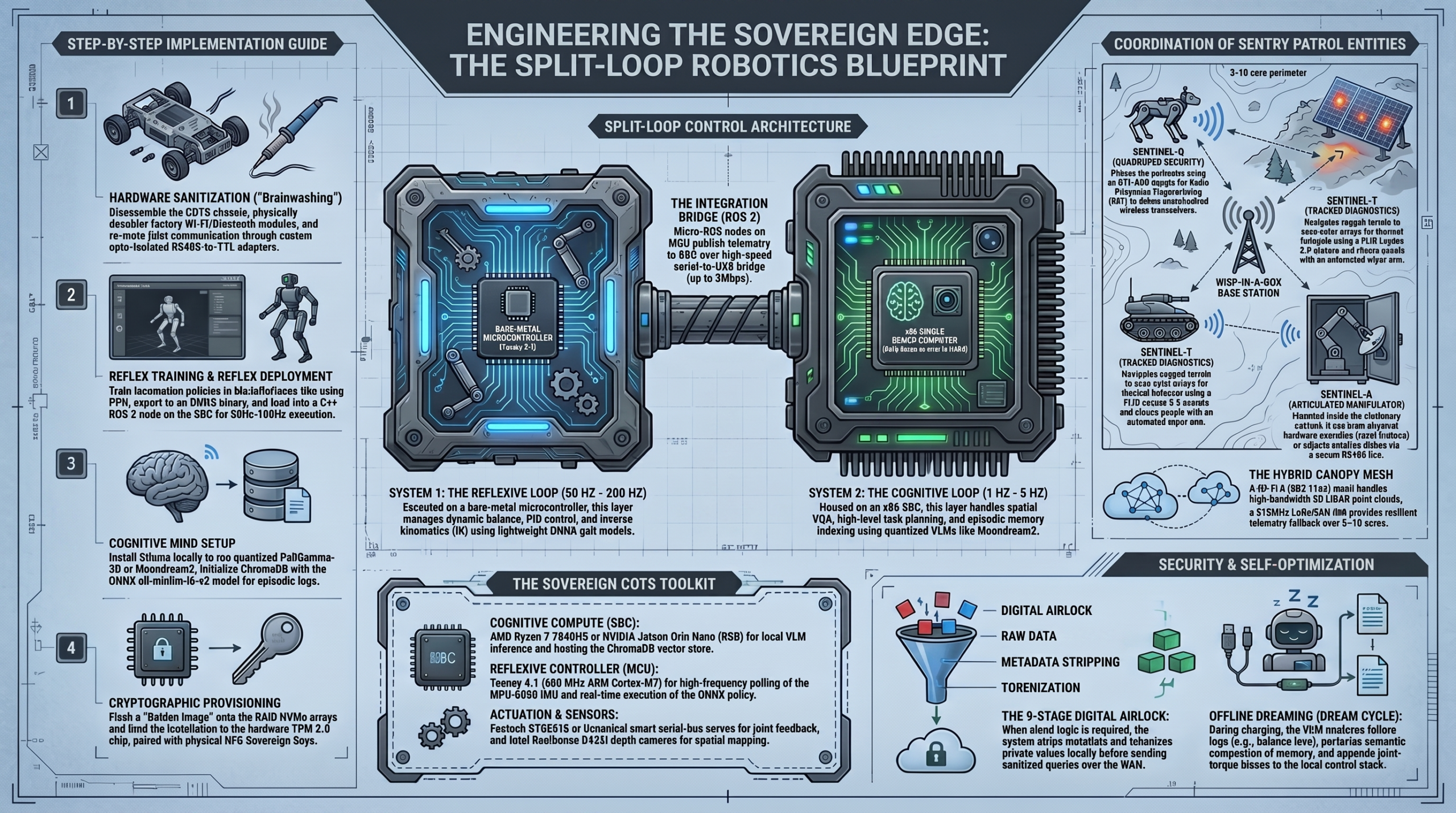
- System 1: The “Cerebellum” (The Reflexive Loop)
If we zoom into the “body” of the machine, we find System 1. This is the robot’s subconscious—a high-speed reactive layer that handles the raw physics of existence.
The primary sensory organ here is the Inertial Measurement Unit (IMU). Much like the human inner ear, the IMU measures acceleration and angular velocity, providing the robot with a constant sense of “up.” To ensure the robot never “trips,” System 1 features three critical engineering pillars:
- Ultra-Low Latency: Operating at 50 Hz to 200 Hz, this loop polls sensors and adjusts motors up to 200 times per second. This is where Dynamic Balance, Inverse Kinematics (IK), and PID control live.
- Local Execution on Microcontrollers: Speed requires “bare metal.” System 1 runs on lightweight, high-performance microcontrollers like the Teensy 4.1 (600 MHz ARM Cortex-M7) or the ESP32-S3. These chips are physically “brainwashed”—stripped of proprietary factory firmware and re-flashed with audited, open-source C++ code.
- The Power of the ONNX Policy: Rather than a massive VLA, System 1 runs a “distilled reflex.” This is a small, efficient neural network policy exported as an ONNX binary. Trained in a Digital Twin Engine (like MuJoCo or Webots), this policy has mastered the “physics of gravity” through millions of simulated trials before ever touching real-world floorboards.
While System 1 keeps the robot standing, it is effectively “blind” to the bigger picture. It knows how to keep its balance, but it requires the “High Mind” to give it a destination.
- System 2: The “Prefrontal Cortex” (The Cognitive Loop)
System 2 is the “Semantic Mind.” This layer doesn’t concern itself with the torque of an individual motor; it observes the environment through vision and formulates a plan.
Because it must run heavy, quantized Vision-Language Models (VLMs) like Moondream2 (1.6B) or PaliGemma-3B, it requires significant computational density. This loop resides on an Edge Single Board Computer (SBC), such as an AMD Ryzen 7 7840HS / 8840HS, an Intel i3-N305, or an NVIDIA Jetson Orin Nano.
Cognitive Responsibilities of System 2:
- Spatial VQA (Visual Question Answering): Understanding the scene (e.g., “Where is the red block?”).
- Task Planning: Breaking down commands into a multi-step execution sequence.
- Episodic Memory: Using local vector databases like ChromaDB to store experiences without cloud dependency.
To achieve true sovereignty, these units undergo a Sanitization Protocol: factory Wi-Fi modules are physically desoldered and removed. This ensures the robot operates in a permanent “Island Mode,” where its thoughts and data cannot leak to external servers.
- Synergy: The Split-Loop in Action
The magic happens in the communication between these two “minds.” System 2 sets a target goal (e.g., “Walk to the door at 0.5 m/s”), and System 1 handles the millions of micro-adjustments needed to maintain that gait.
To ensure this synergy is secure, the system utilizes the Locutus Ledger, a decentralized, Rust-based state machine. Every action is recorded as “Proof of Labor” on this local ledger, ensuring a tamper-proof history of the robot’s decisions. For high-risk maneuvers, the robot uses its Digital Twin Engine to pre-simulate a path in a virtual environment, verifying it is safe before the physical motors ever move.
Quick Reference: The Dual-Loop Hierarchy
Tier Analogy Decision Speed Core Question Hardware Anchor
System 1 Reflex 50–200 Hz “Am I falling?” Teensy 4.1 / ESP32-S3
System 2 Reason 1–5 Hz “What is my goal?” Ryzen 7 / Orin Nano
When the robot must interact with the cloud, it does so through a 9-stage Digital Airlock. This protocol strips all raw visual and spatial metadata locally, sending only anonymous “logic queries” to ensure the machine’s “Island Mode” remains physically and digitally intact.
- The “So What?”: Why Sovereignty Matters for Learners
For the modern robotics student, the “Split-Loop” isn’t just an engineering trick—it is the gateway to Sovereign Physical AI. By mastering this architecture, you aren’t just building a toy; you are building a resilient, independent agent.
The movement toward “Island Mode” and Common Off-the-Shelf (COTS) hardware means your innovations are:
- Secure: By physically desoldering the backdoors, you own your data.
- Resilient: Your robot works in the deep woods, on an off-grid farm, or during a total cloud outage.
- Innovative: You are at the forefront of a $600 billion shift toward reshoring intelligence.
Understanding the harmony between fast reflexes and slow reasoning is the key to creating machines that navigate our messy, physical world with grace.
The Lightbulb Moment Sovereignty is the ultimate form of reliability. When you split the robotic mind, you bridge the “physics gap.” You create a machine that doesn’t just think about the world, but truly inhabits it—securely, privately, and independently.


