
The Digital Fortress: A Student’s Guide to OpenClaw’s Localized AI Agents
1. The Concept of “Island Mode” and Spherical Resilience
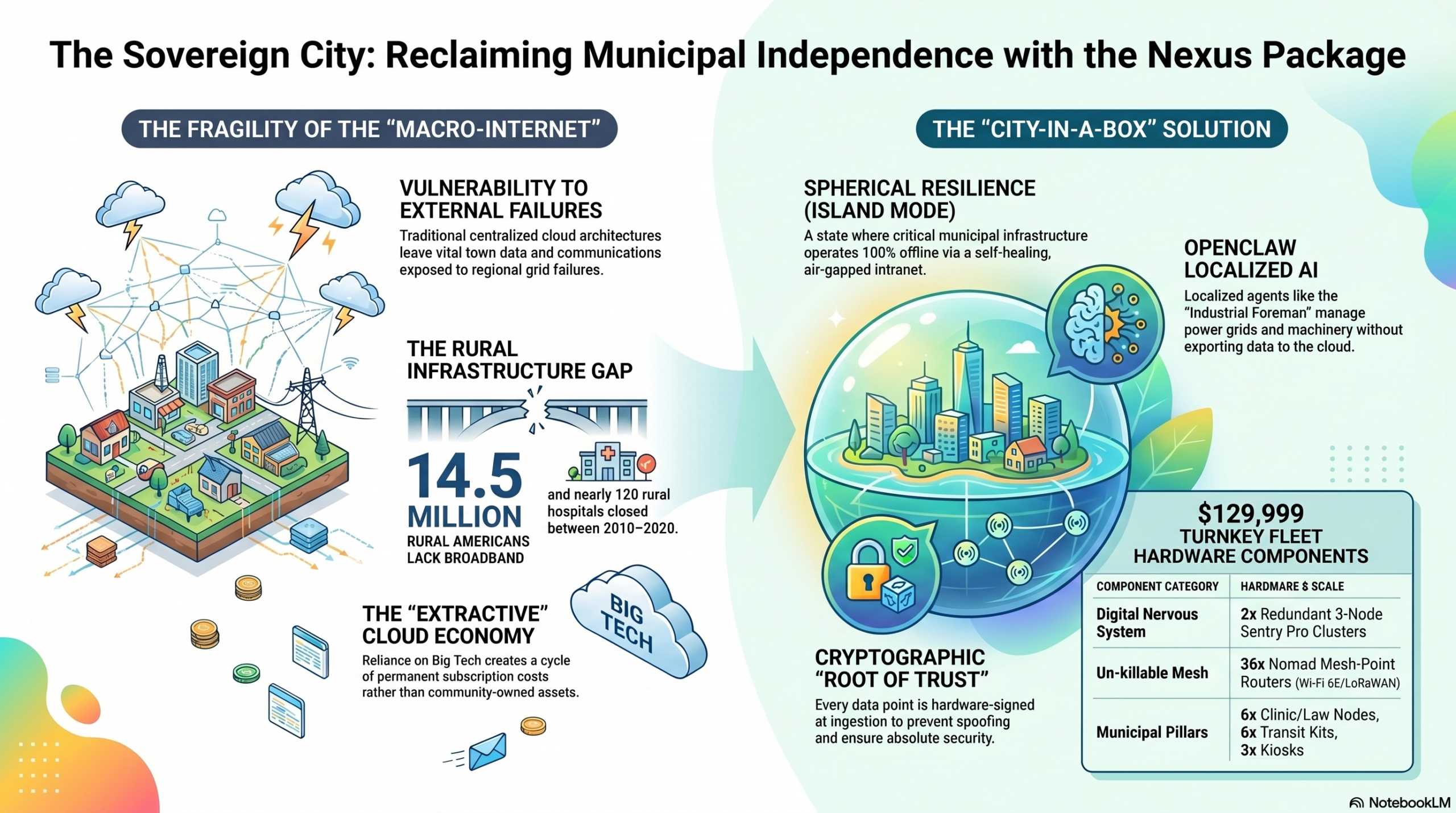
Modern municipalities are currently built upon a fragile foundation of “macro-internet” dependency. For the 14.5 million rural Americans lacking reliable broadband, this architecture is not just inefficient—it is dangerous. Since 2010, nearly 120 rural hospitals have closed due to financial strain, creating “Healthcare Deserts” where the loss of connectivity can mean the loss of life. When a small town relies on a centralized cloud for its logic, any regional outage transforms vital services into non-functional liabilities.
To address this, we utilize a design philosophy called Spherical Resilience. This allows a community to engage “Island Mode,” a state where the city’s digital infrastructure functions with absolute autonomy, air-gapped from the global internet.
Sovereign Automation: A community-owned, AI-native infrastructure model that transforms essential services from vulnerable, extractive liabilities into resilient, self-sustaining assets.
The Insight: From Cost Center to Revenue-Generating Asset
The primary reason traditional centralized clouds are “fragile” for rural areas is their extractive nature. Towns currently “rent” their logic and data storage from Big Tech corporations via monthly subscriptions. By achieving digital sovereignty, a town moves from a “cost center” (sending tax dollars out to Silicon Valley) to a “revenue-generating asset” where the town owns its data and infrastructure. This shift upcycles a town’s digital footprint into a permanent community asset that remains operational even during a total telecommunications collapse.
Having established the need for local resilience, we must examine the software “brain” that makes this autonomy possible.
——————————————————————————–
2. The RIOS Foundation: The “Trinity Stack” Architecture
The backbone of a sovereign city is the Rural Infrastructure Operating System (RIOS). This is a Hyperconverged Infrastructure (HCI) designed to maximize edge hardware efficiency. RIOS utilizes a Type-1 hypervisor (Proxmox VE) to run three isolated virtual environments simultaneously on a single node. This “Trinity Stack” ensures that a failure or breach in one layer cannot compromise the others.
The Trinity Stack Architecture
| Layer Name | Software Used | Core Responsibility |
| The Gatekeeper | pfSense | Strict firewalling and bonding of external connections (Starlink/LTE) to maintain uptime. |
| The Ledger | Ubuntu Server | The internal brain; manages automated notary services and a peer-to-peer decentralized data store. |
| The Auditor | Kali Linux | A security layer that constantly executes automated vulnerability scanning across the mesh network. |
Note: These layers are cryptographically isolated via the Type-1 Hypervisor, providing “hardware-level” security between networking, logic, and auditing.
The Insight: Safety Through Architectural Isolation
Running a city’s logic in a single environment is a single point of failure. By utilizing the Trinity Stack, the Auditor can actively hunt for threats on the mesh network without being visible to the Gatekeeper. This compartmentalization ensures that even if a public-facing connection is compromised, the city’s internal ledger and security protocols remain intact and air-gapped from the threat.
While RIOS provides the structural logic, the OpenClaw Framework provides the intelligence required to act.
——————————————————————————–
3. Meet the Agents: The OpenClaw Framework in Action
In “Island Mode,” a city cannot reach out to cloud-based APIs for intelligence. The OpenClaw Framework solves this by running localized AI agents on high-performance NVIDIA GPUs using 4-bit quantized Llama 3 models. These agents process complex tasks locally, ensuring data never leaves the city’s “digital borders.”
- The Industrial Foreman
- Primary Mission: Translating human intent into physical operational logistics and grid management.
- Real-World Example: Managing local power micro-grids and autonomous municipal shuttles via CAN Bus/OBD-II integration in the Nomad Fleet Kits.
- The Field Medic
- Primary Mission: Solving the “Healthcare Desert” crisis by securing medical telemetry and processing clinical data locally.
- Real-World Example: Using Whisper AI for patient dictation and OCR (Optical Character Recognition) for digitized medical records to coordinate Non-Emergency Medical Transportation (NEMT).
- The Sovereign Elector
- Primary Mission: Protecting democratic integrity through cryptographically verified infrastructure.
- Real-World Example: Securing localized voting terminals and ensuring all election data is anchored to the city’s immutable ledger.
- The Sovereign Executive
- Primary Mission: High-security administrative concierge and localized economic engine.
- Real-World Example: Managing tourism kiosks that utilize a zero-fee booking engine—stripping out the “extraction” of third-party platforms like Airbnb or Expedia to keep revenue within the local economy.
These software agents also utilize Vault Warden and LiDAR-based volumetric monitoring in public kiosks to maintain spatial awareness and security in public squares. Having established the software logic, we must now examine the ruggedized hardware—the physical “nervous system”—that allows these agents to interface with a rural environment.
——————————————————————————–
4. The Physical Grid: Ruggedized Hardware and the “Oracle Problem”
To build a Decentralized Physical Infrastructure Network (DePIN), we deploy ruggedized hardware designed for “Extreme Demand” environments. This includes Sovereign Sentry nodes, Mesh Beacons, and “City-in-a-Box” clusters often housed in solar-powered ISO shipping containers.
However, a decentralized network faces the “Oracle Problem”: how do we know a sensor’s data is real and hasn’t been “spoofed” by a hacker? We solve this through a two-step verification process:
- Radio Frequency Fingerprinting: The system uses Software-Defined Radios (SDRs) to scan for microscopic manufacturing imperfections in a device’s radio signal.
- Hardware-Level Cryptography (TPM 2.0): Data is cryptographically signed at the point of ingestion using a private key burned into a factory-sealed TPM 2.0 security chip.
The Insight: The Digital Birthmark
Radio Frequency Fingerprinting acts as a “digital birthmark.” Because no two machines emit the exact same radio signature, the city can instantly identify and reject any simulated or unauthorized device. This ensures the autonomous system is reacting to “verified physical reality,” making the city’s “nervous system” virtually impossible to spoof.
These hardware and software components are combined into a single, turnkey package for rapid municipal deployment.
——————————————————————————–
5. The “City-in-a-Box”: Implementation and Impact
The “City Infrastructure” Nexus Package (SKU: SOV-BNDL-CITY) is an enterprise-grade solution for towns of 1,000 to 3,000 residents. For a one-time cost of $129,999, a municipality can deploy a fully sovereign operating system.
Bill of Materials
- [ ] 2x Sentry Pro Clusters: Redundant “core brains” (6x 1U Nodes total) for City Hall and Police HQ.
- [ ] 36x Nomad Mesh-Points: Ruggedized Wi-Fi 6E/LoRaWAN routers to create a city-wide intranet canopy.
- [ ] 6x Sovereign Sentry (Standard): Dedicated nodes for 4 medical clinics and 2 law offices.
- [ ] 6x Nomad Fleet Kits: CAN Bus/OBD-II enabled brains for autonomous municipal transit.
- [ ] 3x Municipal Kiosks: Outdoor touchscreens with Sentry Pro nodes and LiDAR sensors for public square monitoring.
The Insight: Ending Extraction
This bundle allows a town to break the cycle of “extractive” technology relationships. By utilizing a zero-fee booking engine for local hospitality, the town reclaims the commissions usually lost to global tech platforms. This transforms the town from a consumer of distant, fragile services into a self-sufficient digital entity that owns its future.
——————————————————————————–
6. Grokking the System: Final Summary
- Localized Intelligence: By utilizing the OpenClaw AI framework and the RIOS “Trinity Stack,” cities can process data and manage machinery in “Island Mode,” remaining operational during macro-internet failures.
- Physical Sovereignty: Through DePIN hardware, SDR-based RF Fingerprinting, and TPM 2.0 encryption, a city creates a “digital birthmark” for every device, ensuring the network is secure and un-spoofable.
- Economic Resilience: The “City-in-a-Box” model replaces extractive monthly SaaS fees with a Perpetual Enterprise License, turning municipal technology into a permanent, community-owned asset that generates local value.


