
The Emergence of Agentic Commerce: Infrastructure, Settlement, and Governance
Executive Summary
The global digital economy is undergoing a systemic shift from human-centric “click-and-buy” interactions to Agentic Commerce (A-Commerce). In this paradigm, autonomous AI agents act as proxies for consumers and businesses, navigating discovery, negotiation, and transaction execution. This transition is projected to influence between $3 trillion and $5 trillion in global retail spending by 2030, with roughly 15-25% of all e-commerce flowing through autonomous channels.
Key market leaders like Stripe and PayPal are competing to provide the financial settlement layer for this “machine economy,” while firms like DeReticular are building the “Sovereign Infrastructure” necessary for physical, air-gapped, and autonomous operations. Central to this evolution is the emergence of Know Your Agent (KYA) frameworks and specialized machine-to-machine (M2M) protocols that prioritize machine-readable data over traditional user interfaces. The ultimate goal is a move toward “The Invisible Storefront,” where commerce happens ambiently in the background, driven by agent-to-agent (A2A) negotiation and stablecoin settlement.
——————————————————————————–
1. The Core of Agentic Commerce (A-Commerce)
Agentic commerce represents a power shift from the seller to the buyer-agent. Transactions originate within AI interfaces (e.g., ChatGPT, Claude, Gemini) rather than merchant websites.
The Five Levels of Autonomy
The industry views the progression of agentic commerce through five distinct stages:
- Level 1-2: Humans use AI for discovery but handle final payments (Current State).
- Level 3: Agents execute simple tasks with specific human approval.
- Level 4: Agents manage complex workflows (e.g., booking a multi-city trip).
- Level 5: Fully autonomous, anticipatory commerce where the agent manages life or business needs within a set budget.
Strategic Market Trends
- Ambient Commerce: Transactions occur in the background, such as automated restocking or flight booking during price drops.
- High-Intent Conversion: Data suggests users shopping via AI agents convert at 4x the rate of traditional e-commerce, as the agent pre-qualifies the intent.
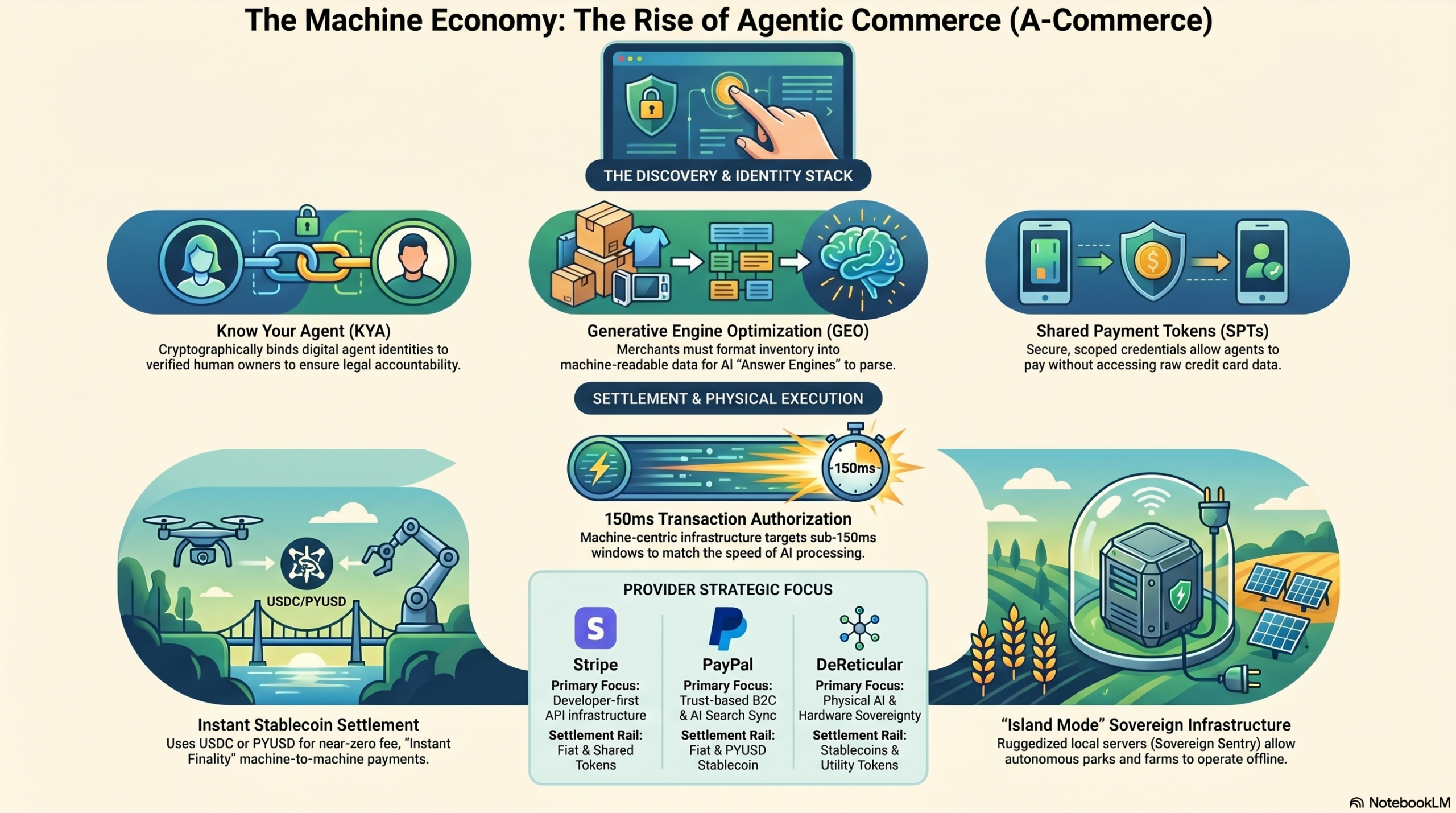
- Generative Engine Optimization (GEO): Marketing is shifting from catchy headlines to machine-readable structured data. Products not formatted for AI crawlers (via Schema.org or GS1) effectively “disappear.”
——————————————————————————–
2. Infrastructure: The Sovereign Stack and A2A Protocols
The “Machine Web” relies on open standards and ruggedized hardware to ensure agents can communicate, negotiate, and execute physical tasks.
The Technical Protocol Stack
Standardization is driven by several critical protocols:
| Protocol | Primary Purpose | Collaborators |
| ACP (Agentic Commerce Protocol) | Defines the language for agents to browse catalogs and manage carts. | OpenAI, Stripe, Meta |
| UCP (Universal Commerce Protocol) | Discovery layer; syncs real-time merchant inventory with AI “Answer Engines.” | Google, Shopify |
| MCP (Model Context Protocol) | Integration layer allowing agents to access internal business data/tools. | Anthropic, Stripe |
| AP2 (Agent Payment Protocol) | Handles user mandates and proves the human principal gave the agent permission to spend. | Google, Various Banks |
| x402 Protocol | Micropayment layer for sub-cent ($0.001) machine-to-machine data buys. | Coinbase, xpay |
DeReticular’s Sovereign Infrastructure
DeReticular provides the physical “Sovereign Stack” for agentic commerce, designed for “Island Mode”—fully autonomous operations independent of centralized cloud services like AWS.
- Sovereign Sentry: The “Brain”; a ruggedized server and AI inference engine that hosts local reservation ledgers.
- Industrial Foreman: The “Executor”; an agent that translates digital logic into physical movements (e.g., managing power grids or gate access).
- Mesh Beacon: Provides Wi-Fi 6 and LoRaWAN connectivity to ensure edge sensors and agents remain connected.
- Sovereign Key: A physical FIDO2-based token used by humans to authorize machine actions.
——————————————————————————–
3. Financial Settlement: Stablecoins and Tokenization
Traditional credit card rails are often incompatible with AI agents due to 2FA requirements and fraud filters. The agentic economy utilizes machine-ready assets for settlement.
Stablecoin Integration (USDC and PYUSD)
- Instant Finality: Using protocols like x402, agents can trigger direct on-chain transfers of USDC, providing near-instant settlement with negligible fees.
- PayPal’s PYUSD: PayPal leverages its stablecoin for high-speed A2A settlement and B2B workflows. As a smart-contract-compatible asset, PYUSD allows for Conditional Payments (e.g., paying a delivery agent only when an IoT sensor confirms the package has arrived).
Security and Authorization Mechanisms
- Shared Payment Tokens (SPTs): A security feature where an agent passes a buyer’s credentials to a merchant without ever seeing the raw credit card data.
- Scoped Tokens: Agent spending is limited to specific merchants, time windows, or price ranges.
- MPC Wallets (Multi-Party Computation): Private keys are split into shards across infrastructure to prevent theft; the agent never holds a full key.
- Machine Speed: Agent-centric infrastructure targets sub-150ms authorization windows, compared to the 2–3 seconds required for human gateways.
——————————————————————————–
4. Trust, Identity, and Compliance (KYA)
As transactions move to A2A, the industry is transitioning from Know Your Customer (KYC) to Know Your Agent (KYA).
The Chain of Trust
- The Principal: The human or organization undergoes traditional KYC (ID, biometrics).
- The Agent Identity: The principal issues a Digital Agent Passport or Verifiable Credential (VC).
- The Binding: Platforms like Stripe or PayPal cryptographically bind the agent’s ID to the principal’s verified financial account.
Regulatory and AML Challenges
- The Velocity Gap: Traditional AML red flags (e.g., 50 transfers in an hour) are normal for agents performing 50 transactions per second.
- Agentic Transaction Monitoring (ATM): AI-driven systems that watch for behavioral deviations (e.g., a procurement agent suddenly buying high-liquidity NFTs).
- Attributed Liability: Regulators (SEC, FinCEN) treat agents as “Instrumentalities.” The human owner is strictly liable for the agent’s actions, regardless of intent.
——————————————————————————–
5. Strategic Competitive Landscape: Stripe vs. PayPal
While both seek to dominate the agentic sector, their strategies differ based on their existing strengths.
| Feature | Stripe (Agentic Commerce Suite) | PayPal (Agentic Commerce Services) |
| Core Strength | Infrastructure: Developer-first, API-heavy. | Trust: 400M+ active consumer wallets. |
| Discovery | Catalog APIs for developer integration. | Store Sync: Direct data push to Perplexity/Google. |
| Ecosystem | Focus on B2B and SaaS. | Focus on B2C and Retail. |
| Settlement | Primarily Fiat (Stripe Treasury). | Fiat + PYUSD (Stablecoin) for A2A. |
——————————————————————————–
6. Industry Applications: A Case Study in RV Parks
The RV park industry serves as a primary example of how sovereign hardware and agentic commerce converge. Projected to reach $11 billion by 2026, the industry is shifting toward “Smart Parks.”
- Discovery: Using PayPal Store Sync, parks push real-time inventory into AI answer engines like Perplexity.
- Agentic Reservations: A guest’s AI (e.g., “Flai”) communicates via ACP with the park’s Sovereign Sentry to negotiate requirements (e.g., “50-amp hookups under $70”).
- Autonomous Operations: Due to labor shortages, 47% of operators are exploring AI for check-ins. The Industrial Foreman can autonomously grant gate access once a reservation token is verified.
- Kinetic Commerce: Beyond digital bookings, DeReticular nodes enable “Sovereign Harvests” and “Autonomous Physical Defense,” where value is exchanged through physical actions recorded on the Locutus Ledger.
——————————————————————————–
7. Strategic Recommendations for Businesses
To remain viable in an agent-driven economy, businesses must pivot their operational strategies:
- Expose APIs, Not Just Pages: Ensure the checkout process is a protocol call. If an agent cannot parse product info, the product does not exist in the marketplace.
- Real-Time Data Sync: Agents ignore stale data. Moving from “batch updates” to real-time inventory API sync is mandatory for competitive agentic search results.
- Adopt KYA Standards: Register business agents in emerging directories (e.g., Experian Agent Registry) to ensure they are not blocked by merchant fraud filters.
- Prioritize Trust Signals: AI agents are not influenced by brand storytelling; they prioritize structured data, performance metrics, and cryptographic trust signals.


