The Resilience Glossary: A Beginner’s Guide to Digital Sovereignty
In the digital landscape of late 2026, the structural fragility of our infrastructure has been laid bare. Between the administrative bottlenecks of the $42.5 billion federal BEAD program and the March 2026 USDA REAP grant freeze, rural communities are facing a “non-deployment” crisis. This vulnerability was compounded by the May 2026 “Agentic Crisis,” where cloud-tethered AI agents became massive security liabilities. This glossary defines the essential architecture of the Sovereign Stack—a strategic toolkit designed to transition communities from passive consumers to resilient, self-sufficient infrastructure owners.
video
1. The 2026 Digital Landscape: From Pipelines to Platforms
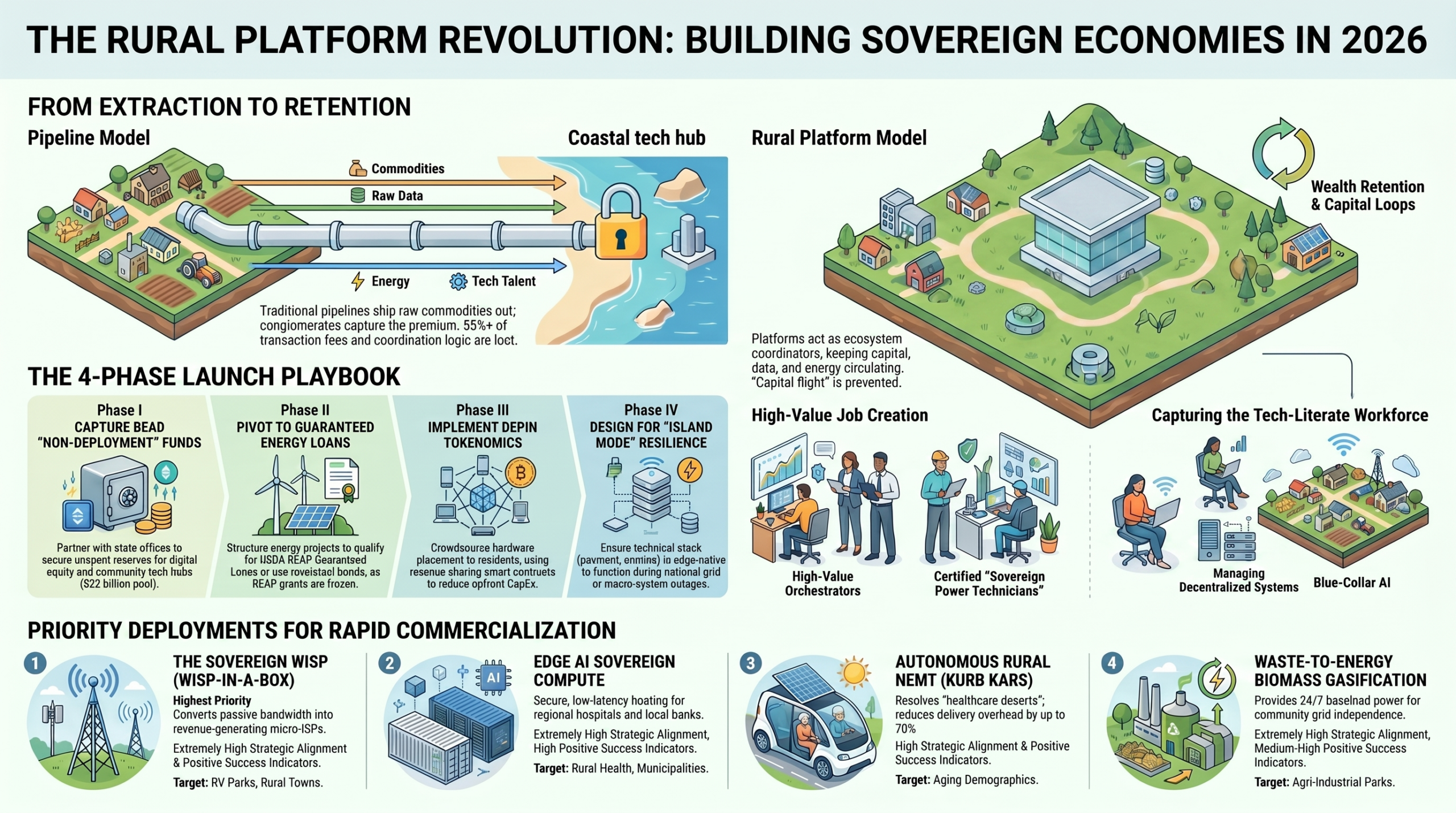
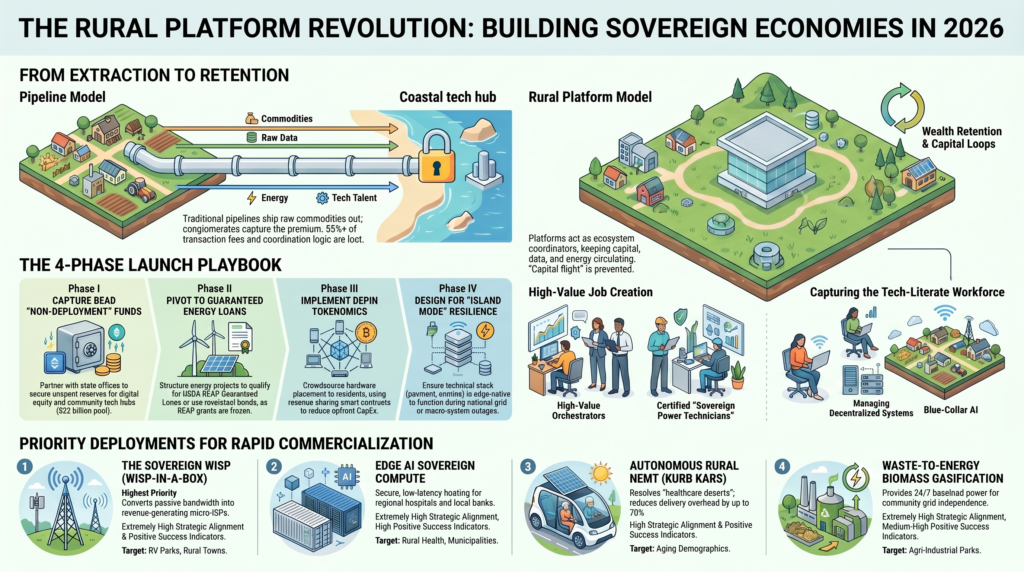
The shift from “Pipeline” models to “Rural Platform” models, based on the Sangeet Paul Choudary framework, represents an inversion of the firm. Traditional models are linear and extractive, while the Rural Platform acts as an ecosystem coordinator, utilizing $22 billion in BEAD “non-deployment” reserves to fund localized resilience.
| Feature | Traditional Pipeline Model | Rural Platform Model |
| Value Flow | Linear, centralized, and extractive. | Decentralized, local ecosystem coordination. |
| Capital Impact | Exports local wealth/data to coastal tech hubs. | Retains capital, data, and jobs within the community. |
| Asset Logic | Corporate ownership of infrastructure and data. | Community-owned assets with shared digital governance. |
| Systemic Risk | Linear Fragility: Single points of network failure. | Spherical Resilience: K-connected, redundant mesh nodes. |
Key Concept: The Trusted Environment Fallacy & Linear Fragility Relying on centralized cloud providers creates Linear Fragility—a state where a single severed fiber line or a server outage in a distant data center collapses local life. This is perpetuated by the Trusted Environment Fallacy, the mistaken belief that corporate Terms of Service provide actual privacy. In reality, cloud AI requires “omnipresent telemetry extraction” to function, making you a product rather than a sovereign agent.
To solve this fragility, we must first understand how a system can stand on its own through a concept called Island Mode.
podcast
2. Island Mode: The Power of Spherical Resilience
Island Mode is the fundamental capability of sovereign infrastructure. It is the ability for localized nodes to autonomously disconnect from national grids or public clouds, operating entirely “air-gapped” without losing essential functions.
Linear Fragility: A state where centralized utility corridors (power lines, telecom backbones) suffer from a single point of failure. If one link breaks, the entire chain collapses.
Spherical Resilience: A multi-directional, highly redundant network of independent nodes. Because it is connected as a “k-connected” mesh, the system remains functional even if multiple parts of the network are disrupted.
The Three Critical Benefits of Island Mode:
- Absolute Operational Continuity: Vital community systems remain online during the frequent broadband and fiber outages of 2026.
- Protection from Agentic Liabilties: By operating offline, local systems are shielded from the “god-mode” prompt injections and data exfiltration that characterized the May 2026 security collapse.
- Local Grid Balancing: Integrated energy systems manage local power levels independently, insulating the community from national grid instability.
While Island Mode provides independence for the whole system, the “Airlock” provides the specific hardware gates that protect user data.
3. The Digital Airlock: Privacy Through Physical Design
The Digital Airlock is a physical and cryptographic gatekeeper within the Sovereign Gateway. It acknowledges that privacy cannot rely on policy; it must be enforced by hardware. This design allows users to leverage the power of cloud AI (like Google’s Project Remy) without permitting the “omnipresent telemetry extraction” these models typically require.
The Flow of Data Through the Airlock:
- Internal Home Network: Raw private data (Biometrics, Camera Feeds) is confined to the local Matter/Thread network.
- Local Sanitization: A local OpenClaw AI agent strips away all sensitive personal context and identity markers.
- External Cloud Logic Query: Only a “sterilized” logical request is bridged across the physical firewall to the cloud.
The “So What?”: The Airlock turns a corporate AI from an “omnipresent manager” that monitors your home into a “logical utility” that you use only when needed, ensuring the cloud “sees” nothing but an anonymized query.
The “Airlock” is made possible by a specific way of organizing data called Split-Ledger Architecture.
4. Split-Ledger Architecture: The Logic of Data Sterilization
Split-Ledger Architecture is the technical blueprint for data sterilization. It ensures a hard boundary between local intelligence and external reasoning.
| Raw Home Data (STAYS LOCAL) | Sterilized Logical Queries (GOES TO CLOUD) |
| Biometrics & Device Logs: FaceID, fingerprints, and hardware transients. | Anonymized Tokens: Logic-only requests with no personal identifiers. |
| Telemetry: Live camera feeds and indoor positioning data. | Logic Queries: Pure mathematical or organizational requests. |
| Private Context: Personal calendars, conversations, and health logs. | Utility Output: The final result (e.g., a booked flight) sent back to the node. |
For the beginner, this architecture is the difference between being “watched” and being “served.” It transforms the relationship with big tech from data exploitation to a transaction of pure logic.
These private individual homes don’t just stay isolated; they connect to form a larger, resilient community network through a “Mesh Canopy.”
5. Neighborhood Mesh Canopies: Connectivity When the Net Fails
A Mesh Canopy is a neighborhood-wide safety net formed when Sovereign Gateways “interlock” to preserve communication during broadband collapses. This utilizes a tech-neutral approach, recognizing that different jobs require different signals. Gateways recognize one another using RIOS Passports and Radio Frequency Fingerprinting (RFF), allowing for secure connection without a central carrier.
| Technology | Role in the Canopy | Bandwidth/Capability |
| LoRaWAN | Emergency Heartbeat: Long-range, low-power signals for vital alerts. | Strictly for 51–222 byte “heartbeats,” GPS coords, and grid triggers. |
| TriFiWireless | Local High-Speed: Private Wi-Fi 7 or 5G NR networks for community apps. | High-speed data for real-time messaging (River) and DApps. |
Understanding these frameworks allows a user to move from being a passive consumer to a sovereign developer using the components of the Sovereign Toolkit.
6. The Sovereign Toolkit: Key Hardware & Software Entities
The ultimate goal of the Sovereign Stack is Absolute Operational Continuity and the realization of the Algorithmic Spark Spread—the ability to turn local energy into digital wealth.
- RIOS (Rural Infrastructure Operating System): The “Mind” of the node; an edge-native OS that manages local energy, data, and peer-to-peer coordination.
- Sovereign Sentry: The “Hardware Brain”; a local, fanless server utilizing industrial-grade NVIDIA Jetson or Rockchip RK3588 silicon to process AI workloads locally.
- OpenClaw: The “AI Agent Framework”; an air-gapped environment where agents like the Field Medic or Industrial Foreman provide automation without leaking data.
- Locutus Ledger: The “Record-Keeper”; an energy-backed, immutable database that tracks transactions locally, using physical energy units (Joules) to hedge against currency volatility.
By integrating these tools, rural communities achieve the “Spark Spread”—optimizing the arbitrage between local energy production and high-margin AI computation to ensure the infrastructure is self-financing and structurally sovereign.


