The Sovereign Stack: A Guide to Community Self-Sufficiency and ‘Island Mode’
1. Introduction: The Vision of the Sovereign Stack
In an era of increasingly fragile national infrastructure and unpredictable supply chains, the DeReticular ecosystem offers a revolutionary blueprint for local resilience known as the Sovereign Stack. This philosophy is engineered to transition communities toward “Island Mode”—a state of total operational independence from failing national energy grids, data networks, and labor markets. By securing the essentials of life—power, transit, and intelligence—at the local level, we insulate the community from the systemic shocks of the global “Reticular” world.
DeReticular operates under a sophisticated Venture Studio model. In this structure, the parent conglomerate acts as a central financing arm (the “Lender”) that provides capital to independent operating divisions (the “Borrowers”). This relationship is governed by Intercompany Debt, a strategic mechanism that ensures each division remains hyper-focused on its specific mandate—whether energy, mobility, or intelligence—while contributing to the self-healing strength of the larger network.
Mission Statement “To build the ‘Sovereign Stack’—a complete toolkit for communities to achieve self-sufficiency and operate in ‘Island Mode.’ By financing and developing independent operating divisions, DeReticular is creating the tools for a new era of local resilience, independent of fragile fuel, data, and labor supply chains.”
By integrating these specialized tools, communities transform from vulnerable endpoints of a global system into robust, sovereign hubs. This systemic evolution is powered by three tangible pillars: The Muscle, The Motion, and The Mind.
——————————————————————————–
2. The Muscle: Powering the Community via Agra Dot Energy
The physical foundation of any self-sufficient community is its “metabolism”—the ability to generate power locally and reliably. Within the Sovereign Stack, this role is performed by The Muscle, represented by the division Agra Dot Energy.
The core technology behind this pillar is Plasma Gasification. Unlike traditional power plants that rely on external fuel lines or global coal markets, Plasma Gasification allows a community to transform its own outputs into energy. This provides the energy independence required to maintain essential services regardless of national grid stability.
Tech Insight Plasma Gasification serves as the physical foundation of the stack because it turns local waste or biomass—such as the hemp produced in Node 4 (Uganda)—into consistent electricity. By closing the loop on local resource management, the community ensures its “Muscle” remains strong without relying on external fuel supply chains.
Once the community’s metabolic needs are met via the Muscle, we must address the circulatory requirements of moving people and goods across the landscape.
3. The Motion: Autonomous Logistics through the Kurb Kar Fleet
With a local power source established, the community requires The Motion to bridge the “last mile” gap. This pillar is realized through the Kurb Kar fleet—a network of autonomous electric pods designed to thrive in rugged, rural environments where traditional transit fails.
The Kurb Kar model is built upon four technological advantages:
- The Vehicle (Autonomous Pods): Ruggedized electric units that handle patient transport and logistics. By removing the high cost of human labor—the primary expense in traditional transit—they make remote rural routes economically sustainable.
- The Brain (NVIDIA Drive): An AZDOT-approved AI platform capable of navigating the unmapped or poorly marked roads common in rural areas, ensuring safety where traditional GPS-based systems falter.
- The Nervous System (Sovereign Connectivity): Utilizing “Signal Fusion,” the fleet bonds Starlink High-Performance satellite internet with CAT4 vSIMs. This creates an unbreakable “Global Mesh Protocol” that ensures 100% uptime, even in remote desert canyons.
- The Power Source (Vehicle-to-Grid/V2G): When not in use, Kurb Kars act as mobile batteries. They plug into the local microgrid to stabilize power loads and trade energy, turning a transportation asset into a revenue-generating utility.
| Feature | Traditional Rural Transit (The “Deadhead” Economy) | The Kurb Kar Model (Sovereign Mobility) |
| Labor Costs | High (Human drivers required) | Zero (Autonomous operation) |
| Availability | Limited (e.g., the “Camel Express” once per week) | 24/7 On-Demand |
| Connectivity | Fragile (Relies on local cell towers) | Resilient (Starlink High-Performance + CAT4 vSIMs) |
| Social Justice | Transportation Deserts | “Neo-Green Book” Initiative (Unbiased reliability) |
| Economic Value | Depreciating asset | Revenue-generating (V2G Arbitrage) |
These autonomous physical assets are not just independent machines; they are coordinated by a central intelligence that learns from every mile driven.
——————————————————————————–
4. The Mind: RIOS and the Global Mesh
Every ecosystem needs a central nervous system to coordinate its functions. In the Sovereign Stack, this is The Mind, powered by the Rural Infrastructure Operating System (RIOS) and the business architecture of Biz Builder Mike.
RIOS functions as a “Global Mesh” that connects all physical components into one responsive network. Its core functions include:
- Federated Learning Mesh: Data from one node improves operations in another. For example, edge-case driving data from the dust storms of Arizona (Node 6) is used to train agricultural tractors in Uganda (Node 4). This data is verified via zkVerify, allowing the community to monetize its unique environmental intelligence by selling verified datasets to global autonomous algorithm developers.
- Agentic Workflow: RIOS replaces human dispatchers with AI agents. These agents negotiate routes, charging schedules, and maintenance needs directly with the vehicles’ onboard computers.
- Cross-Climatic Intelligence: The system learns to manage hardware in extreme conditions—such as optimizing battery cooling in the 120°F Arizona heat—and shares those insights across the entire global network.
This integrated framework finds its most urgent application in the rugged landscape of Western Arizona, where the stack is being deployed to solve a life-or-death crisis.
——————————————————————————–
5. Case Study: Solving the Rural Health Crisis in La Paz County (Node 6)
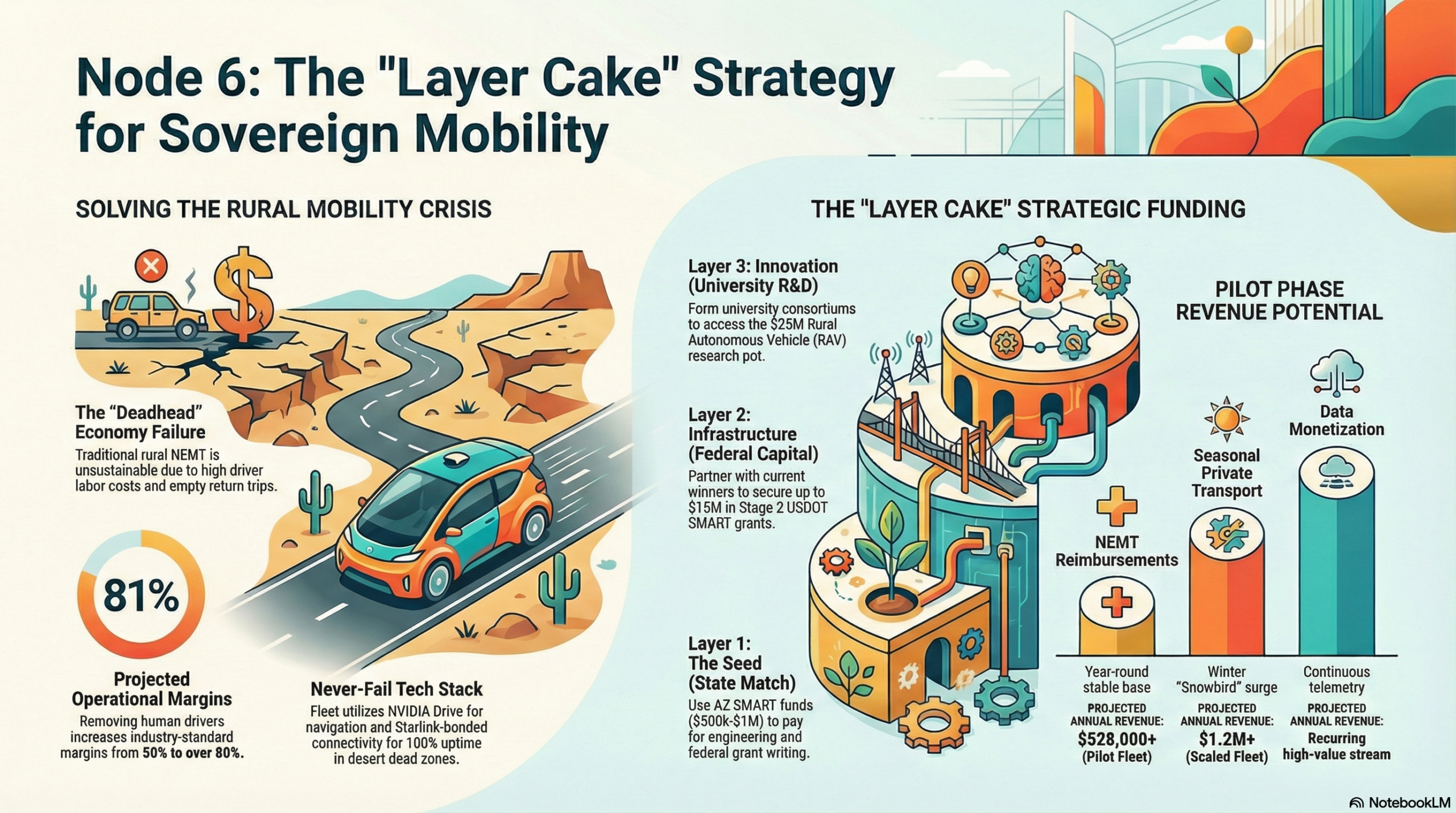
In La Paz County, Arizona, the Sovereign Stack is deployed as Node 6. This initiative is led by Brion Crum, known as “The Human Link,” who bridges the nexus of technology, capital, and real estate. Node 6 addresses an extreme demand scenario: a permanent population of only 1,805 residents with a median age of 71.2 years, coupled with a seasonal “Snowbird” surge of 750,000 to 1,000,000+ visitors.
The failed state of the current “Deadhead” economy is personified by the “Camel Express,” a transit service that operates only once per week. For residents, the 32-mile gap to major hospital care in Parker, AZ, is a barrier to survival. Node 6 transforms this landscape:
- The Integration: Through “Clinic-in-a-Box” technology, Kurb Kars are equipped with diagnostic sensors.
- The Result: A 45-minute commute is transformed into a preliminary medical check-up. Vitals are collected and uploaded via the Starlink/CAT4 bond while the patient is in transit.
- Financial Viability: By eliminating driver costs and utilizing local solar charging, the project expects to increase operating margins from the industry standard of 50% to a projected 81%.
This self-sufficient model proves that the Sovereign Stack is not just a theoretical framework, but a high-margin engine for community survival.
——————————————————————————–
6. The ‘Island Mode’ Advantage: Economic and Social Impact
The transition to “Island Mode” through the Sovereign Stack offers a three-fold impact for the resilient community:
- Economic Impact: The model achieves extreme capital efficiency. Beyond the 81% margin, the elimination of driver labor and the use of V2G arbitrage allows for a Recoup of CapEx in approximately 6 months per vehicle. Capital that once left the community to pay outside brokers is now retained locally.
- Social Impact: The system provides “compassionate care.” The unbiased reliability of the autonomous fleet—part of the Neo-Green Book initiative—is projected to reduce medical appointment no-shows by 40%, ensuring 24/7 access to life-saving treatments like dialysis for the most remote residents.
- Resilience: Because the stack is sovereign, it is “unbreakable.” Even if national fuel, data, or labor supply chains are interrupted, the community’s metabolic (Muscle), circulatory (Motion), and neural (Mind) systems remain fully operational.
As we move into an era of decentralized infrastructure, your role as a learner is to recognize that self-sufficiency is no longer a luxury—it is a strategic necessity.
——————————————————————————–
7. Summary Checklist for the Aspiring Learner
| Pillar | Component Name | Primary Benefit to the Community |
| The Muscle | Agra Dot Energy | Provides energy independence via Plasma Gasification of local waste/biomass. |
| The Motion | Kurb Kar Fleet | Delivers 24/7 autonomous transit; eliminates “Deadhead” costs and enables V2G arbitrage. |
| The Mind | RIOS / Biz Builder Mike | Coordinates the ecosystem via AI; enables Data Monetization via zkVerify and Federated Learning. |


