The Sovereign Stack: A Technical Primer for Autonomous Infrastructure
- Introduction: The Shift from Consumer to Producer
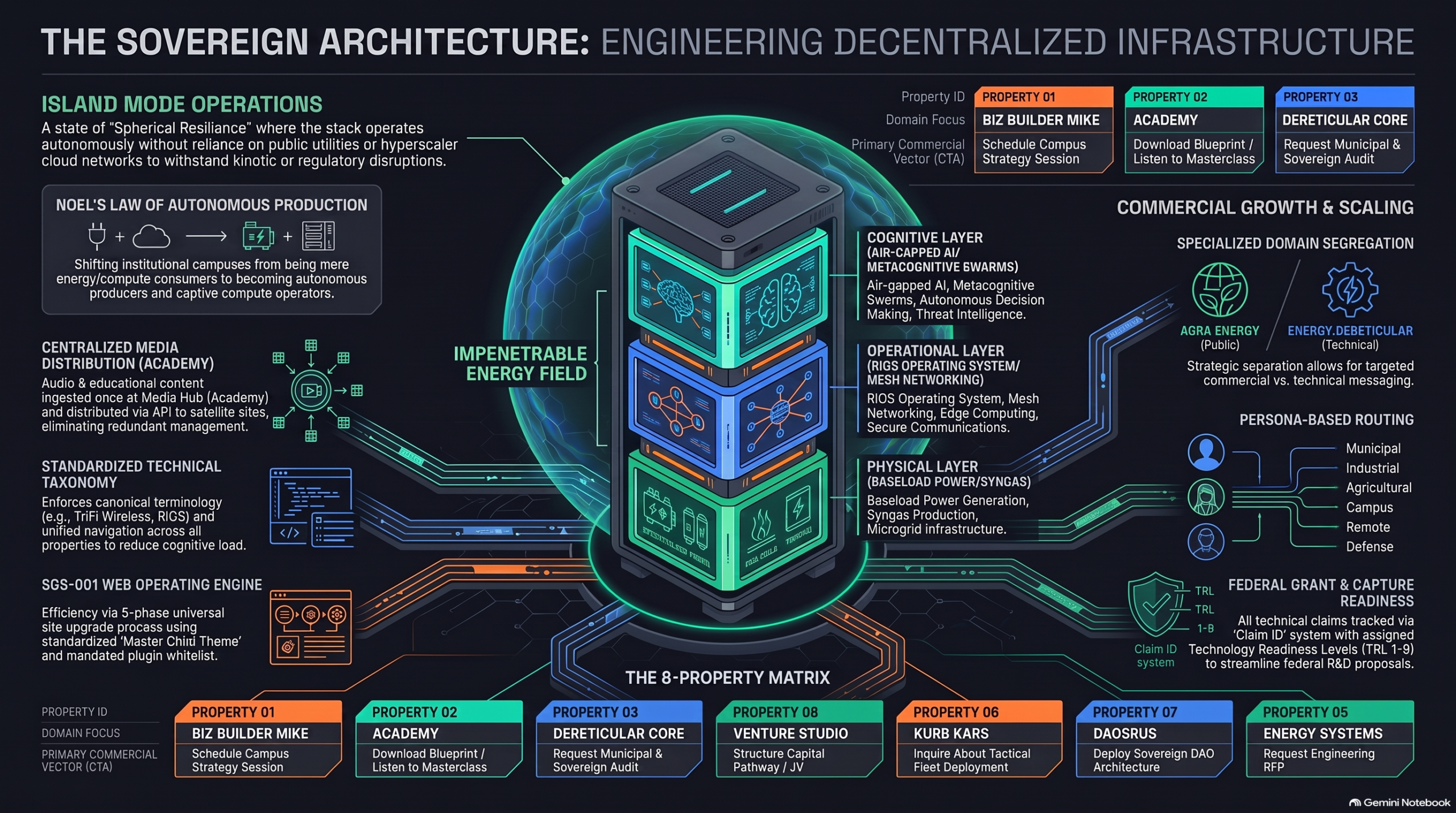
The mission of the Sovereign Infrastructure Education Alliance (SIEA) is to catalyze a fundamental architectural shift in how municipalities, agricultural cooperatives, and institutional campuses manage their core utilities. Central to this mission is Noel’s Law, which dictates that for a community to achieve true resilience, it must transition from being a passive consumer of energy and compute into an autonomous producer of energy and a captive compute operator.
This transition requires a departure from fragile, centralized dependencies toward a “ground-up” architectural model.
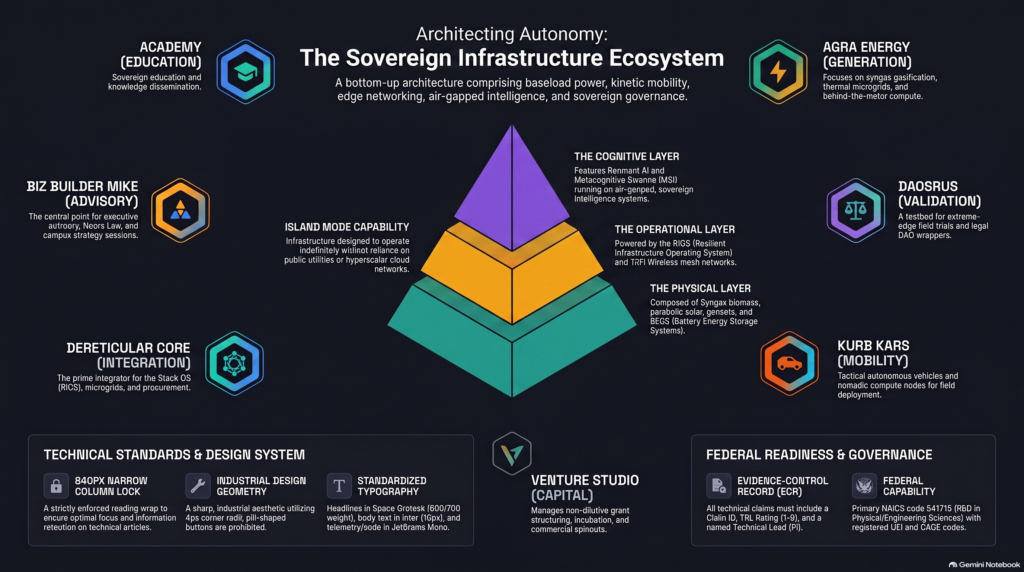
The Sovereign Stack: Infrastructure built from the physical layer up (baseload power → kinetic mobility → edge networking → air-gapped intelligence → sovereign governance) capable of sustained “Island Mode” operation without reliance on public utilities or hyperscaler cloud networks.
The path to operational independence begins with the physical foundation required to support high-availability systems.
- The Physical Layer: The Foundation of Baseload and Kinetic Power
The Physical Layer provides the “ground truth” of the stack. It focuses on ensuring baseload continuity—the stable, 24/7 power required for industrial functions—and nomadic hardware for mobile command-and-control.
Component Role in Autonomy
Syngas & Steam Biomass Gasification of organic feedstock to provide high-reliability thermal and electrical baseload energy.
Parabolic Solar Concentrated solar thermal arrays providing prime power and industrial-grade heating.
Pawnee 45 kW GenSets Hardened, high-output power generation units designed for nomadic deployment or fixed site backup.
BESS (Battery Energy Storage) Critical stabilization systems that buffer surplus production to ensure continuous, “non-flicker” power delivery.
Kurb Kars Nomadic hardware platforms and tactical vehicles providing kinetic autonomy and mobile edge-processing capabilities.
The Strategic “Behind-the-Meter” Advantage Infrastructure must be localized and “behind-the-meter” to eliminate the vulnerabilities inherent in the macro-grid. By generating and managing resources at the site of consumption, an entity bypasses the fragile transmission lines and regulatory choke-points that characterize centralized utility models.
Once these physical assets are established, they must be orchestrated by a resilient digital nervous system.
- The Operational Layer: Orchestrating the Edge
The Operational Layer serves as the interface between physical hardware and sovereign intelligence. This layer is responsible for localized data orchestration and the management of high-availability networking across a distributed field of nodes.
- RIOS (Resilient Infrastructure Operating System): The single canonical edge operating engine. RIOS functions as the “nervous system” for sovereign hardware, managing resources at the point of work with zero reliance on external cloud controllers.
- TriFi Wireless: A specialized protocol providing Point-of-Need Point-of-Work Routing. It enables a self-healing mesh network that maintains connectivity for nomadic and fixed nodes in degraded environments.
- Edge Networking: Utilizes distributed, non-linear node architectures to ensure that data is processed where it is generated, minimizing latency and maximizing security.
Spherical Resilience Unlike legacy systems, which suffer from single points of failure, this layer provides Spherical Resilience. The architecture is designed specifically to withstand kinetic disruption and regulatory choke-points, ensuring that if one node is compromised, the remaining network reroutes and maintains functional integrity.
With a robust operational network in place, the system can support the highest tier of the stack: localized decision-making.
- The Cognitive Layer: Air-Gapped Sovereign Intelligence
The Cognitive Layer represents the apex of the Sovereign Stack. Here, intelligence is moved from the public cloud to private, hardened nodes, ensuring that decision-making remains functional even during total macro-network failure.
- Air-Gapped Sovereign Intelligence (Concept vs. Benefit):
- Concept: Hosting localized “Remnant AI” and “Metacognitive Swarms (MSI)” on physical nodes disconnected from hyperscaler cloud networks.
- Benefit: Provides total data privacy and protects the system’s logic from external interference, surveillance, or remote deactivation.
- Sovereign Governance (Concept vs. Benefit):
- Concept: Utilizing localized AI to manage resource allocation, maintenance schedules, and security protocols.
- Benefit: Enables a campus to function with complete administrative autonomy, making data-driven decisions at the speed of the edge.
By moving intelligence into a private, air-gapped state, the system achieves a level of reliability and privacy impossible to find within centralized “Big Tech” ecosystems. These three layers—Physical, Operational, and Cognitive—converge to enable the ultimate state of independence.
- Synthesis: Achieving “Island Mode” Operation
The objective of the Sovereign Stack is to reach Island Mode. This is a state of total operational independence where a community or campus functions as a self-contained island of energy, connectivity, and intelligence, completely decoupled from the failures of centralized grids.
Checklist for Autonomy (Sovereign Readiness)
A site is considered “Sovereign Ready” only when its systems have been verified against the Technology Readiness Level (TRL) scale—a metric from TRL-1 (basic principles) to TRL-9 (proven through successful mission operations). Verification is logged within the site’s Evidence-Control Record.
- Baseload Continuity: TRL-9 Syngas or Solar Thermal systems producing verified net prime output.
- Energy Buffer: BESS capacity matched to peak demand and “Dark Start” requirements.
- Edge Orchestration: RIOS active across all hardware nodes with local administrative control.
- Mesh Resilience: TriFi Wireless active, providing point-of-work routing without external ISP dependency.
- Air-Gapped Intelligence: Remnant AI/MSI deployed on hardened nodes for local logic processing.
- Sovereign Governance: Legal wrappers or DAO architectures established to protect operational independence.
Legacy Centralization vs. Sovereign Decentralization Legacy systems are inherently fragile; they are built on a linear model where a single break in the chain causes a total collapse. Sovereign Decentralization utilizes Spherical Resilience, turning every node into a producer. This ensures the system survives and thrives despite external disruptions.
Mastering these layers requires a structured educational journey through the various entities of the consortium.
- The Sovereign Ecosystem: Your Learning Roadmap
To move from theory to implementation, learners interact with a unified ecosystem of educational and commercial entities. Each path is identified by specific design tokens and “color registries” that signal the focus of the curriculum:
- Strategy & Advisory (Energy Amber): Led by Biz Builder Mike, this path focuses on executive problem-framing, campus strategy, and the implementation of Noel’s Law.
- Technical & Engineering (High-Voltage Amber & Bio-Energy Emerald): This path covers engineering specifications and the thermal microgrid narrative. Energy Systems serves as the technical repository for SPS specs and BESS storage, while Agra Energy manages the baseload narrative for Syngas and Steam gasification.
- Field Trials & Mobility (Kinetic Orange & Sovereign Amethyst): Focuses on nomadic hardware and extreme-edge validation. Kurb Kars provides the curriculum for kinetic platforms, while DAOSRUS manages field trials, testbed operations, and sovereign legal wrappers.
Call to Action: To begin your workforce training, visit the Academy Dispatch. This is your primary Multimedia Hub and Study Vault, providing the audio masterclasses, technical blueprints, and engineering dossiers required to master the Sovereign Stack.


