The Sovereign Enclave Blueprint: Strategic Architecture for Decentralized Infrastructure, Compute, and Capital
- The Death of “The Line”: A New Philosophy of Spherical Resilience
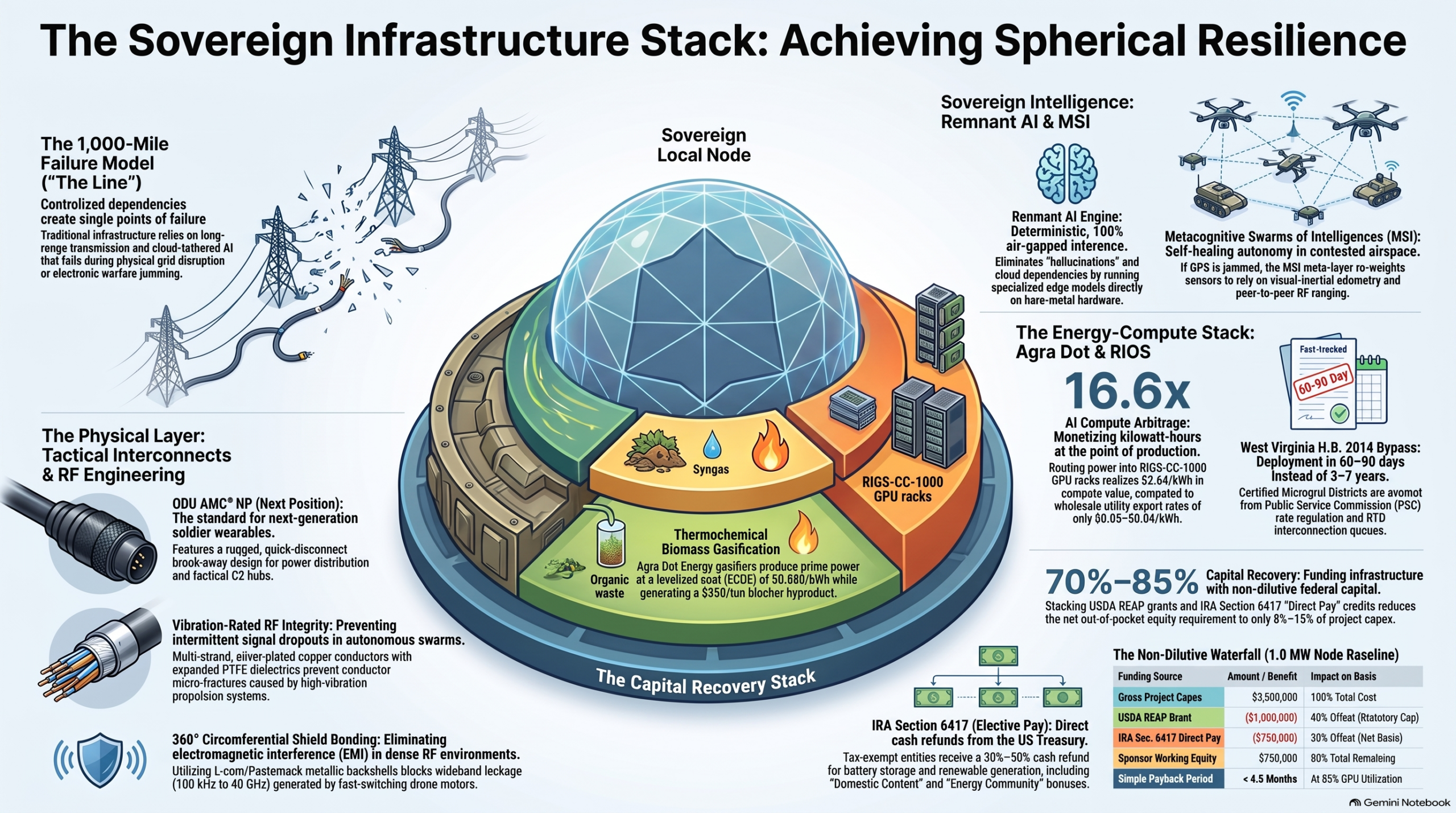
The prevailing infrastructure of the 21st century is built upon “The Line”—a fragile, 1,000-mile failure model characterized by centralized generation transmitted across vulnerable corridors and probabilistic cloud compute tethered to exposed fiber. This linear dependency represents an existential threat; a single point of failure in the bulk power grid or a fiber cut in a contested theater precipitates total system collapse. Under the prevailing electronic warfare regime, the only viable strategic posture for 2026 and beyond is “Spherical Resilience”: an omnidirectional, decentralized architecture that maintains total operational continuity within an air-gapped enclave, regardless of external collapse.
The Sovereign Mandate is defined by three philosophical axioms:
- The Digital Airlock: Sovereignty requires the absolute isolation of critical model weights and telemetry from the public internet.
- Split-Ledger Integrity: Local machine-to-machine transactions must be settled on private, air-gapped ledgers to prevent exfiltration.
- The 1,000-Mile Failure Model Antidote: Intelligence and power must be generated at the point of consumption.
Feature The Line (Fragile Linear Dependency) Spherical Resilience (Omnidirectional Enclave)
Energy Source Centralized Grid / Long-distance Transmission Local Baseload Syngas & Solar Thermal
Compute Model Cloud Monopoly / Probabilistic LLMs Air-Gapped / Deterministic Remnant AI
Connectivity Public Fiber / Cellular Dependencies Local Mesh (WISP-in-a-Box)
Regulatory Path 3–7 Year RTO Interconnect Queues Certified Microgrid District (60–90 days)
Resilience Single-Point-of-Failure Vulnerability Island-Mode / Black-Start Capability
This philosophical shift necessitates a radical departure in physical energy architecture, moving power generation behind-the-meter to fuel the intelligence layer.
- Decentralized Sovereign Microgrids: The Physical Layer of Independence
The prerequisite for sovereign compute is a stable, behind-the-meter baseload power supply that eliminates grid-interconnect risk. By decoupling from the utility monopoly, an enclave bypasses the multi-year delays of the “Permitting Wall” and ensures that high-density intelligence remains operational even during civil infrastructure collapse or electromagnetic interference.
Evaluation of the Energy Stack
The Sovereign Microgrid achieves a Levelized Cost of Energy (LCOE) of $0.038/kWh through the technical synergy of Agra Dot Energy thermochemical gasification and DOE Parabolic Solar Thermal augmentation.
- Gasification: Plasma gasifiers convert forestry slash and agricultural waste into high-BTU synthesis gas (CO + H₂).
- Solar Augmentation: DOE parabolic troughs focus sunlight at 80x concentration to produce 350°C industrial steam. This steam is injected into the gasifier chambers to preheat the reaction, eliminating daytime parasitic fuel consumption.
The 700V DC Native Topology
To maximize efficiency, the microgrid utilizes Pawnee 45 kW Wankel Rotary GenSets. These units are uniquely engineered to run continuously on unrefined syngas without catalytic scrubbers—a critical “Sovereign” advantage in austere environments where complex exhaust treatment is a failure point.
- Direct DC Rectification: Power is distributed via a 700V DC native busbar, bypassing AC-DC conversion losses to achieve 97.7% power-chain efficiency.
- Switching: Sub-16ms automatic transfer ensures seamless island-mode operation.
Comparative Reliability: Legacy vs. Sovereign (Guam Case Study)
The brown tree snake (Boiga irregularis) on Guam frequently collapses legacy grids. The sovereign architecture provides a proactive defense.
Metric Legacy Suppression (Grid-Tethered) Sovereign Robotic Eradication (Octagon Skids)
Power Source Vulnerable Centralized Grid Behind-the-Meter Baseload
Response Type Reactive Post-Blackout Maintenance Proactive Infrastructure Defense
Dependency Vulnerable to Grid/Comm Outages Continuous “Island Mode” Autonomy
Hardware Exposed Utility Infrastructure Hardened Expeditionary Skids
The stability of this 700V DC busbar provides the reliable environment required for the high-density intelligence layer.
- Sovereign Compute Enclaves: High-Density AI and Deterministic Autonomy
Given the current theater of pervasive data exfiltration, the data center must function as a “Sovereign Matrix.” Air-gapped compute is the only method to protect critical model weights from remote intrusion. This enclave creates a secure digital airlock, ensuring intelligence remains private and functional in disconnected operating theaters.
RIOS-CC-1000 and Kove:SDM Architecture
The RIOS-CC-1000 cluster integrates NVIDIA H100/Blackwell arrays within liquid-cooled modular racks. A key differentiator is the deployment of Kove:SDM software-defined memory.
- Microsecond-Latency Optical RAM Pooling: Kove:SDM acts as a disaggregated memory fabric, allowing edge nodes to pool RAM dynamically. This enables high-density AI workloads that exceed the physical capacity of individual server nodes.
Remnant AI vs. Cloud LLMs
The enclave utilizes the Remnant AI Engine, which replaces the vulnerabilities of cloud-tethered models:
- Deterministic Inference: Unlike probabilistic LLMs, Remnant AI uses deterministic inference trees to eliminate “hallucinations” in safety-critical missions.
- Bare-Metal Performance: Running directly on-chip with zero network telemetry, the system is immune to latency bottlenecks and RF jamming.
The Metacognitive Swarm (MSI) Framework
The MSI framework operates on a two-tiered cognitive architecture:
- Object-Level: Individual nodes (UAVs/UGVs) handle multi-spectral sensor fusion and motor kinematics.
- Meta-Level: A supervisory loop monitors model confidence. In GPS-denied or jammed environments, the meta-layer automatically re-weights sensor inputs, shifting navigation to visual-inertial odometry (VIO) and peer-relative RF ranging.
This density of compute is enabled by a regulatory bypass that allows for rapid physical deployment.
- Bypassing the Permitting Wall: Regulatory and Statutory Engineering
The “Permitting Wall” represents the primary bottleneck for AI, with PJM interconnection queues exceeding 3–7 years. Legal engineering is as vital as mechanical engineering; by leveraging specific statutory paths, an enclave can move from site selection to commissioning in a 60–90 day build cycle.
West Virginia H.B. 2014 and the “Silicon Hollow”
The Power Generation and Consumption Act (W. Va. Code §5B-2-21) provides a utility franchise exclusivity bypass. By siting on former coal-transition brownfields—designated as “Silicon Hollow” sites—projects can be designated as Certified Microgrid Districts. This legal moat exempts the enclave from Public Service Commission (PSC) rate regulation and RTO interconnection queues.
The Captive Load Ratio
To maintain this exemption, the microgrid must consume the majority of its energy on-site. The Agra Dot/RIOS stack achieves an 84.8% captive load ratio, insulating the project from export tariffs and utility disputes.
- Leveraging the Non-Dilutive Capital Stack: Financial Engineering
Preserving enterprise equity is a strategic priority. By stacking federal grants and tax credits, developers can deploy multi-million dollar infrastructure with only 8%–10% out-of-pocket equity.
The Grant Recovery Waterfall
For a 1.0 MW node with a $2.5M Capex, the waterfall functions as follows:
- USDA REAP Grant: 50% capital grant (capped at $1,000,000).
- IRA Section 6417/48E: Elective Pay refund of 30% (Base) + 10% (Energy Community) + 10% (Domestic Content), totaling up to 50% of the net basis.
The AI Compute Arbitrage Proof
The economic durability of the enclave is defined by the conversion of low-cost fuel into high-value compute.
- Gross Realized Value per kWh = (Market Rate per GPU-Hour [1.85]) / (Hourly GPU Power Consumption [0.70 kW]) = ~2.64/kWh.
- Target Arbitrage Multiple = $2.64 (Realized) / $0.038 (LCOE Cost) = 69.5x.
Alternative Financing Taxonomy
Mechanism Cost (APR) Dilution Primary Target
C-PACE 6.5% – 8.5% 0.0% Land & Troughs
Private Activity Bonds 4.0% – 6.0% 0.0% Regional Utilities
DePIN RWA Tokenized Debt 10.0% – 14.0% 0.0% WISP Towers/Mesh
- The Bridge Facility: Managing the Liquidity Cycle
The “Working Capital Timing Deficit” is a structural vulnerability where developers fund 100% of costs before receiving retrospective reimbursements. Bridge facilities provide the connective tissue for deployment.
The Liquidity Recovery Cycle
- Month 0: Draw from bridge facility for hardware procurement.
- Month 3: Commercial Operations Date (COD); RIOS clusters begin earning compute revenue.
- Month 6–10: USDA REAP and IRS Direct Pay disbursements extinguish bridge principal.
Project Financing Scenario Models
- Scenario A (Pure Non-Dilutive Municipal Stack): 40% USDA REAP, 30% IRA, 22% FEMA BRIC, and 8% Sponsor Equity.
- Scenario B (Commercial Private Project SPV): 40% C-PACE, 28.2% IRA 6418 Credit Transfer, 21.8% GPU Lease, and 10% SPV Equity. Both models achieve 0% enterprise dilution.
- Expeditionary Logistics and Hardware Integrity
Operational continuity in austere theaters relies on the physical integrity of “Project Octagon.” Under severe Propulsion Harmonics, standard hardware fails.
Physical Interconnects and EMI Mitigation
- Tactical Connectors: ODU AMC® NP connectors provide a fast break-away release and pin-and-groove keying, rated for >2,000 mating cycles.
- 360° Shielded RF Cabling: L-com vibration-rated 50Ω coax prevents fretting corrosion—the micro-motion between contacts caused by motor harmonics.
- EMI Defense: Continuous metallic backshells provide 360° shielding to block Wideband EMI leakage from high-power PWM motor lines, protecting sensitive telemetry.
The Sovereign Factory (DAOS R US)
To mitigate severed supply lines, “The Sovereign Factory” provides point-of-need fabrication. These containerized units use additive and subtractive manufacturing to reduce component lead times from weeks to minutes.
Guam Sovereign Eradication Case Study
The Guam initiative demonstrates the integrated stack: Pawnee all-terrain robotics, equipped with multi-spectral thermal tracking and Remnant AI on-chip classification, navigate dense jungles to neutralize invasive species threatening military grid stability. This is “Sovereign Intelligence” in action—deterministic, air-gapped, and powered by behind-the-meter resilience.
This convergence of physical integrity, deterministic intelligence, and non-dilutive capital forms the Master System Blueprint for the Sovereign Enclave.


