
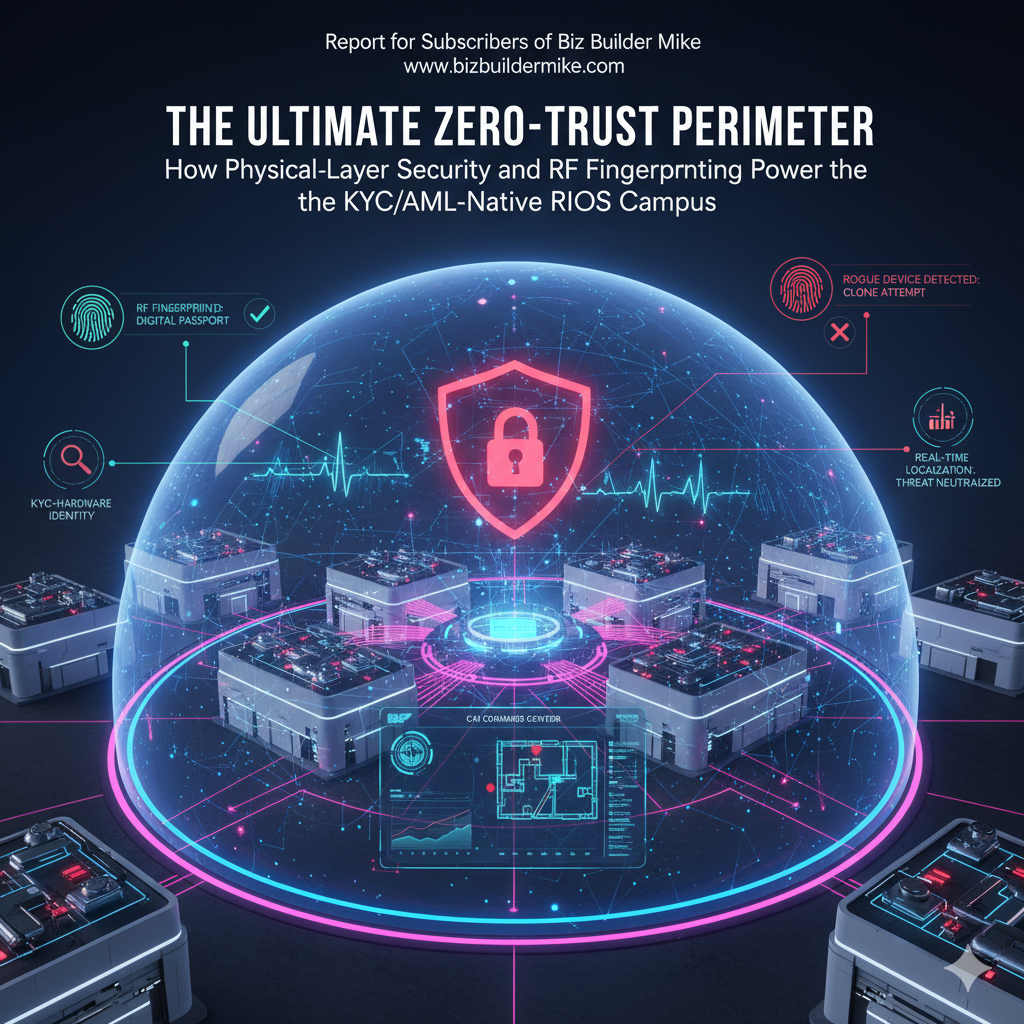
The Ultimate Zero-Trust Perimeter: How Physical-Layer Security and RF Fingerprinting Power the KYC/AML-Native RIOS Campus
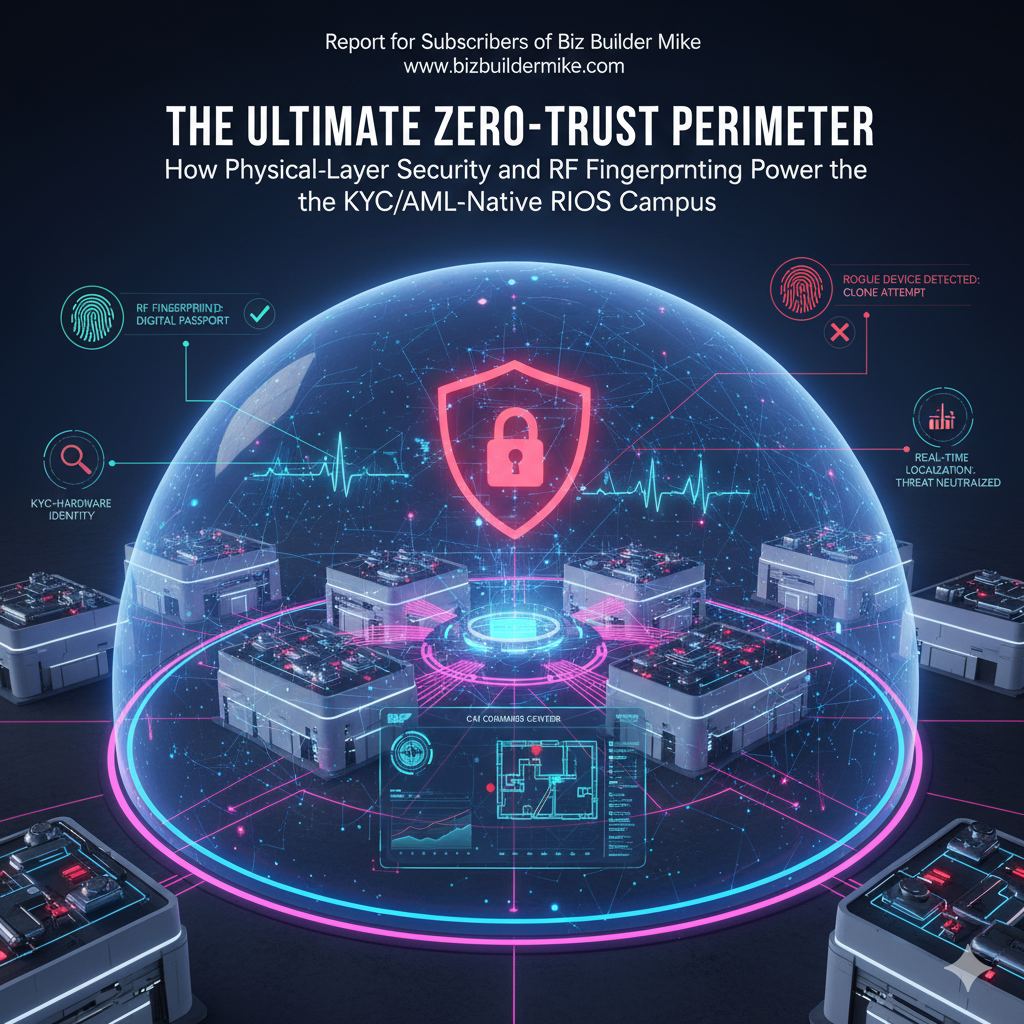
Report for Subscribers of Biz Builder Mike
(Website: www.bizbuildermike.com)
The Ultimate Zero-Trust Perimeter: How Physical-Layer Security and RF Fingerprinting Power the KYC/AML-Native RIOS Campus
The Future of Business is Autonomy. In the closed-loop, high-value ecosystem of the RIOS Campus, traditional cybersecurity is not enough. When revenue generation is tied directly to the uptime of an AI Compute Engine, you need a defense system that is not just software-defined, but physically absolute.
This report details the strategic value of integrating Advanced Security Monitoring into the Cognitive Mesh Network, turning it into a real-time Command, Control, and Intelligence (C4I) system that seamlessly supports the campus’s native Know Your Customer (KYC) and Anti-Money Laundering (AML) requirements.
1. Beyond Digital: Securing the Physical-Layer with RF Fingerprinting
The core of this defense system is the ability to identify a device’s identity at the most fundamental level—the radio signal itself.
1.1. RF Fingerprinting for Absolute Identity (The Un-Spoofable Passport)
Traditional network security relies on layer 3 (IP Address) and layer 2 (MAC Address). These addresses can be easily spoofed using common software. The RIOS Campus, however, employs a technique called Radio Frequency Fingerprinting (RFF), which is made possible by the distributed mesh nodes equipped with Dedicated Listening Radios (DLRs).
- How it Works: Every wireless chip, due to minute, physical imperfections in its manufacturing (variations in transistors, filters, and oscillators), emits a unique, intrinsic hardware impairment—a subtle signature in its radio signal (like frequency offset or phase noise). The DLRs are sensitive enough to capture these physical layer characteristics[1][2][3].
- Zero-Trust Access: The RIOS system pre-registers and maps the RFF of every authorized device—from the Compute Engine’s internal NICs to the control tablets used by maintenance staff. This RFF acts as an un-spoofable Digital Passport[2]. Access is only granted if the device’s MAC Address, cryptographic key, and its RFF all match the registered profile.
- The Power of AI: Advanced RFF systems use Physics-Informed Neural Networks (PINNs) and machine learning to analyze these complex signals, allowing the mesh to maintain accuracy even when signals are distorted by environmental noise or movement[3].
1.2. Flagging the Physical-Layer Rogue Device
This RFF mechanism is the first line of defense against the most common threats to closed systems:
- Clone Detection: If a malicious actor spoofs the MAC address of an authorized device (e.g., an LTO battery control unit) to infiltrate the network, the mesh will instantly flag it because the device’s unique RFF will not match the authorized hardware’s signature. This turns a digital intrusion into a physical violation[2][4].
- Unregistered Threats: Any un-enrolled device (Wi-Fi, Bluetooth, Zigbee, etc.) that transmits within the RIOS campus airspace is instantly identified as a Physical-Layer Rogue Device.
2. Airspace Defense and Localization: Turning Data into Physical Action
Once an unauthorized signal is detected, the distributed nature of the mesh network kicks in to provide a real-time C4I (Command, Control, and Intelligence) response.
2.1. Hyper-Accurate Localization and Triangulation
Each DLR-equipped mesh node is not just a Wi-Fi repeater; it’s a passive sensor, similar to the acoustic meshes used in modern air defense systems[5][6].
- Real-Time Triangulation: The system uses techniques like Angle-of-Arrival (AoA) and Time Difference of Arrival (TDoA), measuring how long it takes the rogue signal to reach various mesh nodes. By combining this data across the network, the AI engine can precisely triangulate the rogue device’s physical location (e.g., within 1-2 meters)[7][8].
- Jamming and Drone Mitigation: The system provides Airspace Defense by not only detecting the presence of a jamming signal but also pinpointing its exact physical source. This localization data is instantly fed to campus security, transforming a generic “network attack” alert into an actionable order to “Neutralize the rogue transmitter at Node 4, Sector Beta”[7][9].
2.2. The ‘Pattern of Life’ for Forensic Audit
The system continuously records all wireless activity, creating a “Pattern of Life” for every device detected, authorized or not. This is critical for post-incident forensic investigation and compliance reporting[7].
3. Strategic Value: Physical Security Meets Financial Compliance (KYC/AML-Native)
In the RIOS Campus, where the Microgrid and Compute Engine generate revenue, the security platform is designed to be KYC/AML-Native.
| Compliance Layer | Traditional Method (Software-Only) | RIOS Physical-Layer Defense | Strategic Value for Biz Builder Mike Subscribers |
| Know Your Customer (KYC) | Digital verification of a user’s ID, address, and login credentials[10][11]. | Physical Identity Verification: KYC is extended to hardware identity. Every device is physically verified via its RFF. This means the user is not just logged in with a valid ID; they are also operating a physically validated piece of hardware[12]. | Eliminates Synthetic Identity Fraud at the Hardware Layer. Prevents bad actors from using cloned or un-vetted hardware to interact with the GTL or Compute Engine control systems. |
| Anti-Money Laundering (AML) | Continuous monitoring of transaction history for suspicious financial behavior[10][13]. | Continuous Location Monitoring: AML is extended to physical asset location and activity. The Cognitive Mesh tracks the precise “pattern of life” (location and movement) of all authorized and unauthorized devices[7]. | Prevents Physical Collusion & Covert Signaling. If an authorized control device is found communicating with an unregistered device (Physical-Layer Rogue) near a sensitive asset (GTL Unit) at a suspicious time, the system triggers a physical AML alert, preventing the use of the RIOS network for illicit signaling or data exfiltration[14][15]. |
Conclusion: The RIOS Campus as the Business Security Gold Standard
For subscribers building a high-value, autonomous business, the RIOS Campus provides a blueprint for resilience. By weaponizing the ubiquitous Wi-Fi Mesh with dedicated sensing radios, the system creates a digital-and-physical perimeter that is un-spoofable, self-aware, and actionable.
This convergence is the definition of Advanced Security: moving security controls from the software layer (which can be hacked) to the immutable physical layer (which cannot). It creates a unified C4I system that ensures the continuous, compliant, and financially-sound operation of the entire RIOS business ecosystem.
Sourceshelp


