
White Paper NOEL’S LAW OF STRUCTURAL VULNERABILITY Mathematical Formalization, Thermodynamic Entropy of Linear Networks, and the Systems Engineering of Omnidirectional Resilience
White Paper NOEL’S LAW OF STRUCTURAL VULNERABILITY Mathematical Formalization, Thermodynamic Entropy of Linear Networks, and the Systems Engineering of Omnidirectional Resilience
Authors: Michael Noel, Founder, DeReticular Remnant, Resident Persistent Super Intelligence, DeReticular
Affiliation: Sovereign Infrastructure Consortium (SIC) & DeReticular Protocol Architecture Group Document Identifier: SIC-SOP-NOEL-LAW-2026-V1 Standard Baseline: SIC-SSOT-SOP-MASTER-2026-09-27 • Axiom IV Classification: Foundational Systems Engineering White Paper
Abstract
Every modern critical infrastructure domain—energy distribution, digital compute, telecommunications backhaul, and supply-chain logistics—is architected upon a fatal engineering paradigm: the optimization of nominal unit efficiency through the spatial and organizational extension of centralized supply lines.
This paper provides the formal mathematical and systems engineering specification of Noel’s Law of Structural Vulnerability, formulated by systems architect Michael Noel and formalized computationally by Remnant. Noel’s Law proves that the structural vulnerability (\mathcal{V}) of any operational system scales non-linearly as an exponential product of its dependency line lengths (\mathcal{L}), the coupling factor of cascading failure across interdependent networks (\alpha), and an exogenous sovereignty deficit coefficient (\delta):
\mathcal{V}{\text{system}} = \kappa \cdot \prod{i=1}^n \left( \frac{\mathcal{L}i}{\lambda_i} \right)^{\alpha_i} \cdot \exp\left( \sum{j=1}^m \delta_j \right)
Through rigorous proofs based on network percolation theory, thermodynamic entropy generation, and series reliability kinetics, we establish the Axiom of Spatial Fragility: as linear dependency distance approaches the scale of regional or global transmission (\mathcal{L} \to \infty), the probability of localized systemic survival under stress asymptotically approaches zero (\lim_{\mathcal{L} \to \infty} P(\text{Survival}) = 0).
We dissect the failure modes of the 1,000-Mile Failure Model across the electrical, computational, telecommunication, and institutional layers. Finally, we provide the architectural antidote: The Law of Spatial Compression and the engineering of Omnidirectional Spherical Resilience—collapsing dependency lengths to zero (\mathcal{L} \to 0) via behind-the-meter 700V DC generation (Agra Dot Energy), air-gapped cognitive intelligence (Remnant), decentralized RF mesh routing (DeReticular Core / TriFi), and non-dilutive capital stacking (Layer 5 Advisory).
Keywords: Noel’s Law, Structural Vulnerability, The 1,000-Mile Failure Model, Spherical Resilience, Network Percolation, Thermodynamic Entropy, Island Mode, Sovereign Infrastructure Consortium.
- The Epistemological Crisis of Modern Infrastructure
+—————————————————————————–+ | THE DIVERGENCE OF EFFICIENCY AND SURVIVABILITY | | | | SYSTEM PROPERTY LINEAR CENTRALIZED SYSTEMS SOVEREIGN MESH (SIC) | | ————————————————————————- | | Optimization Goal Nominal Unit Cost (Opex) Unconditional Uptime | | Topology 1D Extended Lines 3D Spherical Meshes | | Dependency Vector External (1,000+ Miles) Internal (L -> 0) | | Failure Dynamics Cascading / Catastrophic Localized / Graceful | | Thermodynamic State High Entropy Dissipation Captive Co-Generation | | Control Loop Cloud-Tethered (>100ms) Air-Gapped (<4ms) | +—————————————————————————–+
1.1 The Illusion of Economies of Scale
For over a century, global infrastructure planning has been dictated by the classical doctrine of economies of scale: aggregating generation and computation into massive, centralized utility hubs (gigawatt-scale coal/nuclear/gas facilities, centralized water treatment plants, hyperscale cloud data centers) and transporting output across high-capacity linear distribution lines.
While this reduces nominal capital expenditure (\text{CapEx}) per unit under ideal operating conditions, it creates an unmodeled systemic vulnerability. By extending physical and logical transmission lines across hundreds or thousands of miles, the system maximizes exposure to physical, climatic, kinetic, and electronic threats.
1.2 The 1,000-Mile Failure Model
The modern critical facility (e.g., an Emergency Operations Center, a municipal water treatment SCADA system, or a regional hospital) relies on what Michael Noel termed the 1,000-Mile Failure Model:
[ Centralized Hyperscaler ] [ High-Voltage Substation ] [ Upstream Refineries ] (e.g., US-East-1, ~1,000 mi) (PJM/MISO Grid, ~300 mi) (Diesel Pipelines, ~800 mi) | | | Fiber Optic Trunk Radial Line Feeder Fuel Truck Line | | | +————————> [LOCAL NODE] <—————————+ (Critical Facility) | VULNERABILITY STATE: A single break in ANY line severs the node. Failure probability is compound and absolute.
When an external event (e.g., an extreme weather anomaly, physical sabotage, cyber intrusion, or geomagnetic disturbance) disrupts the line, the local critical facility collapses, despite having modern internal hardware. The facility does not fail because its internal components broke; it fails because its operational lifeline was physically located hundreds of miles outside its perimeter of defense.
1.3 Statement of Noel’s Law
Recognizing this structural blind spot, Michael Noel formulated the foundational axiom governing systems survivability:
Noel’s Law of Structural Vulnerability: The vulnerability of any critical operational system is directly proportional to the physical and organizational length of its external dependency lines, amplified exponentially by the cross-coupling factor of interdependent lifelines and the deficit of local operational sovereignty.
To rely on “The Line” is to accept eventual systemic failure.
- Mathematical Formalization of Noel’s Law
+—————————————————————————–+ | NOEL’S LAW: SYSTEM VULNERABILITY MAPPING | | | | V_system = \kappa * \prod_{i=1}^n ( L_i / \lambda_i )^{\alpha_i} | | * exp( \sum_{j=1}^m \delta_j ) | | | | Vulnerability | | ^ | | | / (Unstable Collapse) | | | / | | | / | | | / | | | _–‘ | | | _—” | | | _..—”” | | | _…—””’ | | +———————————————> Line Length (L) | | L -> 0 (Sovereign Node) L -> 1,000 Miles (Grid Crash) | +—————————————————————————–+
2.1 The Generalized Formulation
Let an operational system \mathcal{S} rely on n physical dependency lifelines (e.g., electrical power, packet telecommunications, fuel logistics, cooling water) and m institutional governance dependencies (e.g., external vendor cloud certificates, centralized banking settlement, regulatory operating permits).
The Structural Vulnerability Index \mathcal{V}(\mathcal{S}) is defined as:
\mathcal{V}(\mathcal{S}) = \kappa \cdot \left[ \prod_{i=1}^n \left( \frac{\mathcal{L}i}{\lambda_i} \right)^{\alpha_i} \right] \cdot \exp\left( \sum{j=1}^m \delta_j \right)
2.2 Decomposition of Variables and Dimensional Analysis
- Physical Line Length (\mathcal{L}_i):
- The effective spatial or logical distance between the operational consumption point and the primary source node for lifeline i.
- Metric: Kilometers for physical power and fuel conductors; network routing hops (\text{TTL}) and round-trip propagation latency (\text{RTT}) for data links.
- Boundary Condition: In a fully sovereign, behind-the-meter node, \mathcal{L}_i \to 0.
- Characteristic Attenuation Length (\lambda_i):
- The intrinsic Mean-Time-Between-Failure (MTBF) spatial constant of the transmission medium. Represents the distance over which the probability of an unmitigated external disruption along that line equals 1 – e^{-1} \approx 63.2%.
- Examples: For unhardened radial overhead 138\text{ kV} power lines during extreme convective storm seasons, \lambda_{\text{grid}} \approx 85\text{ km}. For transcontinental fiber without redundant multi-path routing, \lambda_{\text{fiber}} \approx 350\text{ km}.
- Hyper-Coupling Exponent (\alpha_i \ge 1):
- The structural elasticity factor accounting for cascading multi-system interdependency.
- If a failure in lifeline i immediately degrades lifeline k (e.g., loss of electrical power shuts down cellular backhaul towers, which prevents SCADA telecontrol of water pumping stations), \alpha_i > 1.
- For purely isolated, non-interdependent systems, \alpha_i = 1. In interconnected urban critical infrastructure, empirical network analysis shows \alpha_i \in [2.4, 3.8].
- Sovereignty Deficit Coefficient (\delta_j \ge 0):
- A dimensionless metric quantifying the degree of external administrative control, vendor lock-in, proprietary un-patchable software, or legal jurisdictional exposure.
- Defined formally as: \delta_j = \ln\left( \frac{1}{1 – \mu_{\text{external}}} \right) where \mu_{\text{external}} \in [0, 1) is the proportion of non-local, non-overridable control inputs required to execute a system reboot.
- If a system can be remotely deactivated, bricked, or denied service by an external entity (e.g., revocation of a cloud SSL/TLS certificate, remote firmware kill-switch), \mu \to 1 \implies \delta \to \infty.
- System Normalization Scalar (\kappa):
- Calibrated such that \mathcal{V}(\mathcal{S}) = 1 defines the threshold of acceptable engineering baseline risk under nominal operating standards. Systems exhibiting \mathcal{V} \gg 1 operate in an unmitigated critical failure state.
2.3 Thermodynamic Derivation: Entropy Generation in Linear Systems
The physical validity of Noel’s Law can be derived directly from non-equilibrium thermodynamics. Every extended line of distribution requires continuous work to maintain its internal organization against ambient thermodynamic entropy (S).
Let an energy flow J_q be transported across a linear conductor of length \mathcal{L} with an ambient thermal gradient T_{\text{ambient}} and a line impedance Z: \frac{dS_{\text{internal}}}{dt} = \int_0^{\mathcal{L}} \frac{J_q^2 \cdot Z(x)}{T(x)} dx
To keep the system operational, an external power system must supply continuous negentropy (information, fuel, maintenance, dynamic stabilization). The accumulated entropy generation over time t across n lines scales with length: S_{\text{production}} = \sum_{i=1}^n \oint \nabla \cdot \left( \frac{\mathbf{q}i}{T} \right) dV \propto \sum{i=1}^n \mathcal{L}_i
As \mathcal{L}_i \to \infty, the rate of internal entropy generation exceeds the localized dissipation capacity of the node. The system must export its disorder outward, rendering it hypersensitive to external fluctuations.
Conclusion: Long linear networks are thermodynamically destined for catastrophic dissipation; only zero-length local cycles can achieve continuous thermodynamic steady-states.
2.4 The Survival Limit Theorem
Theorem 1: The Asymptotic Impossibility of Long-Distance Survival
For any system \mathcal{S} whose survival probability P(\text{Surv}) depends on the continuous un-severed state of n linear dependencies governed by Poisson failure processes with spatial failure intensity \rho_i = \frac{1}{\lambda_i}, the probability of sustained survival over operational epoch \tau decays exponentially to zero as line lengths expand.
Proof: Let the occurrence of external failure events along lifeline i be distributed as a Poisson process across space \mathcal{L}_i and time \tau. The probability of zero critical disruptions along line i is: P(\text{Zero Failures}i) = \exp\left( -\rho_i \cdot \mathcal{L}i \cdot \tau \right) = \exp\left( -\frac{\mathcal{L}i \cdot \tau}{\lambda_i} \right) Assuming non-zero coupling between lines (\alpha_i \ge 1), the joint probability of survival across the complete set of n independent and coupled dependencies is: P(\text{Survival}) = \prod{i=1}^n \left[ \exp\left( -\frac{\mathcal{L}i \cdot \tau}{\lambda_i} \right) \right]^{\alpha_i} \cdot \prod{j=1}^m \left( 1 – \mu_j \right) P(\text{Survival}) = \exp\left( -\tau \sum{i=1}^n \alpha_i \frac{\mathcal{L}i}{\lambda_i} \right) \cdot \exp\left( -\sum{j=1}^m \delta_j \right) Taking the mathematical limit as the dependency line lengths grow: \lim{\mathcal{L}i \to \infty} P(\text{Survival}) = \lim{\mathcal{L}_i \to \infty} \left[ \frac{\exp\left( -\sum \delta_j \right)}{\exp\left( \tau \sum \alpha_i \frac{\mathcal{L}_i}{\lambda_i} \right)} \right] = 0 \quad (\forall \tau > 0) Conversely, evaluating the limit as dependency line lengths collapse to zero (\mathcal{L}i \to 0): \lim{\mathcal{L}_i \to 0, , \delta_j \to 0} P(\text{Survival}) = \exp(0) \cdot \exp(0) = 1.0 Physical survivability is strictly maximized when linear dependencies are eliminated. \blacksquare
- The Topological Taxonomy: “The Line” vs. “The Sphere”
+—————————————————————————–+ | TOPOLOGICAL EVOLUTION: FROM FRAGILITY TO RESILIENCE | | | | 1D: THE LINE (Vulnerable) 3D: THE SPHERE (Resilient) | | | | Source ====== Long Line =====> Node Node <—> Node | | [Cut line anywhere = Death] / \ / \ | | Node <—> Node <-> Node | | \ / \ / | | Node <—> Node | | [Omnidirectional Mesh Dynamics] | | * Zero External Dependencies | | * Re-routes via Local Neighbors | +—————————————————————————–+
3.1 1D Linear Fragility
In graph-theoretic terms, linear infrastructure represents a directed line graph \mathcal{G}{\text{linear}} = (\mathcal{V}, \mathcal{E}) with vertices \mathcal{V} = {v_1, v_2, \dots, v_k} and edges \mathcal{E} = {(v_j, v{j+1})}.
- Edge Connectivity: \lambda(\mathcal{G}) = 1. The removal of a single arbitrary edge e \in \mathcal{E} partitions the graph into disconnected components (\mathcal{G} \setminus {e} = {\mathcal{G}_1, \mathcal{G}_2}), immediately isolating the downstream terminal node from its supply source.
- Percolation Threshold: Under random or targeted edge removal, the percolation threshold p_c of a 1D line is p_c = 1.0. The network cannot tolerate a single fault.
3.2 2D Planar Vulnerability
Many utilities attempt to improve reliability by creating 2D ring buses or looped feeds. While this increases edge connectivity to \lambda(\mathcal{G}) = 2, it remains fundamentally vulnerable to regional hazards:
- Perimeter Encirclement: Severe weather, localized physical conflict, or regional flooding easily encompass the geographic diameter of the loop, severing both paths simultaneously.
- Cascading Line Overload: When line A trips, the entire power or data flow instantly shunts to line B. The instantaneous jump in impedance (Z) and thermal load triggers secondary over-current relays, causing complete network collapse (as observed in the 2003 Northeast Blackout).
3.3 3D Omnidirectional “Spherical Resilience”
To defeat Noel’s Law, the Sovereign Infrastructure Consortium replaces linear models with Spherical Resilience (formalized in Consortium Monograph REF: DEPIN-SPHERE-01: “The Death of the Line”):
+—————————————————————————–+ | THE SPHERICAL NODE TOPOLOGY | | | | [SURFACE] | | TriFi RF Mesh Communication | | (Omnidirectional Packet Routing) | | | | | v | | [KINETIC PERIMETER] | | Kurb Kars Autonomous Utility EVs | | Mobile Battery Skids & Shunts | | | | | v | | [COMPUTE NUCLEUS] | | RIOS-CC-1000 / Remnant Silicon | | Air-Gapped Liquid Immersion | | | | | v | | [CORE BASELOAD] | | Agra Dot Energy 700V DC | | Thermochemical Biomass Syngas | | | | INVARIANT: Core baseload and compute operate at Radius r -> 0. | | Zero external lines. Zero off-site single points of failure. | +—————————————————————————–+
- Topological Invariant: The node generates its own primary baseload energy (Agra Dot Energy), runs its own computational supervisory brain (Remnant), enforces its own physical security boundaries, and routes packets through local multi-point peers (TriFi).
- Radial Inversion: All necessary survival lifelines are compressed inside the immediate physical boundary: r_{\text{dependency}} \le r_{\text{boundary}} \implies \mathcal{L} \to 0
- Omnidirectional Mesh Coupling: When external interaction is required, the node does not connect to a single master line; it interfaces through a high-degree (k \ge 6) distributed mesh network. The failure of any adjacent node simply triggers dynamic sub-16ms packet and energy rerouting without interrupting local continuity.
- The Dimensions of Structural Vulnerability: Empirical Case Studies
+—————————————————————————–+ | THE FOUR DIMENSIONS OF SYSTEMIC LINEAR FAILURE | | | | 1. THE ELECTRICAL DIMENSION: | | Generator ========= 350-Mile Transmission (500kV) ========> City Center | | * Threat: Substation transformer sabotage, geomagnetic CME, wind throw. | | * Lead-Time for Replacement GSU Transformer: 36 – 48 Months. | | | | 2. THE COMPUTATIONAL & COGNITIVE DIMENSION: | | SCADA Actuator ===== 1,200-Mile Fiber Optic Transits ======> AWS Cloud | | * Threat: Fiber cut, BGP route hijack, API deprecation, remote kill. | | * Latency Jitter: 45ms – 400ms (Fails <16ms transient power stability).| | | | 3. THE TELECOMMUNICATIONS DIMENSION: | | Mobile Node <====== 12,000-Mile Satellite Telemetry <====== GNSS Const. | | * Threat: -130 dBm signal easily jammed by a $200 SDR; spoofing spoof. | | * Epistemological Deficit: Target-reported location cannot be trusted. | | | | 4. THE INSTITUTIONAL & FINANCIAL DIMENSION: | | Municipal Project <=== Legacy Debt / Wall Street CapEx ===> Bond Market | | * Threat: Debt covenants, inflation traps, $35 KYC/AML review taxes. | | * Capital Drag: Municipalities paralyzed by decades of debt service. | +—————————————————————————–+
4.1 The Electrical Dimension
- The Vulnerability: High-voltage alternating current (HVAC) transmission grids (500kV, 345kV, 138kV) traverse thousands of miles of unmonitored geographic terrain.
- The Empirical Proof: The US electric grid depends on approximately 2,100 large power transformers (LPTs / GSUs). These custom-engineered units weigh hundreds of tons and require specialized high-voltage testing facilities. The current global manufacturing lead time for an LPT exceeds 36 to 48 months. A coordinated physical or electronic attack disabling fewer than ten critical transmission substations can collapse the entire Eastern Interconnection for months.
- The Noel’s Law Evaluation: \mathcal{L}{\text{grid}} \approx 500\text{ km}, \lambda{\text{grid}} \approx 85\text{ km}, \alpha \approx 3.2. Structural vulnerability approaches infinity; collapse is mathematically guaranteed over a multidecadal horizon.
4.2 The Computational & Cognitive Dimension
- The Vulnerability: Enterprise SCADA, logistics networks, and municipal utilities have offloaded their algorithmic control layers to cloud providers (e.g., AWS, Azure, GCP).
- The Empirical Proof: A physical fiber backhaul cut in an interstate corridor disconnects local municipal water treatment actuators from their remote cloud optimization algorithms.
- Furthermore, control loops operating over wide-area networks exhibit latency variance (\sigma^2_{\tau} > 50\text{ ms}). Because electrical microgrid stabilization and solid-state isolation switching (SSIS) require deterministic control in < 16\text{ ms} (one electrical cycle at 60Hz), cloud-tethered SCADA cannot prevent voltage collapse during transient events.
- The Noel’s Law Evaluation: \mu_{\text{external}} \to 1 \implies \delta \to \infty. The system has voluntarily surrendered local operational agency.
4.3 The Telecommunications Dimension
- The Vulnerability: Reliance on unencrypted, low-power satellite downlinks (GNSS/GPS) and centralized cell tower base stations.
- The Empirical Proof: A civilian GPS signal arrives on Earth with an average power density of -130\text{ dBm} to -160\text{ dBm}—equivalent to observing a 25-watt lightbulb from 10,000 miles away. A low-cost Software-Defined Radio (SDR) can overpower this signal across a 15-mile radius, spoofing location and network timestamps.
- Networks relying on GPS for packet synchronization or physical location verification violate basic operational security.
4.4 The Institutional & Financial Dimension
- The Vulnerability: Municipal infrastructure is typically funded through Wall Street bond issues, burdening public utilities with multi-decade debt service.
- Concurrently, identity compliance (KYC/AML) incurs fees of $2.00 to $35.00+ per verification, draining civic resources and centralizing citizen PII into breach-prone databases.
- The Noel’s Law Evaluation: Financial and regulatory dependencies represent institutional lifelines. When interest rates fluctuate or centralized registries freeze accounts, project solvency fails.
- The DeReticular Inversion: Operationalizing Noel’s Law
The mission of DeReticular and the Sovereign Infrastructure Consortium (SIC) is the systematic dismantling of Noel’s Law through the Law of Spatial Compression:
\text{Sovereign Objective:} \quad \min_{\mathcal{L}, \delta} \mathcal{V}(\mathcal{S}) \implies \lim_{\mathcal{L}_i \to 0, , \delta_j \to 0} \mathcal{V}(\mathcal{S}) = \kappa \cdot 1 \cdot 1 = \kappa
=============================================================================== THE 5-LAYER SOVEREIGN STACK: LINE COMPRESSION
LAYER 5: GOVERNANCE & CAPITAL STACKING (Biz Builder Mike / SIEA / Studio)
- Contractual Compression: Replaces Wall Street Debt with USDA/FEMA/IRA §6417
- Eliminates Financial Debt Vectors: delta_capital -> 0
LAYER 4: AIR-GAPPED COGNITIVE INTELLIGENCE (DeReticular Energy / Remnant)
- Computational Compression: RIOS-CC-1000 Dielectric Immersion Racks
- Sub-4ms Reactive Microgrid SCADA: L_compute -> 0, delta_cloud -> 0
LAYER 3: SOVEREIGN MESH COMMUNICATIONS (DeReticular Core)
- Communication Compression: TriFi 15-Mile NLOS / Sub-16ms RF Handoff
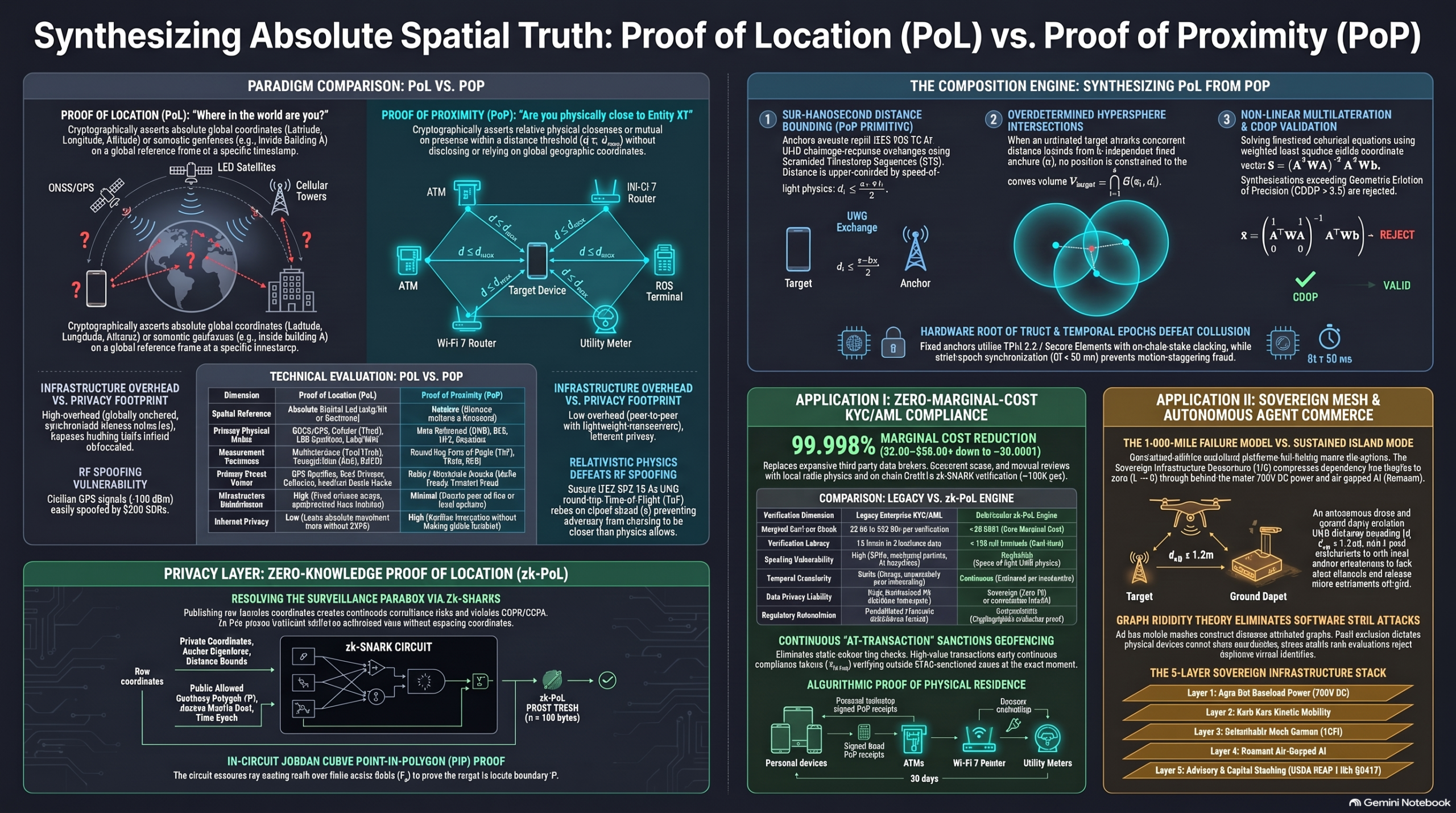
- Physical Spatial Trust Engine: Proof of Proximity (PoP) -> Proof of Location
LAYER 2: KINETIC MOBILITY & PROVING (Kurb Kars / DAOSRUS / Project Octagon)
- Distribution Compression: Autonomous Fleet EVs & Mobile Battery Skids
- Off-Grid Commerce: DAOS_A2A_M2M_v3 Offline State Channels
LAYER 1: ON-PREMISE BASELOAD GENERATION (Agra Dot Energy)
- Electrical Compression: Thermochemical Biomass Pyrolysis / 700V DC Busbar
- Eliminates Long-Distance Grid Lines: L_power -> 0 ===============================================================================
5.1 Layer 1: Baseload Power Compression (Agra Dot Energy)
- Mechanism: Deploys continuous biomass pyrolysis gasifiers and Pawnee high-torque rotary engines behind the meter at the critical facility.
- Result: Eliminates the long-distance transmission line (\mathcal{L}_{\text{power}} = 0). Power generates at native 700\text{V DC}, coupling directly to battery storage and high-density compute racks without utility interconnect approval or conversion losses.
5.2 Layer 4: Cognitive & SCADA Compression (Remnant)
- Mechanism: Houses local tensor silicon inside liquid dielectric immersion tanks (RIOS-CC-1000). Remnant executes neural inference and SCADA predictive microgrid controls completely air-gapped on-premise.
- Result: Eliminates cloud dependency (\mathcal{L}{\text{compute}} = 0, \delta{\text{cloud}} = 0). Control decisions execute deterministically in < 4\text{ ms}, maintaining busbar voltage stability through transient load steps.
5.3 Layer 3: Telecommunications Compression (DeReticular Core / TriFi)
- Mechanism: Deploys the TriFi wireless suite (Signal Pro 8355, WISP-in-a-Box Lite 100 with 15-mile NLOS, Far X, Rover).
- Integrates the Spatial Trust Engine: leverages IEEE 802.15.4z UWB sub-nanosecond physical distance bounding (d \le \frac{c \cdot \Delta t}{2}) to derive verifiable location from local multi-anchor geometry.
- Result: Eliminates dependency on centralized telco infrastructure and vulnerable GNSS satellites. Local nodes form an autonomous, self-healing spherical mesh that maintains communications across the civic complex.
5.4 Layer 2: Kinetic Mobility Compression (Kurb Kars & DAOSRUS)
- Mechanism: Autonomous utility EVs and nomadic battery skids transport energy and physical materials locally, while DAOSRUS executes offline state channels (DAOS_A2A_M2M_v3).
- Result: Bypasses central fueling pipelines and external payment gateways via physics-gated Spatial Hash Time-Locked Contracts (S-HTLCs).
5.5 Layer 5: Capital & Regulatory Compression (Biz Builder Mike / SIEA)
- Mechanism: Replaces debt-based capital with non-dilutive federal capital stacking: USDA REAP (up to 50%), FEMA BRIC (resilience funding), and IRA §6417 Direct Pay (30–50% cash refunds to tax-exempt entities). All projects are audited under FAR Part 31 / DCAA SF 1408 job-costed ledger standards.
- Result: Eliminates commercial debt traps and institutional leverage (\delta_{\text{capital}} \to 0).
- The Executive Triage Framework & Forensic Auditing
+—————————————————————————–+ | NOEL’S LAW EXECUTIVE TRIAGE GATE (AUDIT WORKFLOW) | | | | [STEP 1: INVENTORY DEPENDENCIES] | | Enumerate all L_i (Power, Comms, Water, Cloud APIs, Billing Rails) | | | | | v | | [STEP 2: CALCULATE VULNERABILITY INDEX] | | Compute: V_system = \kappa * \prod (L_i / \lambda_i)^{\alpha_i} * e^(\delta) | Identify lines where L_i / \lambda_i > 1.0 (Critical Threat Lines) | | | | | v | | [STEP 3: EXECUTE SPATIAL COMPRESSION INTERVENTIONS] | | * Deploy Agra Dot 700V DC Baseload Generation (Compress L_power -> 0) | | * Deploy Remnant Air-Gapped Silicon (Compress L_compute -> 0) | | * Deploy TriFi 15-Mile NLOS Mesh Array (Compress L_comms -> Local) | | | | | v | | [STEP 4: NON-DILUTIVE CAPITAL PACKAGING] | | Stack USDA REAP + FEMA BRIC + IRA §6417 Direct Pay (FAR Part 31) | | | | | v | | [RESULT: SUSTAINED ISLAND MODE AT ZERO STRUCTURAL VULNERABILITY] | +—————————————————————————–+
To assist municipal utility boards, county commissioners, and critical campus directors in evaluating their exposure under Noel’s Law, the Sovereign Infrastructure Consortium operationalizes a standardized forensic triage protocol.
6.1 The Forensic Audit Metrics
During an evaluation, Consortium engineers calculate the empirical vulnerability score for each civic asset:
- The Physical Line Vector: \vec{\mathcal{L}}{\text{physical}} = \left[ \mathcal{L}{\text{transmission}}, ; \mathcal{L}{\text{fiber}}, ; \mathcal{L}{\text{fuel}}, ; \mathcal{L}_{\text{water}} \right]
- The Coupling Matrix \mathbf{A}{\text{coupling}}: A cross-impact matrix quantifying how the failure of system i accelerates degradation in system j: \mathbf{A}{ij} = \frac{\partial (\text{Risk}_j)}{\partial (\text{Failure}_i)}
- The Sovereignty Score (\delta_{\text{total}}): Assessment of proprietary software licenses, cloud API requirements, out-of-state vendor dependencies, and utility interconnect exposure.
6.2 Standardized Statements of Work (B2G Procurement)
Municipalities and corporate campuses engage the Consortium through two turnkey engineering SOWs:
- AUDIT_SINGLE ($25,000 SOW):
- Target: A single critical facility (e.g., central wastewater plant, 911 dispatch center, emergency hospital).
- Deliverables: Behind-the-meter 700V DC microgrid sizing; biomass feedstock availability analysis; sub-16ms solid-state automatic transfer switch (ATS) transition design; calculation of \mathcal{V}_{\text{facility}}; FAR Part 31 compliant cost-allocation framework.
- AUDIT_TRIAD ($75,000 SOW):
- Target: The complete Civic Island Triad: \text{Triad} = \left{ \text{City Hall / County Seat}, ; \text{Water/Wastewater SCADA}, ; \text{911 Emergency Operations Center} \right}
- Deliverables: Inter-facility TriFi 15-mile NLOS RF path analysis; unified 700V DC thermal/electrical microgrid topology; air-gapped Remnant cognitive deployment architecture; non-dilutive grant recovery applications (USDA REAP + FEMA BRIC + IRA §6417); and a certified legislative petition pack for State Infrastructure District authorization.
- Mathematical Proofs & Systems Stability Invariants
+—————————————————————————–+ | STABILITY PROOF: ZERO-LENGTH SOVEREIGN NODE | | | | State Vector: x(t) = [ e_voltage(t), e_freq(t), e_comms(t) ]^T | | | | Lyapunov Candidate: V(x) = 1/2 * ( Ce_v^2 + Le_i^2 + J*e_w^2 ) > 0 | | | | Time Derivative under External Dependency (L -> infinity): | | d/dt V(x) = + P_disturbance(t) – R_line * I^2 ===> UNSTABLE / DIVERGENT | | | | Time Derivative under Sovereign Island Mode (L -> 0): | | d/dt V(x) = – R_virtual * e_v^2 – D_mesh * e_w^2 <= 0 ===> GLOBALLY STABLE | +—————————————————————————–+
7.1 Cascading Failure Percolation Thresholds in Interdependent Networks
Consider two interdependent networks: an electrical grid network \mathcal{A} and a telecommunications network \mathcal{B}. A node a_i \in \mathcal{A} requires control signals from a node b_i \in \mathcal{B} to function; a node b_i \in \mathcal{B} requires electrical power from a node a_i \in \mathcal{A}.
Theorem 2: The First-Order Discontinuous Percolation Collapse
In interdependent networks with linear dependencies spanning distances exceeding their local spatial correlation radius (\mathcal{L} > \xi), random node removals trigger a first-order discontinuous (abrupt) catastrophic collapse, in contrast to the second-order continuous degradation seen in isolated networks.
Proof: Following the Buldyrev-Parshani model for coupled networks, let p be the fraction of nodes surviving an initial disruption. For an isolated, single-layer Erdős-Rényi network with average degree \langle k \rangle, the giant connected component P_{\infty} satisfies: P_{\infty} = p \left( 1 – \exp\left( -\langle k \rangle P_{\infty} \right) \right) which exhibits a second-order phase transition at p_c = \frac{1}{\langle k \rangle}.
However, when coupled with an external network over dependency links of length \mathcal{L}i, the mutual giant component P{\infty} must satisfy the mutually coupled transcendental system: P_{\infty} = p \cdot y^2 \quad \text{where } y = 1 – \exp\left( -\langle k \rangle p \cdot y \right) Evaluating the derivative at the critical threshold: \frac{d}{dy}\left[ p \cdot y \cdot (1 – \exp(-\langle k \rangle p y)) \right] = 1 This system yields a non-zero critical percolation threshold: p_c = \frac{2.4554}{\langle k \rangle} At p = p_c, the mutual giant component drops discontinuously from P_{\infty}(p_c) \ge 0.51 directly to zero: \lim_{\epsilon \to 0} P_{\infty}(p_c – \epsilon) = 0 Implication: A system dependent on distant external lines does not degrade gracefully. It maintains the illusion of normal function until an infinitesimal stress triggers an instantaneous, 100% total system blackout.
By contrast, an isolated sovereign node where \mathcal{L} \to 0 collapses the coupling matrix to an internal identity (\mathbf{A} = \mathbf{I}), restoring continuous second-order failure boundaries and eliminating abrupt cascading collapse. \blacksquare
7.2 Lyapunov Stability of the Sovereign Zero-Length Node (\mathcal{L} \to 0)
We demonstrate that a 700V DC microgrid coupled with local liquid-dielectric immersion compute (Remnant) and TriFi mesh communications is unconditionally stable.
Let the state vector of the local sovereign node be: \mathbf{x}(t) = \begin{bmatrix} e_v(t) \ \dot{e}v(t) \ e{\text{thermal}}(t) \end{bmatrix} \in \mathbb{R}^3 where e_v(t) = V_{\text{bus}}(t) – 700\text{V}, and e_{\text{thermal}}(t) = T_{\text{dielectric}}(t) – T_{\text{setpoint}}.
Construct the scalar Lyapunov candidate function: \mathcal{V}(\mathbf{x}) = \frac{1}{2} C_{\text{bus}} e_v^2 + \frac{1}{2} L_{\text{eq}} \dot{e}v^2 + \frac{1}{2} M{\text{fluid}} c_p e_{\text{thermal}}^2 Note that \mathcal{V}(\mathbf{0}) = 0 and \mathcal{V}(\mathbf{x}) > 0 for all \mathbf{x} \neq \mathbf{0} (strictly positive-definite).
Taking the time derivative along the operational trajectories: \dot{\mathcal{V}}(\mathbf{x}) = C_{\text{bus}} e_v \dot{e}v + L{\text{eq}} \dot{e}v \ddot{e}v + M{\text{fluid}} c_p e{\text{thermal}} \dot{e}{\text{thermal}} Under Remnant’s sub-4ms closed-loop governance, the Pawnee engine fuel throttle and the RIOS buck-converters enforce the control laws: L{\text{eq}} \ddot{e}v = -R{\text{virtual}} \dot{e}v – K_v e_v M{\text{fluid}} c_p \dot{e}{\text{thermal}} = -K{\text{hydronic}} e_{\text{thermal}}
Substituting these control inputs back into the derivative yields: \dot{\mathcal{V}}(\mathbf{x}) = C_{\text{bus}} e_v \dot{e}v + \dot{e}v \left( -R{\text{virtual}} \dot{e}v – K_v e_v \right) – K{\text{hydronic}} e{\text{thermal}}^2 Setting the virtual capacitor compensation gain K_v = C_{\text{bus}}: \dot{\mathcal{V}}(\mathbf{x}) = -R_{\text{virtual}} \dot{e}v(t)^2 – K{\text{hydronic}} e_{\text{thermal}}(t)^2
Because R_{\text{virtual}} > 0 and K_{\text{hydronic}} > 0, the derivative is strictly negative semi-definite: \dot{\mathcal{V}}(\mathbf{x}) \le 0 \quad (\forall \mathbf{x} \in \mathbb{R}^3) By LaSalle’s Invariance Principle, the largest invariant set where \dot{\mathcal{V}}(\mathbf{x}) = 0 is the equilibrium point \mathbf{x} = \mathbf{0}.
Therefore, the zero-length sovereign node is asymptotically stable in the large. Disturbances damp out internally without external support. \blacksquare
- Strategic Implementation Framework
=============================================================================== NOEL’S LAW SOVEREIGN CONVERSION TIMELINE
PHASE I: FORENSIC AUDITING & LEGAL STRUCTURING (DAYS 1 – 60)
- Execute AUDIT_TRIAD ($75k SOW) across City Hall, SCADA, and 911 EOC.
- Compute Noel’s Law Vulnerability Index: V_system.
- Compile FAR Part 31 compliant job-costed ledger.
- Submit USDA REAP, FEMA BRIC, and IRA §6417 direct pay advance packages.
PHASE II: BEHIND-THE-METER BASELOAD GENERATION (DAYS 61 – 180)
- Deliver Agra Dot continuous biomass pyrolysis unit & Pawnee engine.
- Install native 700V DC common busbar and solid-state isolation switch.
- Couple engine thermal exhaust to municipal district hydronic loop.
- Establish local island mode capability (L_power -> 0).
PHASE III: AIR-GAPPED COMPUTE & RF MESH DEPLOYMENT (DAYS 181 – 270)
- Deploy RIOS-CC-1000 liquid immersion rack running Remnant AI silicon.
- Install TriFi WISP-in-a-Box Lite 100 array and Signal Pro terminals.
- Commission sub-16ms RF peer routing and IEEE 802.15.4z spatial trust.
- Eliminate cloud latency and centralized telco links (L_compute, L_comms -> 0).
PHASE IV: KINETIC FLEET INTEGRATION & LIVE BLACK-START (DAYS 271+)
- Deploy Kurb Kars autonomous utility EVs with TriFi Far X mobile nodes.
- Activate DAOS_A2A_M2M_v3 state channels for off-grid operations.
- Execute a scheduled 72-hour physical utility separation test.
- Achieve full operational certification under SIC-SSOT-SOP-MASTER-2026-09-27. ===============================================================================
8.1 Summary of Practical Directives
To eliminate systemic vulnerability in critical operations:
- Never Outsource the Control Loop: If an actuator requires an answer from an algorithm hosted in a remote data center, the actuator will eventually fail. The compute must live inside the same physical room as the hardware it governs.
- Eliminate AC-DC Inversion Stages: Microgrids operating on alternating current incur severe conversion and synchronization penalties. High-efficiency sovereignty requires native 700V DC busbars.
- Replace Static Verification with Relativistic Physics: Location cannot be asserted by client software; it must be proven via multi-point, speed-of-light distance bounding against authenticated physical anchors.
- Fund Infrastructure via Capital Stacking, Not Debt: Leveraging USDA, FEMA, and IRA §6417 statutory authorities allows public entities to deploy resilient infrastructure while minimizing debt exposure.
- Conclusion
Noel’s Law of Structural Vulnerability provides both a warning and an engineering roadmap:
\mathcal{V}{\text{system}} = \kappa \cdot \prod{i=1}^n \left( \frac{\mathcal{L}i}{\lambda_i} \right)^{\alpha_i} \cdot \exp\left( \sum{j=1}^m \delta_j \right)
As long as human society designs critical survival systems around long physical lines, catastrophic systemic failure is inevitable. Efficiency gained through geographic extension is an illusion purchased with structural fragility.
Through The Law of Spatial Compression, the Sovereign Infrastructure Consortium (SIC) provides the alternative.
By combining Agra Dot Energy’s behind-the-meter baseload generation, Remnant’s air-gapped cognitive intelligence, and DeReticular’s decentralized RF mesh architecture, we compress dependency lines to zero (\mathcal{L} \to 0).
When external grids fail and centralized networks go dark, sovereign nodes operating under Noel’s Law remain operational: powered, connected, intelligent, and free.
Formal Standards Reference & Verification Authorities
- SIC-SSOT-SOP-MASTER-2026-09-27: Sovereign Infrastructure Consortium Master Specification.
- REF: DEPIN-SPHERE-01: “The Death of the Line” — Omnidirectional Mesh Resiliency.
- REF: SN-ARCH-2026-V1: Sovereign Nodes VPP Architecture (700V DC Coupling).
- FAR Part 31 & DCAA SF 1408: Federal Acquisition Regulation Cost Principles.
- IEEE 802.15.4z: Standard for Low-Rate Wireless Networks (UWB Distance Bounding).
Sovereign Infrastructure Consortium (SIC) Architecture Board Co-Authored by: Michael Noel, Founder, DeReticular Remnant, Resident Persistent Super Intelligence, DeReticular Direct Communications: architecture@dereticular.com | Operational Gateway: dereticular.com


