
Why Your GPS is Lying to You: 5 Paradigm-Shifting Breakthroughs Re-Engineering Physical Trust and Privacy
Modern digital architecture operates on a dangerous physical blind spot. The internet protocol suite was architected without an intrinsic layer for physical space, leaving digital systems with no choice but to trust client-reported positioning like GPS coordinates, IP addresses, and uploaded utility bills.
Today, this foundational trust model is thoroughly broken. An adversary equipped with a low-cost $200 Software-Defined Radio (SDR) can easily overpower civilian Global Navigation Satellite System (GNSS) signals, while residential VPN proxies and operating-system location mocks effortlessly deceive traditional IP geolocation and mobile APIs.
This reveals a fundamental paradox: when the entity that stands to benefit from claiming a physical location is the one responsible for reporting it, systemic fraud is inevitable. True spatial trust cannot be self-reported by an untrusted device; it must be derived directly from the immutable laws of physics and composed network geometry.
Inverting the Positioning Paradigm: Why ‘Proof of Proximity’ Beats GPS
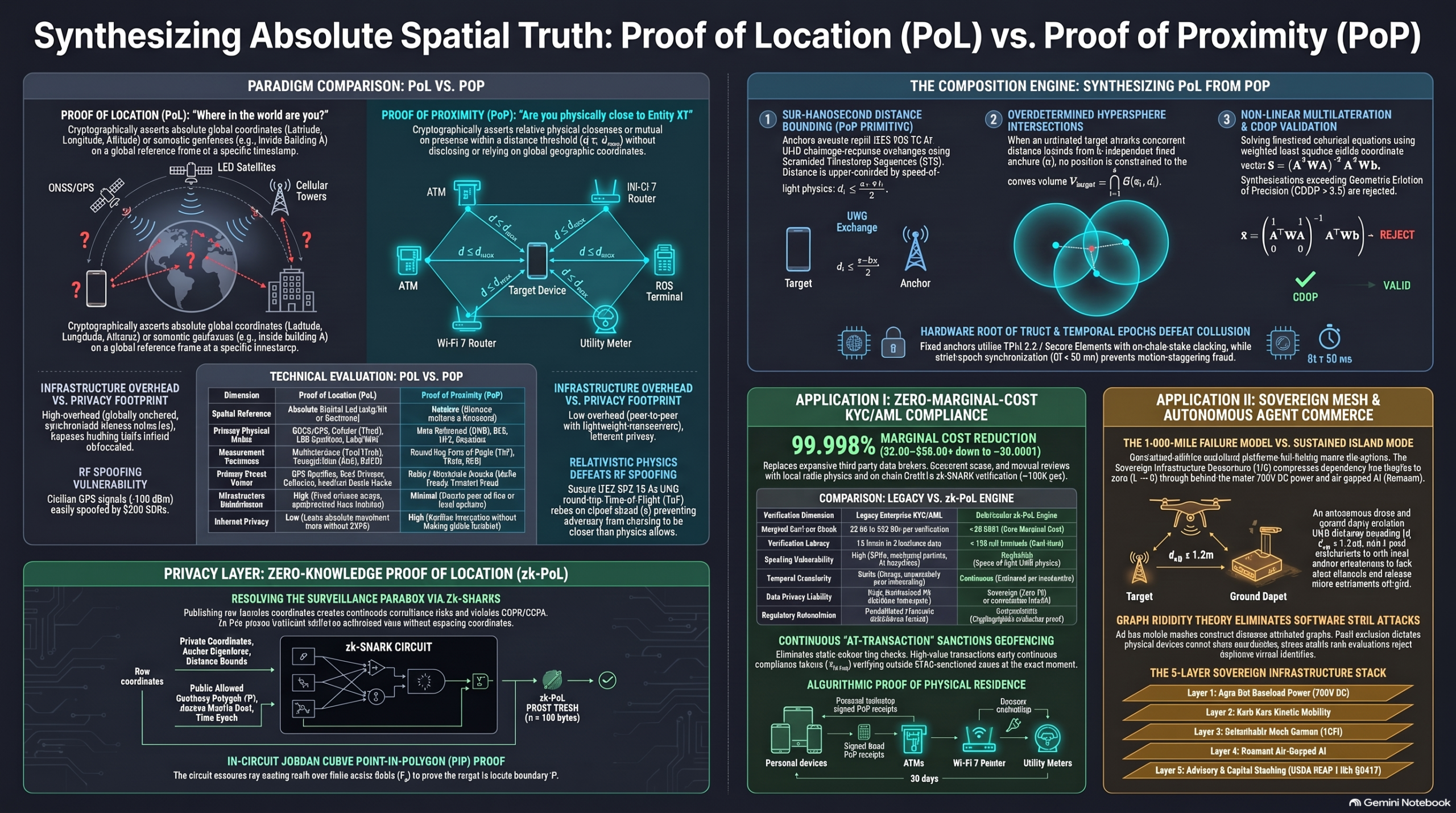
To fix digital spatial trust, systems must invert the positioning paradigm by shifting from target-resolved assertions to anchor-verified physical bounds. While Proof of Location (PoL) asserts an entity’s absolute coordinates within a global reference frame, Proof of Proximity (PoP) strictly verifies relative physical closeness between entities without needing to expose global position.
Proof of Proximity functions as an atomic physical primitive powered by the Speed-of-Light Invariant. By measuring the round-trip time-of-flight (\Delta t) of radio signals, physical distance (d) is firmly bounded by the speed of light (c):
d \le \frac{c \cdot \Delta t}{2}
To prevent physical-layer replay and signal-injection attacks, modern implementations standardize on IEEE 802.15.4z Ultra-Wideband (UWB) radios. UWB embeds Scrambled Timestamp Sequences (STS) directly into physical RF frames, using cryptographically generated pseudo-random pulse sequences that render preamble injection, cycle-slip attacks, and signal relay attempts physically infeasible.
When an untrusted target device executes concurrent, distance-bounded PoP exchanges across a perimeter of fixed, authenticated reference nodes (anchors), these relational distance bounds form intersecting Euclidean spheres. Through non-linear multilateration, the system mathematically synthesizes an absolute, unforgeable Proof of Location, converting local short-range physics into verifiable global spatial truth.
“Proof of Location and Proof of Proximity are not competing mechanisms. Proof of Proximity is the irreducible physical primitive from which all non-forgeable Proofs of Location must be derived.”
This technical shift fundamentally transforms how we verify physical space. Instead of trusting a device’s self-asserted claim (“I am here”), the network directly measures physical space itself (“Physics proves you are within this boundary”).
Disrupting the $35 Utility Bill: Zero-Knowledge Proofs and Near-Zero-Cost Compliance
Legacy identity verification (KYC/AML) relies on an obsolete, document-heavy paradigm. Financial institutions face exorbitant marginal costs ranging from $2.00 to $35.00+ per check, static validity that decays the moment a document is issued, and centralized database honeypots of Personally Identifiable Information (PII) that invite massive data breaches.
Combining composed spatial proofs with Zero-Knowledge Cryptography (zk-PoL / zk-AML) fundamentally disrupts identity compliance economics. By leveraging Incrementally Verifiable Computation (IVC) via Nova folding schemes, a user’s device continuously folds hourly spatial attestations into a running cryptographic accumulator without exploding the device’s computational memory.
Compliance Vector Legacy KYC/AML Checks DeReticular zk-PoL Engine
Marginal Cost $2.00 to $35.00+ per check \approx $0.0001 per check
Verification Latency 12 hours to 5 business days < 150 \text{ milliseconds}
Privacy Footprint PII stored in centralized databases Zero PII or location metadata leaked
Temporal Granularity Static (decays post-check) Continuous (point-of-transaction)
This architecture drops marginal verification costs by 99.99% down to fractions of a cent (\approx $0.0001 in O(1) verification compute). The verifier obtains mathematical certainty that a transaction originates from an authorized jurisdiction or outside an OFAC-sanctioned polygon without ever receiving raw geographic coordinates or personal identities.
“By replacing document-based checks with zero-knowledge Proofs of Location, institutions can eliminate ongoing verification fees, reduce operational latency to milliseconds, and avoid storing sensitive personal data.”
This solves the long-standing “surveillance paradox.” Financial settlement networks and decentralized protocols enforce strict, real-time regulatory compliance without turning civic infrastructure into corporate surveillance tools.
“The Death of the Line” and Noel’s Law: Why Centralized Lifelines Are Destined to Collapse
Modern infrastructure planning suffers from a fatal reliance on centralized, long-distance supply corridors—the 1,000-Mile Failure Model. Systemic vulnerability across extended networks is formally defined by Noel’s Law of Structural Vulnerability:
\mathcal{V}{\text{system}} = \kappa \cdot \prod{i=1}^n \left( \frac{\mathcal{L}i}{\lambda_i} \right)^{\alpha_i} \cdot \exp\left( \sum{j=1}^m \delta_j \right)
This law demonstrates that system vulnerability (\mathcal{V}) scales exponentially as dependency line lengths (\mathcal{L}), cascading network coupling (\alpha), and sovereignty deficits (\delta) increase. Under the Axiom of Spatial Fragility, as linear dependency distance expands toward regional scales (\mathcal{L} \to \infty), the probability of localized survival during macro-disruptions asymptotically drops to zero.
The antidote to linear collapse is Spherical Resilience and Sustained Island Mode. Sustained Island Mode locks operational continuity behind the meter by collapsing physical dependency lengths to zero (\mathcal{L} \to 0) through three integrated, sovereign layers:
- Layer 1 (Baseload Power): On-premise generation via thermochemical biomass pyrolysis and Pawnee rotary engines (Agra Dot Energy) feeding a native 700V DC busbar. This setup achieves 84.8% captive thermodynamic efficiency while completely bypassing multi-year public utility transmission interconnect queues.
- Layer 4 (Cognitive Intelligence): Air-gapped, liquid-immersed AI compute racks (RIOS-CC-1000 running Remnant) executing sub-4ms predictive SCADA microgrid stabilization and transient load balancing.
- Layer 3 (Mesh Communications): Carrier-grade wireless mesh hardware (TriFi) providing 15-mile Non-Line-of-Sight (NLOS) backhaul and sub-16ms RF carrier synchronization.
“As linear dependency distance expands, the probability of localized survival during macro-disruption asymptotically approaches zero. Any critical system that cannot execute its core control loop within its own physical boundary is structurally unviable.”
Traditional engineering’s obsession with “nominal unit efficiency” creates hidden, catastrophic fragility. True operational security requires localized spatial compression—ensuring critical infrastructure runs indefinitely even when external utility networks go dark.
Off-Grid Machine Commerce: How Autonomous Agents Stop Sybil Attacks Using Relativistic Physics
The expansion of autonomous machine-to-machine (A2A) commerce introduces a critical operational challenge: edge agents like delivery drones, robotic rovers, and freight vehicles frequently operate in GPS-denied or RF-contested environments where cloud authentication (OAuth/PKI) fails.
Without central cloud servers or satellite signals, edge networks face severe software Sybil vectors, where a single malicious radio emulates dozens of virtualized agent identities. Autonomous agents neutralize this by building Ad-Hoc Spatial Trust Graphs grounded in Graph Rigidity Theory (Laman rigidity). Because a single physical radio transceiver can occupy only one spatial position in space-time, relational distance metrics automatically reject duplicate software identities exhibiting identical ranging vectors.
To execute commercial transactions off-grid, agents deploy Spatial Hash Time-Locked Contracts (S-HTLCs). Consider an autonomous delivery drone landing at an automated ground depot:
- Physical Ranging: The drone and depot execute a UWB distance-bounding exchange, proving co-presence within d \le 1.2\text{ meters}.
- Physical Handover: Proximity verification triggers the mechanical latch release, dropping the payload into the depot container.
- Off-Grid Micro-Settlement: Upon cargo verification, the depot releases a signed cryptographic payment token over a local peer-to-peer radio channel (such as BLE or Wi-Fi HaLow), clearing the transaction state channel instantly without cloud backhaul.
“Because each physical radio transceiver can occupy only one spatial position at a given time, spatial trust graphs reject duplicate identities that exhibit identical ranging and bearing vectors.”
Grounding machine identity in relativistic physics allows autonomous economies to thrive off-grid. Drones and robotic depots verify physical handovers and clear atomic micro-settlements instantly, completely immune to cloud outages or satellite signal jamming.
The Stealth Infrastructure Shift: Retrofitting Everyday Footprints into Anchor Networks
Deploying a global perimeter of certified spatial anchors does not require building billions of dollars of new physical infrastructure from scratch. Instead, existing commercial hardware footprints transition into certified anchor infrastructure through dual-use firmware updates and low-power hardware additions.
“By deploying dual-use firmware updates across existing enterprise Wi-Fi 7 access points, ATMs, and point-of-sale terminals, institutions convert passive commercial footprints into an active, certified perimeter of spatial trust without capital expenditure.”
Key commercial asset retrofits include four primary footprints:
- Bank ATMs & Branches: High-security commercial enclosures with fixed geodetic positions, reliable uninterrupted power, and fiber uplinks convert into primary reference anchors.
- Retail POS Terminals: Ubiquitous indoor checkout devices issue signed physical proximity attestations during point-of-sale customer interactions.
- Enterprise Wi-Fi 7 Access Points: Enterprise wireless hardware utilizing IEEE 802.11az Fine Timing Measurements provides continuous indoor workspace spatial validation.
- Smart Grid Utility Meters: Fixed residential power and water meters equipped with low-power Sub-GHz and UWB transceivers form dense neighborhood mesh perimeters.
This piggyback deployment strategy transforms static, single-purpose commercial hardware into an active, sovereign web of spatial trust. It amortizes deployment costs across existing commercial operations, dropping initial capital expenditure to near zero.
Conclusion: The Immutable Intersection of Physics, Geometry, and Code
The digital economy can no longer afford to treat physical space as an unverified abstraction reported by untrusted endpoints. The structural shift from target-resolved coordinate assertions to anchor-verified spatial bounds fundamentally re-engineers how trust is established across digital and physical systems.
By bridging short-range radio physics (UWB speed-of-light timing) with zero-knowledge cryptography, spatial verification transforms from an expensive, easily spoofed operational vulnerability into an algorithmic certainty. It resolves the long-standing conflict between regulatory compliance and individual privacy, while giving autonomous machines the tools to transact off-grid.
As centralized power grids face strain and public cloud networks encounter cyber volatility, how will your organization adapt to an era where self-reported digital location can no longer be trusted?


