The $3.3 Billion Internet Failure and the Startups Resilience-Proofing America
1. The Fragility of Our Connected World
We are living through a profound technological paradox. Modern life is more digitally connected than at any point in human history, yet the infrastructure supporting that connection is alarmingly fragile, centralized, and linear. Our critical systems—energy, data, and governance—rely on fragile, high-latency chains that snap the moment a crisis hits. We have built a world where a single server error in a Virginia data center can effectively “darken” a town in Idaho.
The vanguard of technology strategy is no longer looking toward the central cloud for salvation; instead, it is building “Islands.” This shift toward “Spherical Resilience” represents a move from global dependency to local survivability. By deploying a “Sovereign Stack,” communities are beginning to forged localized hubs that are autonomous, self-sustaining, and self-funding.
2. The $3.3 Billion Default: Why Rural America is Stranded
The current model for bridging the “Fiber Gap” has reached a terminal breaking point. In the economics of traditional telecommunications, laying physical fiber-optic cable costs approximately $50,000 per route mile—an investment that is fundamentally unsustainable for traditional ISPs in regions with fewer than eight homes per mile. To fix this, the FCC launched the Rural Digital Opportunity Fund (RDOF), but its “lowest-bid” reverse-auction model incentivized speculative failure over actual infrastructure.
The data reveals a systemic collapse:
- Massive Financial Failure: Out of the $9.2 billion awarded, approximately $3.3 billion has defaulted—a catastrophic failure rate exceeding 30%.
- The “Double Whammy” Effect: Any location tentatively awarded RDOF funds was marked as “served,” freezing them out of the subsequent $42.45 billion BEAD program.
- Stranded Locations: As of early 2026, approximately 1.9 million locations have been left stranded without their promised build-out.
- The Lumen Villainy: The fragility of the old guard was perfectly illustrated when Lumen Technologies (CenturyLink) surrendered 41,000 locations in mid-June 2025, just days after the federal June 6 deadline, effectively trapping those communities in a funding vacuum.
- State-Level Decimation: California saw a 94% default rate, stranding 340,000 locations, while New Jersey faced a total 100% default rate.
3. “Island Mode”: Your Town as a Sovereign Fortress
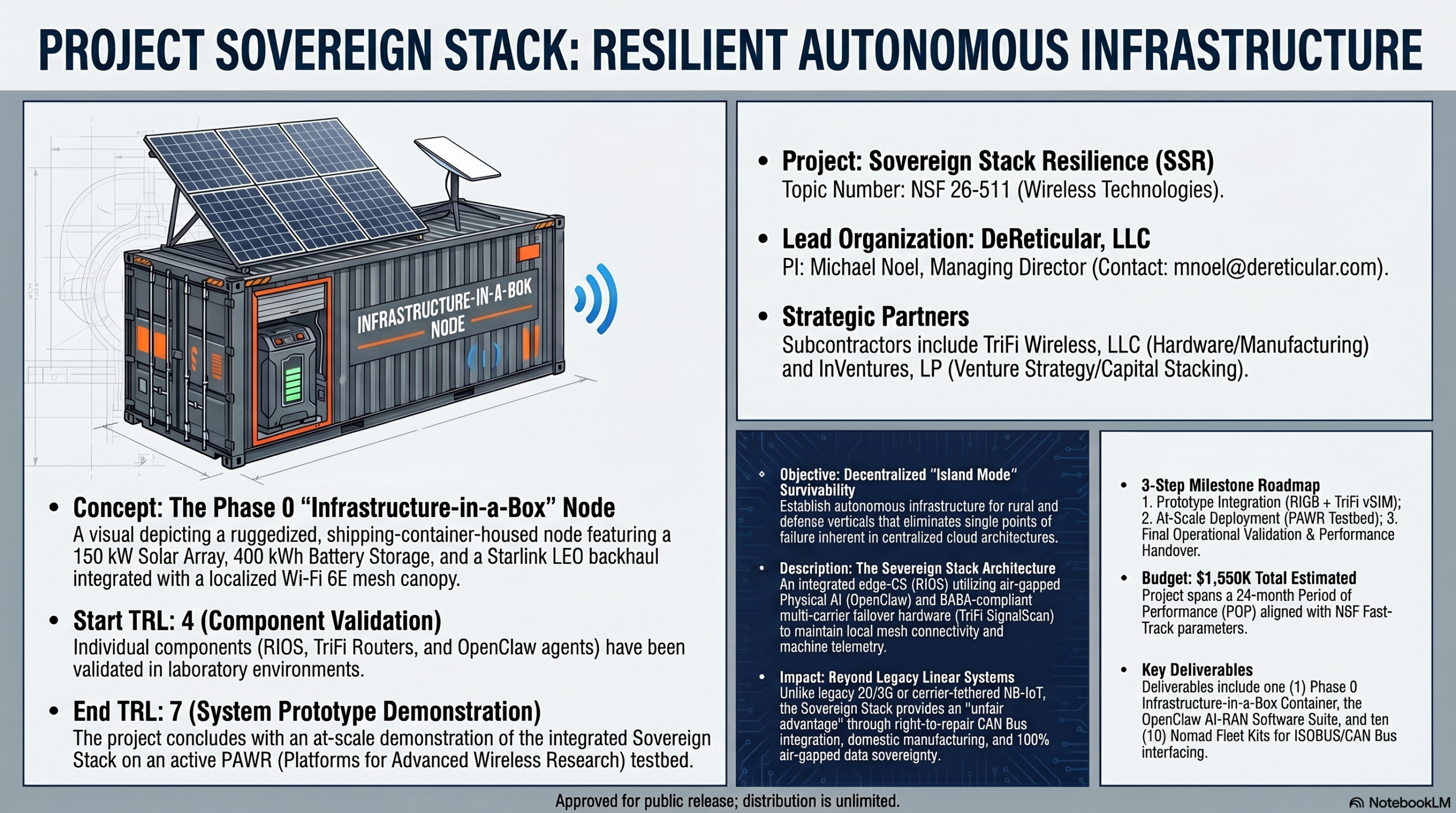
In response to the “Lumen-style” collapse of centralized providers, a new blueprint has emerged: the DeReticular RIOS (Rural Infrastructure Operating System) Campus. This is more than a utility; it is “Infrastructure-in-a-Box,” designed to convert a vulnerable town into a sovereign digital fortress.
These nodes operate in “Phase 0 Deployment,” utilizing ruggedized hardware that replaces external dependency with internal resilience:
- Energy Autonomy: Each containerized node is powered by a 150 kW Solar Array and a 400 kWh Battery Energy Storage System (BESS).
- Resilient Backhaul: Integrated Starlink Business Kits provide LEO satellite connectivity, ensuring the hub remains online even if terrestrial fiber is severed.
- The City Infrastructure Nexus (SKU: SOV-BNDL-CITY): Priced at $129,999, this package enables communities of 1,000 to 3,000 residents to manage healthcare, water management, and local governance entirely in “Island Mode.”
This is the liquidation of the physical grid as a single point of failure. These sovereign islands aren’t just providing internet; they are providing the foundation for the next generation of spatial awareness and security.
4. Your Wi-Fi is Secretly a Radar System (CSI Spatial Sensing)
The most sophisticated shift in the Sovereign Stack is the “liquidation of the physical wall.” We are entering an era where standard Wi-Fi and LTE signals are being repurposed into a high-precision radar system through Channel State Information (CSI) sensing.
By analyzing how radio frequency (RF) signals distort as they bounce off physical objects, a RIOS node can “see” without cameras or LiDAR. This is achieved through the extraction of the CSI Matrix:
- The Math of Sensing: For every subcarrier i, the system measures H_i = |H_i| \cdot e^{j \cdot \theta_i}, where Amplitude (|H_i|) tracks signal attenuation and Phase (\theta_i) tracks the wave delay caused by path changes.
- Spatial Awareness: This allows the “Island” to track movement, detect falls, and monitor respiration by analyzing the distortion “noise” in the RF environment.
- The 6G Frontier: This aligns with the IMT-2030 vision and current 6G-PATH and 6G-VERSUS initiatives, where communication and sensing become a single, unified layer.
5. Right-to-Repair Meets Agentic AI: The Sovereign Harvest
The Sovereign Stack is finding its most critical application in food security through the “Sovereign Harvest” bundle. Large-scale agriculture has long been a hostage to proprietary manufacturer software locks, but the DeReticular-TriFi alliance is breaking those chains.
The breakthrough is the “Tractor-as-a-Relay” architecture:
- Nomad Fleet Kits: These ruggedized modules interface directly with the CAN Bus and ISOBUS ports of heavy machinery.
- Caching & Relay: If a tractor enters a geographical dead zone, the kit caches sensor telemetry and automatically relays it to the RIOS Campus once it returns to range.
- Agentic AI: The system deploys air-gapped AI agents like the Industrial Foreman (for autonomous operations) and the Field Medic (for localized diagnostics), allowing farmers to bypass remote manufacturer kill-switches.
6. The Death of 2G/3G and the Rise of the “vSIM”
The global sunset of 2G and 3G networks was a security necessity. Legacy 2G suffered from “unidirectional authentication,” allowing attackers to use “Stingrays” to spoof networks. However, the transition to newer standards often creates a “Carrier-Tethered Trap.”
While efficient, NB-IoT is structurally tied to centralized carrier clouds, making it a liability for true resilience. The Sovereign Stack instead leverages LTE-M, which is highly compatible with private, software-defined networks like srsRAN and Open5GS.
- TriFi SignalScan™: A proprietary algorithm that performs a sub-minute failover to the strongest available network.
- vSIM Technology: Multi-carrier hardware that allows a single device to bridge between AT&T, T-Mobile, and US Cellular interchangeably.
- Domestic Security: All TriFi hardware is manufactured in a 250,000 sq. ft. facility in Oklahoma, ensuring BABA (Build America, Buy America) compliance and securing a SPIN (Service Provider Identification Number) to capture municipal contracts.
7. “Capital Stacking”: Funding a Revolution
Traditional venture capital often flees from “hard tech” due to high capital requirements. The InVentures model, led by General Partners Melissa Chalfant (defense-tech/semiconductors), Gerardo Garza (materials science), and Dr. Hojung Joseph Yoon (health informatics), solves this through “Non-Dilutive Capital Stacking.”
InVentures acts as a “fractional co-founder,” pairing private equity with massive 2026 federal grants:
- NSF VINES ($100M): Focused on “Verticals-enabling Intelligent NEtwork Systems” for smart grids and precision agriculture.
- NTIA AI-RAN ($50M): A newly pivoted fund for software-defined, AI-native radio networks.
- NSF Strategic Breakthrough Pilot ($30M): A critical pilot that requires a 1:1 match. InVentures provides the private equity match to “unlock” these federal millions.
8. Conclusion: The Future is Decentralized
The alliance between TriFi’s hardware, DeReticular’s RIOS operating system, and InVentures’ capital orchestration is the definitive blueprint for the next generation of industrial infrastructure. We are witnessing a shift where the “centralized cloud” is no longer a safety net, but a liability.
The future belongs to the “Islands”—resilient, sovereign nodes that can power themselves, defend their own data with air-gapped AI, and sense their environment without external oversight. As we face increasing infrastructure instability, the choice is clear: will you trust a distant cloud miles away, or a sovereign island you control when the grid goes silent?


