
Operational Integration Specification: DeReticular Sovereign Ecosystem Deployment for Municipal Resiliency
- System Scope and Architectural Framework
Context and Strategic Importance
Catastrophic failures of regional utility grids—whether induced by severe space weather, kinetic attacks, cyber warfare, or extreme meteorological events—inevitably collapse centralized municipal lifelines. Legacy urban and suburban infrastructures exhibit extreme fragility due to tight coupling with long-distance high-voltage Alternating Current (AC) transmission lines and cloud-hosted digital control networks. The primary operational mandate during wide-area infrastructure collapse is the rapid, deterministic execution of municipal “Island Mode” transition. To prevent systemic societal breakdown, a multi-tiered sovereign ecosystem must replace centralized single-point-of-failure power, telecommunications, transit, and computing backbones. By deploying a localized, air-gapped, and physically self-sustaining architecture, municipal operations, critical care facilities, emergency services, and local supply chains maintain uninterrupted operational continuity regardless of regional or national grid collapse.
Ecosystem Architecture Mapping
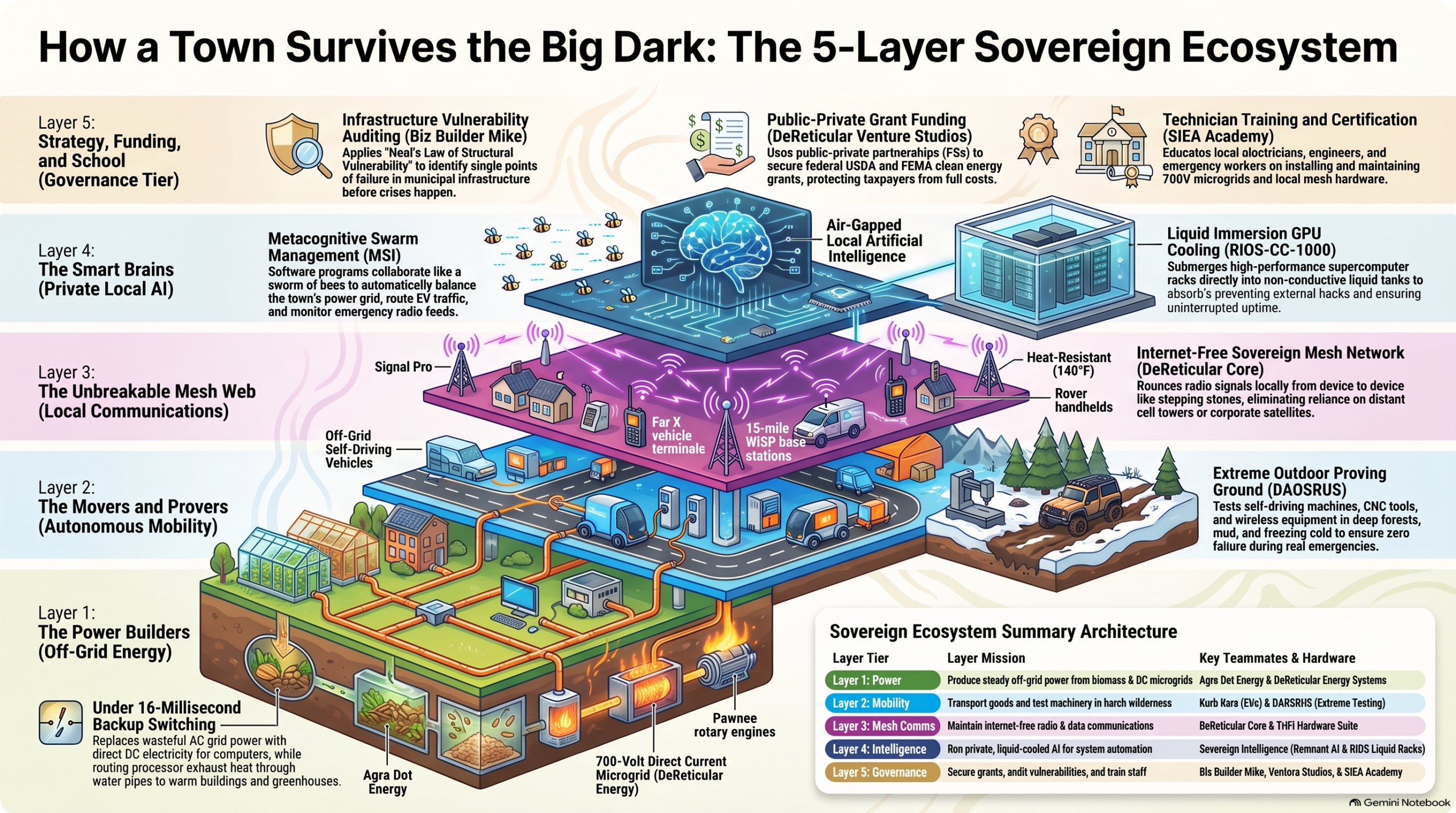
The DeReticular framework integrates five discrete operational layers into a unified sovereign deployment specification.
Layer Number & Domain Core Operational Mission Primary Entities & Hardware Components Resiliency Mechanism
Layer 1: Power Dispatchable continuous local baseline generation and high-voltage DC microgrid distribution Agra Dot Energy, DeReticular Energy Systems, Pawnee Rotary Engines, 700V DC Bus, Sub-16ms Magic Switch Dual-stage biomass thermochemical conversion (pyrolysis/gasification) for 24/7/365 firm power; sub-16ms auto-transfer; integrated hydronic waste-heat capture
Layer 2: Mobility Off-grid autonomous logistics, mobile power dispatch, and field hardware validation Kurb Kars Autonomous Utility Fleet, Mobile Battery Pods, Digital Adventures Outdoors R US (DAOSRUS) Direct 700V DC microgrid fast-charging (cloud/internet independent); extreme-environment physical stress testing across rugged terrains
Layer 3: Mesh Comms Peer-to-peer decentralized field telecommunications and RF spatial coverage DeReticular Core, TriFi Hardware Suite (Signal Pro 8355, WISP-in-a-Box Lite, Far X X1271, Rover SLG-06) Multi-hop stepping-stone radio packet routing; complete physical isolation from centralized cellular towers, fiber backbones, and satellite backhauls
Layer 4: Intelligence Air-gapped edge computing, liquid immersion thermal management, and autonomous swarm control Sovereign Intelligence, Remnant AI Processors, RIOS-CC-1000 Immersion Racks, Metacognitive Swarm Intelligence (MSI) Complete logical and physical air-gapping; non-conductive dielectric liquid immersion cooling; autonomous multi-agent dynamic resource balancing
Layer 5: Governance Vulnerability auditing, strategic capital deployment, and accredited technical workforce development Biz Builder Mike, DeReticular Venture Studios, SIEA / SIEA Academy / DeReticular Academy Noel’s Law single-point-of-failure audit methodology; Public-Private Partnerships (P3) utilizing federal grant programs; non-profit workforce certification
Systemic Risk Mitigation Analysis
Transitioning municipal infrastructure from fragile, remote supply dependencies to an integrated 5-layer sovereign framework systematically mitigates catastrophic cascade failures. Legacy utilities depend on uninterrupted external inputs: grid-tied transformers require upstream sub-station synchronization, digital SCADA systems require continuous internet backhaul, and municipal transit fleets rely on central fuel distribution networks. Under the 5-layer DeReticular framework, these vulnerabilities are eliminated. Local thermochemical generation generates continuous baseline power without external supply chains, while an air-gapped high-voltage DC bus powers critical loads directly. Inter-layer dependencies are engineered to be mutually reinforcing: Layer 1 powers Layer 2 mobility and Layer 4 compute; Layer 4 algorithms optimize Layer 1 power allocation and Layer 3 RF spectrum management; Layer 3 provides the communication substrate across all field assets; and Layer 5 secures the legal, financial, and human capital required to sustain the physical hardware over multi-decade operational lifecycles.
+—————————————————————————————————+
| DERETICULAR CROSS-LAYER CONTROLS |
+—————————————————————————————————+
| |
| +—————————+ Hydronic Heat Loop +———————————+ |
| | Layer 4: Compute Racks | =============================> | Layer 1: Municipal Microgrid | |
| | (RIOS-CC-1000 Dielectric) | | (District Heat & Greenhouses) | |
| +—————————+ +———————————+ |
| || || |
| MSI Agent Telemetry 700V DC Direct Bus Power |
| || || |
| v v |
| +—————————+ Dynamic RF Topology +———————————+ |
| | Layer 3: Sovereign Mesh | <—————————-> | Layer 2: Mobility Fleets | |
| | (TriFi Hardware Suite) | (Vehicle-Mounted Far X) | (Kurb Kars & Battery Pods) | |
| +—————————+ +———————————+ |
| |
+—————————————————————————————————+
Section Transition
Establishing this integrated 5-layer framework requires establishing baseline power generation and direct-current distribution, which form the physical foundation of Layer 1.
- Layer 1: High-Voltage DC Generation, Rapid Switchover, and Power Distribution
Context and Strategic Importance
Uninterrupted local power generation and direct-current distribution form the absolute physical prerequisite for municipal survival. Downstream emergency lifelines—including hospital life-support systems, water treatment pumps, autonomous transit charging, edge compute nodes, and emergency communications—cannot function during wide-area regional grid collapse without localized firm energy production. Layer 1 establishes an autonomous high-voltage microgrid engineered to bypass regional utility single-points-of-failure entirely.
Continuous Local Biomass Generation Specifications
Municipal energy independence is severely bottlenecked by multi-year regional utility interconnection queues and the high variability of weather-dependent renewables. To establish immediate, non-intermittent firm dispatchable capacity, Layer 1 deploys the thermochemical power generation system developed by Agra Dot Energy:
+—————————————————————————————————+
| AGRA DOT ENERGY THERMOCHEMICAL POWER LOOP |
+—————————————————————————————————+
| |
| +———————–+ Pyrolysis & Gasification +———————————-+ |
| | Organic Biomass Feed | —————————–> | Clean Fuel Synthesis | |
| | (Wood Chips / Scrap) | (Thermochemical Conversion) | (Zero Combustion Smoke) | |
| +———————–+ +———————————-+ |
| | |
| v |
| +———————–+ 24/7/365 Continuous +———————————-+ |
| | 700V DC Microgrid Bus | <—————————– | Pawnee Rotary Engines | |
| | (Bypasses Utility Queue) | (Firm Dispatchable Electricity) | |
| +———————–+ +———————————-+ |
| |
+—————————————————————————————————+
- Feedstock Aggregation & Conditioning: Local agricultural scrap, forestry waste, and municipal wood chip residues are gathered and processed to uniform moisture parameters.
- Thermochemical Conversion (Pyrolysis & Gasification): Raw biomass is processed inside sealed, high-temperature reaction chambers. By applying precise thermal profiles in an oxygen-deprived environment, organic matter breaks down thermochemically without combustion, preventing the creation of smoke and particulate fly-ash while generating a clean syngas fuel stream.
- Firm Energy Generation: The synthesized gaseous fuel directly drives heavy-duty Pawnee rotary engines. Unlike intermittent solar PV or wind assets, these internal combustion rotary units produce continuous, 24/7/365 baseline electricity regardless of ambient solar irradiance, cloud cover, or extreme winter weather conditions.
- Bypassing Interconnection Bottlenecks: By deploying local thermochemical generation directly behind the municipal boundary, communities bypass multi-year regional utility interconnection queues, establishing immediate energy sovereignty.
700V DC Architecture and Rapid Switchover Engineering
DeReticular Energy Systems constructs the internal power distribution topology around a high-efficiency 700-Volt Direct Current (700V DC) architecture:
- 700V DC Infrastructure Efficiency: Conventional municipal distributions utilize Alternating Current (AC), requiring multiple power factor corrections and step-down transformations before powering native DC infrastructure such as EV battery banks, variable frequency drives, and compute server power supply units (PSUs). By distributing high-voltage DC directly across the municipal footprint, DeReticular Energy Systems eliminates step-down heat losses and inverter inefficiencies, reducing energy conversion losses by up to 20% when supplying high-density compute loads.
- Sub-16ms “Magic Switch” Switchgear: To maintain absolute continuity during external grid collapse or localized power source shifting, the system incorporates the solid-state DeReticular “Magic Switch” auto-transfer mechanism.
[ Primary Grid Supply ] | v
[ Agra Dot Biomass Genset ] —> | Sub-16ms Magic Switch | —> [ 700V DC Microgrid Bus ]
^ |
| v
[ Fault Detection Logic ] [ Zero-Reset Compute Loads ]
- Operational Mechanism: The Magic Switch continuously samples voltage phase, amplitude, and line frequency. Upon sensing a voltage drop or waveform instability on the primary input, solid-state logic commutates power sourcing to the internal Pawnee rotary generation bus in under 16 milliseconds. Because 16ms is well within the hold-up time of standard industrial power supplies, this rapid switchover prevents compute processor reboots, GPU state dropouts, equipment flickering, and memory corruption across critical emergency infrastructure.
Thermal Waste Recovery Capture System
High-density GPU computing infrastructure and Pawnee engine blocks emit substantial high-grade thermal energy. Layer 1 integrates a closed-loop hydronic reclamation network:
- Direct Liquid Reclaiming Loop: Liquid dielectric fluid from Layer 4 compute racks and thermal jackets on Layer 1 engine blocks transfer waste heat into secondary hydronic heat exchangers.
- Thermal Distribution Infrastructure: Insulated warm-water piping distributes recovered thermal fluid throughout municipal district heating circuits.
- Auxiliary Municipal Applications: Recovered heat energy provides space heating for emergency administrative facilities, municipal buildings, and cold-climate agricultural infrastructure (greenhouses), optimizing overall plant thermal efficiency above 85%.
Section Transition
With baseline 700V DC electrical energy and hydronic heat stabilized, Layer 1 supplies continuous power to charge and operationalize the Layer 2 autonomous mobility fleet.
- Layer 2: Autonomous Off-Grid Mobility and Extreme-Environment Testing
Context and Strategic Importance
Wide-area infrastructure collapse renders conventional transportation unviable due to closed commercial fuel stations, loss of central EV charging networks, disrupted traffic management systems, and loss of commercial cellular connectivity. Maintaining municipal resilience requires autonomous utility transport fleets capable of navigating degraded physical environments and operating without external internet connectivity.
Kurb Kars Autonomous Utility Fleet Deployment
The Kurb Kars fleet provides autonomous physical transport logistics built specifically for off-grid municipal crisis response:
+—————————————————————————————————+
| KURB KARS OFF-GRID MOBILITY INTERFACES |
+—————————————————————————————————+
| |
| +—————————+ Direct 700V DC Fast-Charge +——————————–+ |
| | Layer 1 Microgrid Bus | =============================> | Kurb Kars Battery Pods & EVs | |
| | (Internet-Independent) | | (Autonomous Transport Fleet) | |
| +—————————+ +——————————–+ |
| || |
| Extends RF Mesh Coverage |
| || |
| v |
| +—————————+ Tactical Mission Profiles +——————————–+ |
| | Layer 3 Sovereign Mesh | <=============================> | Ambulatory / Medical Delivery | |
| | (Far X Mobile Node Expansion) | Mobile Battery Dispatch Units | |
| +—————————+ +——————————–+ |
| |
+—————————————————————————————————+
- Direct-to-Microgrid Interface: Kurb Kars utility vehicles and mobile battery pods interface directly with Layer 1 700V DC fast-charging terminals. Recharging operations utilize local physical handshake protocols, executing without external internet authentication, cloud billing connections, or commercial grid power dependencies.
- Tactical Mission Profiles:
- Off-Grid Patient Transport: Ambulatory units execute autonomous, sensor-guided patient extraction and transfer between field aid stations and regional hospitals.
- Medical & Essential Supply Distribution: Autonomous cargo configurations deliver pharmaceutical, surgical, water purification, and ration payloads along pre-mapped physical corridors.
- Mobile Energy Dispatch: Modular Kurb Kars mobile battery pods transport multi-kilowatt-hour stored electrical capacity to detached critical assets (such as isolated water pumping stations or field command centers) to restore offline equipment.
- Dynamic Mesh Topology Expansion: Each Kurb Kars vehicle is equipped with a roof-mounted TriFi Far X (X1271) terminal. As vehicles move through the deployment zone, they act as dynamic, mobile mesh repeaters, expanding the Layer 3 telecommunications bubble into un-serviced or physically degraded sectors.
DAOSRUS Proving Ground Protocols
To ensure zero structural or operational failure during extreme disaster events, all physical mobility assets, automated tools, and wireless field nodes undergo environmental stress validation managed by Digital Adventures Outdoors R US (DAOSRUS):
- Environmental Validation Regimes: Hardware assets are subjected to stress-testing regimes across harsh physical environments, including dense forest canopy, deep mud, sub-zero cold, and high-angle rocky terrain.
- Validation Standards: Autonomous vehicles, automated computer numerical control (CNC) field fabrication tools, and ruggedized wireless nodes must demonstrate uninterrupted mechanical operation, physical IP67/IP68 ingress protection, thermal resistance, and loss-of-signal auto-recovery prior to deployment.
Section Transition
With physical transit and hardware durability validated through Layer 2 protocols, field operations depend on Layer 3 for field communications and data backhaul.
- Layer 3: Sovereign Mesh Telecommunications and TriFi Hardware Suite
Context and Strategic Importance
Centralized cellular networks, undersea fiber backbones, and commercial satellite constellations represent single points of failure that regularly collapse during major disasters. Layer 3 deploys a local, internet-independent “Sovereign Mesh” network that maintains communications across municipal boundaries through decentralized peer-to-peer radio architecture.
DeReticular Core Mesh Topology
DeReticular Core provides internet-independent spatial data routing across the operational footprint:
- Peer-to-Peer Stepping-Stone Routing: The network utilizes dynamic ad-hoc routing algorithms. Every deployed node acts as an autonomous repeater, receiving, validating, and relaying encrypted data packets to adjacent nodes without passing through a central switch or cellular base station.
- Data Transport Inter-Layer Interface: Layer 3 acts as the operational nervous system for the entire deployment. It ingests real-time telemetry from Layer 1 microgrids and Layer 2 vehicles, passes this data to Layer 4 Remnant AI processing nodes, and delivers Layer 4 control commands back to field actuators.
[ Layer 1 Microgrid / Layer 2 Fleet ]
| (Telemetry Data)
v
[ TriFi Mobile / Fixed Mesh Nodes ] <—> [ TriFi Backbone Nodes ]
^ |
| (Swarm Control Packets) v
[ Layer 4 Remnant AI / MSI Engine ]
TriFi Hardware Suite Specifications
The TriFi product suite delivers targeted radio-frequency (RF) coverage tailored to diverse municipal facility profiles and environmental constraints.
Product Name Form Factor / Deployment Technical Range / Environment Primary Resiliency Role
TriFi Signal Pro 8355 Weatherproof metal enclosure mounted to elevated anchor facilities (schools, hospitals, water towers) Multi-gigabit local throughput; multi-mile directional range between primary infrastructure nodes Establishes fixed high-bandwidth radio backbone links connecting critical municipal command facilities
TriFi WISP-in-a-Box Lite Weatherproof commercial base station enclosure Up to 15-mile non-line-of-sight (NLOS) signal bubble through dense foliage, forestry, and terrain obstacles Penetrates natural topographies to connect remote rural perimeters and outlying municipal boundaries
TriFi Far X (X1271) Dual-antenna low-profile terminal mounted to utility vehicle and ambulance roof surfaces Fleet-wide dynamic coverage bubble (360-degree local mobile Wi-Fi coverage surrounding moving vehicle) Transforms Layer 2 Kurb Kars transit fleets into mobile mesh communication nodes
TriFi Rover (SLG-06) Handheld, drop-resistant, rubberized pocket hotspot with thermally isolated internal power cell Ruggedized field operation in extreme ambient thermal environments up to 140°F (60°C) Provides portable, high-durability wireless network access for emergency field teams in severe thermal zones
Section Transition
The real-time data transport layer provided by Layer 3 feeds sensor telemetry directly into Layer 4 edge compute nodes for processing and swarm orchestration.
- Layer 4: Air-Gapped Intelligence, Liquid Immersion Cooling, and Swarm Orchestration
Context and Strategic Importance
Real-time crisis management requires automated decision-making and continuous telemetry processing. Reliance on public cloud-hosted AI infrastructure exposes municipalities to cloud service outages, severed fiber links, latency delays, and external cyber vulnerabilities. Layer 4 delivers air-gapped artificial intelligence hardware and autonomous control systems operating inside local municipal facilities.
Air-Gapped Remnant AI Architecture
The Sovereign Intelligence product line relies on “Remnant AI” processing nodes:
- Absolute Air-Gapping Isolation: Remnant AI processing clusters are physically and logically isolated from public internet backbones. Processing nodes operate strictly within the bounds of the local Layer 3 Sovereign Mesh network.
- Cyber Immunity and Continuity: Complete physical air-gapping guarantees protection against external cyber-attacks, remote code execution vulnerabilities, and remote service disablement, maintaining operation during external network failures.
+—————————————————————————————————+
| LAYER 4 LIQUID COMPUTE & CONTROL LOOPS |
+—————————————————————————————————+
| |
| +—————————+ Dielectric Heat Capture +——————————–+ |
| | RIOS-CC-1000 GPU Racks | =============================> | Layer 1 District Heat Loop | |
| | (Dielectric Submersion) | | (Greenhouses & Buildings) | |
| +—————————+ +——————————–+ |
| || |
| Local Telemetry Ingest |
| || |
| v |
| +—————————+ Mesh Network Control +——————————–+ |
| | Remnant AI Engine | <============================> | Layer 3 TriFi Mesh Backbone | |
| | (Air-Gapped Processing) | | (MSI Swarm Signaling) | |
| +—————————+ +——————————–+ |
| || |
| Command Execution |
| || |
| +—————————-+—————————–+ |
| | | |
| v v |
| +—————————+ +—————————+ |
| | Layer 1 Microgrid Switch | | Layer 2 Autonomous Fleet | |
| | (Dynamic Power Balance) | | (Logistics Optimization) | |
| +—————————+ +—————————+ |
| |
+—————————————————————————————————+
RIOS-CC-1000 Liquid Immersion-Cooled Racks
High-density GPU clusters require advanced thermal management that air cooling cannot provide during ambient heat waves or constrained emergency conditions. Layer 4 utilizes RIOS-CC-1000 liquid immersion compute racks:
- Dielectric Immersion Mechanics: Processing units and GPU accelerators are submerged inside sealed tanks filled with a specialized non-conductive dielectric fluid. Heat generated by silicon components transfers directly into the liquid phase, eliminating thermal throttling and localized hot-spots.
- Operational Advantages: Direct liquid immersion eliminates parasitic energy consumption from high-CFM cooling fans, reduces acoustic operational noise to negligible levels, and protects sensitive electronics from dust, moisture, and ambient atmospheric contamination.
- Thermal Integration with Layer 1: Heat absorbed by the dielectric fluid is continuously pumped through liquid-to-water heat exchangers, routing high-grade thermal waste directly into the Layer 1 district hydronic heating and agricultural loops.
Metacognitive Swarm Intelligence (MSI) Autonomous Operations
System-wide dynamic control is executed by Metacognitive Swarm Intelligence (MSI) software agent clusters:
- Autonomous Microgrid Load Balancing: MSI software agents monitor real-time bus voltage and load generation across Layer 1. The swarm automatically executes dynamic load shedding, throttles non-essential infrastructure, and regulates Pawnee engine outputs to preserve system stability during peak load surges.
- Dynamic Logistics Routing: MSI agents continuously process terrain data, obstacle reports, and emergency requests across the Layer 3 mesh to dynamically route Layer 2 Kurb Kars autonomous fleets around physical hazards.
- RF Spectrum Orchestration: MSI agents monitor signal-to-noise ratios across the Layer 3 TriFi network, dynamically reallocating RF channels and adjusting node power outputs to maintain clear, interference-free communications for priority emergency services.
Section Transition
Automated computational and intelligence systems operate within the organizational structures, financial pathways, and technical qualifications established by Layer 5.
- Layer 5: Structural Governance, Strategic Finance, and Workforce Training
Context and Strategic Importance
Deploying microgrid assets, autonomous fleets, mesh networks, and liquid compute racks requires robust governance, funding structures, and workforce development. Layer 5 provides the organizational planning, capital deployment pathways, and technical education required to design, deploy, and maintain sovereign municipal infrastructure throughout its operational lifecycle.
Vulnerability Auditing and Noel’s Law
Municipal resilience planning begins with comprehensive structural audits led by Biz Builder Mike, utilizing Noel’s Law of Structural Vulnerability:
+—————————————————————————————————+
| NOEL’S LAW STRUCTURAL VULNERABILITY AUDIT PROCESS |
+—————————————————————————————————+
| |
| [ Phase 1: Dependency Mapping ] —> Identify Single Points of Failure (SPOFs) |
| (e.g., Water Treatment Plant on 1 AC Transformer) |
| |
| [ Phase 2: Vulnerability Analysis ] -> Evaluate Cascading Structural Interdependencies |
| (Power Loss -> Telecommunications Loss -> Supply Freeze) |
| |
| [ Phase 3: Architecture Design ] –> Engineer Segmented 700V DC Microgrid Isolation Loops |
| (Bypasses Utility SPOFs via Layer 1-4 Systems) |
| |
+—————————————————————————————————+
- Noel’s Law Premise: A system’s operational vulnerability is defined by its most critical un-redundant external dependency. If a primary lifeline (such as municipal water processing) depends on an un-redundant component (such as a single utility transformer or cloud server connection), the entire system inherits zero-day fragility.
- Audit Methodology: Biz Builder Mike advisors conduct systematic physical and digital evaluations of municipal utilities. The team traces cross-system dependencies to locate hidden single points of failure.
- Mitigation Planning: Advisors work with local leaders, city councils, and emergency planners to redesign vulnerable dependencies into segmented, self-healing local microgrid loops prior to emergency events.
DeReticular Venture Studios Financial Framework
Deploying advanced microgrids and sovereign technologies requires creative funding models that minimize capital costs for local municipalities. DeReticular Venture Studios manages financial execution through structured capital strategies:
- Public-Private Partnerships (P3): Venture Studios structures deployment projects as Public-Private Partnerships, aligning private infrastructure investment with municipal utility requirements.
- Non-Dilutive Federal Grant Pathways: Capital acquisition models leverage federal program funding to insulate local taxpayers from upfront capital expenditure:
- USDA Clean Energy Programs: Securing rural clean energy loans and grants for Agra Dot Energy thermochemical processing plants.
- FEMA Disaster Resilience Grants: Utilizing Building Resilient Infrastructure and Communities (BRIC) funding to subsidize 700V DC distribution, TriFi mesh networks, and RIOS-CC-1000 compute infrastructure.
SIEA Academy Technical Certification Program
Long-term physical operational capability depends on qualified local personnel. The educational framework is governed by SIEA (Sovereign Infrastructure Educational Association), an overarching non-profit association that operates both the SIEA Academy and DeReticular Academy:
- Target Personnel: Municipal engineers, industrial electricians, system administrators, and emergency response personnel.
- Core Technical Curriculum:
- 700V DC Microgrid Systems: High-voltage direct-current safety protocols, Pawnee rotary engine maintenance, thermochemical gasification management, and sub-16ms Magic Switch testing.
- Liquid Compute & Thermal Plumbing: Maintenance of RIOS-CC-1000 dielectric immersion tanks, dielectric fluid dynamics, and hydronic waste-heat reclamation loops.
- Mesh Network RF Engineering: Spatial node placement, antenna elevation configuration on institutional anchor sites, and TriFi hardware suite troubleshooting.
Section Transition
By integrating 700V DC power generation, off-grid mobility, mesh telecommunications, air-gapped AI, and non-profit governance pathways, the 5-layer DeReticular framework provides a complete, self-sustaining operational blueprint for permanent municipal survival.


