
DeReticular Project Brief Sovereign Infrastructure and Confidential Compute
Executive Summary
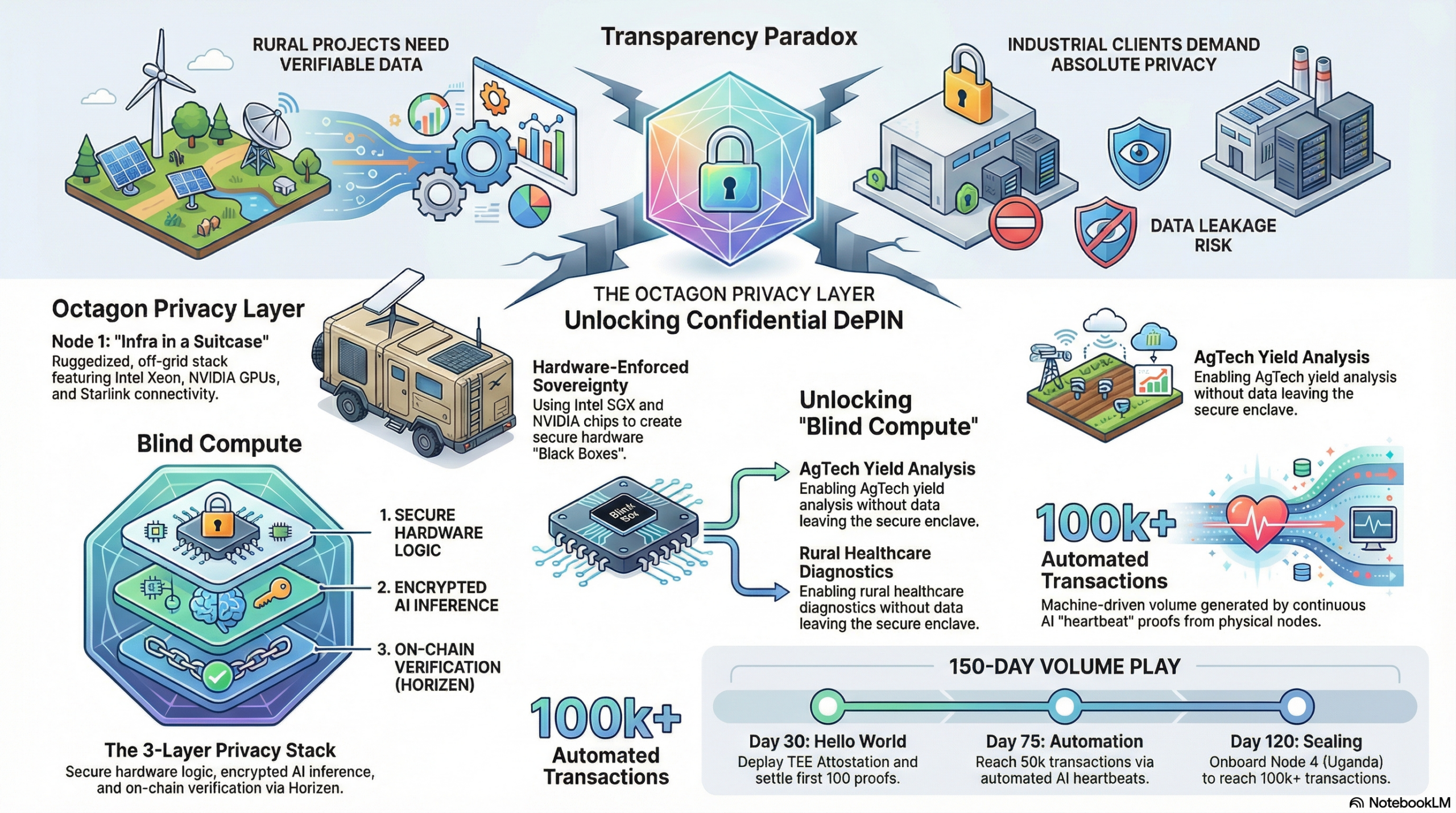
DeReticular is developing the Rural Infrastructure Operating System (RIOS), a network of autonomous, self-reliant “Sovereign Nodes” designed to provide off-grid power, connectivity, and industrial-grade compute. The project’s core mission is to solve “The Transparency Paradox,” a fundamental conflict where rural infrastructure projects require verifiable proof of operations to access DeFi liquidity but must simultaneously guarantee absolute privacy and sovereignty for their industrial clients.
The proposed solution is “The Octagon Privacy Layer,” a technological stack that enables “Blind Compute” by migrating sovereign rural infrastructure to a Confidential Edge Compute model. This is achieved by integrating hardware-based Trusted Execution Environments (TEEs) from Intel and NVIDIA with blockchain-based verification systems like Horizen. This combination allows for the secure processing of sensitive data (e.g., AgTech yield maps, HIPAA-compliant medical data) without the node operator ever accessing the raw information, while cryptographically proving that the computations were performed correctly.
With physical assets already secured—including an operational pilot site (Node 1) in the USA and a 7,000-acre industrial site (Node 4) in Uganda for scaling—DeReticular is positioned to become a first-mover in the “Confidential DePIN” market. The project is seeking a $100,000 grant in ZEN allocation to fund the engineering of a TEE-to-Blockchain bridge, establishing DeReticular as the first “Confidential DePIN” anchor tenant on the Horizen network.
Project Overview and Philosophy
Mission: The Rural Infrastructure Operating System (RIOS)
DeReticular’s primary objective is to build RIOS, a network of autonomous nodes that deliver essential infrastructure services—power, connectivity, and compute—independent of traditional, fragile grids. This initiative is guided by a philosophy termed “Operation Octagon,” which advocates for replacing fragile linear infrastructure with a more resilient, self-reliant nodal model.
The Central Conflict: The Transparency Paradox
https://mikeh69.podbean.com/e/autonomous-rural-infrastructure
The project directly addresses a critical impasse faced by rural infrastructure development:
- The Conflict: Rural projects are often starved for capital. To access modern financing mechanisms like DeFi, they must provide verifiable proof of their operations (e.g., uptime, energy output). However, potential industrial clients in sectors like AgTech and Healthcare demand absolute sovereignty and privacy over their proprietary data, refusing solutions that involve surveillance or potential data leaks.
- The Gap: Current solutions present a binary, unworkable choice between Total Transparency (surveillance, which alienates industrial clients) and Total Privacy (opaque operations, which are unfundable).
Core Technology: The Octagon Privacy Layer
DeReticular’s solution is a strategic pivot from a “Rural Cloud” to a “Confidential Cloud,” creating a privacy-preserving AI network. This is achieved through a multi-layered technology stack designed to provide verifiable, confidential edge computing at scale.
The Privacy Stack
The architecture is composed of three distinct layers that work in concert to create a secure, verifiable system:
| Layer | Component | Function |
| Layer 1 | Hardware Root of Trust | Utilizes Intel SGX and NVIDIA Confidential Compute chips to create a hardware-enforced “Black Box” known as a Trusted Execution Environment (TEE). |
| Layer 2 | Inference Engine | AI models run securely inside the TEE. Data enters encrypted, is processed in the secure enclave, and leaves encrypted, ensuring the node operator cannot see it. |
| Layer 3 | Horizen Verification | A node generates a cryptographic “Remote Attestation” quote from the TEE. Horizen verifies this proof on-chain to confirm the integrity of the code that was executed. |
The DeReticular x Horizen Process Flow
The synergy between DeReticular’s physical infrastructure and Horizen’s verification capabilities creates a “Supermatch” for confidential computing:
- Data Capture: A physical node (e.g., Node 1) captures sensitive telemetry or AI task data.
- TEE Processing: The data is processed within a TEE enclave on Intel/NVIDIA hardware, functioning as a secure “Black Box.”
- Proof Generation: A cryptographic receipt (ZK Proof or Remote Attestation quote) is generated to prove the integrity of the computation.
- On-Chain Verification: The proof is verified on the Horizen chain, establishing trust without leaks.
The result is a system capable of Verifiable, Confidential Edge Compute at Scale.
Physical Assets and Infrastructure
DeReticular has secured significant physical assets that serve as the foundation for the RIOS network.
- Node 1 (USA): A live, operational pilot campus that functions as the primary testbed for software and hardware integration. Its status is OPERATIONAL.
- Node 4 (Uganda): A SECURED 7,000-acre industrial site designated for “Agra Dot Energy” plasma gasification and scaling operations. This site is envisioned as the “volume engine for the Horizen network.”
RIOS Tier 1 Expeditionary Node: “Infra in a Suitcase”
The project has developed a ruggedized, deployable hardware stack designed for harsh environments. This pilot unit arrives fully assembled for immediate use.
| Component | Specifications |
| Compute | Intel Xeon + NVIDIA A2/L4 GPUs (supporting TEE standards like SGX and Confidential Compute) |
| Connectivity | Starlink + 5G Mesh |
| Power | Solar + Plasma Gasification (Waste-to-Energy) |
Physical Features of the Container:
- Dimensions: 77.2″ (196cm) H x 23.8″ (60.4cm) W x 41.4″ (105.2cm) D
- Capacity: 3,300lb (1,500kg) stationary weight capacity
- Mounting: Supports standard 19-inch rack-mountable equipment with adjustable depth
Grant Application Strategies
The project has developed two distinct strategies tailored to specific Web3 grant programs, leveraging different aspects of its technological capabilities.
Application A: Thrive zkVerify – “The Volume Play”
- Strategy: Position Node 1 as an automated machine that generates a high volume (250,000+) of verification proofs (“heartbeats”) to validate its uptime and green energy status for the zkVerify network.
- Value Proposition:
- Verification Without Surveillance: Proving solvency and green compliance without revealing GPS location or proprietary logs.
- High-Frequency Volume: Creating reliable, 24/7 machine-to-machine transaction volume.
- Resiliency: A “Disaster-Proof DePIN” that remains online during grid failures.
Application B: Horizen Boost – “The Privacy/TEE Play”
- Strategy: This is identified as the strongest synergy. The narrative is pivoted from “Rural Infrastructure” to “Confidential Edge Computing,” framing the hardware stack as an existing platform being “boosted” with Horizen’s privacy layer.
- Winning Synergy: The concept of Privacy-Preserving AI (Confidential DePIN) perfectly aligns with Horizen’s focus on TEEs and real-world use cases. It also provides a clear path to generating high transaction volume through machine automation rather than human user acquisition.
- Funding Ask: A request for $100,000 (in ZEN Allocation) to fund the engineering of the TEE-to-Blockchain Bridge.
Execution Plan and Market Strategy
150-Day Execution Plan: The Volume Play
The project has outlined a clear, milestone-based plan to demonstrate traction and scale on the Horizen network.
| Timeline | Milestone | Key Actions | Metric Goal |
| Day 30 | Hello World | Deploy “TEE Attestation Service” on Horizen. Generate the first cryptographic quote from Node 1 hardware. | Deployment Complete |
| Day 75 | 50k Transactions | Automate machine-driven volume. Node 1 submits a privacy proof for every AI heartbeat (~670 proofs/day). | 50,000+ Proofs |
| Day 120 | 100k Transactions | Scale by onboarding Node 4 (Uganda). Two nodes running continuous inference heartbeats to double network volume. | 100,000+ Proofs |
Go-to-Market: “The Confidential Franchise Model” (B2B)
The strategy focuses on selling “Blind Compute” infrastructure directly to rural operators and industrial clients.
- The Pitch: “Use Node 1 to run AI on your proprietary data. Horizen proves we never saw it.”
- Growth Model: A single industrial partner can bring thousands of automated sensors and transactions to the network.
Target Markets for “Blind Compute”
| Market | Use Case |
| AgTech | Farmers can upload proprietary yield maps for AI analysis without exposing land data to competitors. |
| Rural Healthcare | Clinics can run diagnostic AI on patient data locally (HIPAA compliant) without data leaving the secure hardware enclave. |
| DeFi Lending | Enables undercollateralized lending based on “Proof of Solvent Operations” verified by Zero-Knowledge proofs, de-risking rural assets. |
Revenue Model
DeReticular plans to generate revenue through four primary streams:
- Compute-as-a-Service (CaaS): Selling AI inference compute from off-grid GPUs.
- Energy-as-a-Service (EaaS): Selling baseload power to local hosts.
- Trust Premium: Charging SaaS fees for the “Verification Module” that unlocks preferential DeFi rates.
- Hardware Sales: Selling “RIOS in a Box” kits.
Project Team
The project is led by a team of experts with defined roles in architecture, growth, engineering, and operations.
| Name | Role |
| Michael Noel | Project Lead & Architect |
| Ash Aly | Strategic Growth & Web3 |
| John Watkins | Systems Engineering |
| Linda Abeja | Ops & Community |
| Mike Tumwesigye | Rural Implementation |


