Clash of the Agents: The 2026 AI Landscape Comparison
1. Executive Orientation: The Shift to Agentic AI
The year 2026 marks the definitive conclusion of the “Chatbot Era.” For the previous three years, users interacted with Large Language Models (LLMs) in a reactive, “search and find” capacity—prompting a model and awaiting a discrete response. We have now transitioned into the era of Agentic AI, where the fundamental paradigm is “assign and execute.”
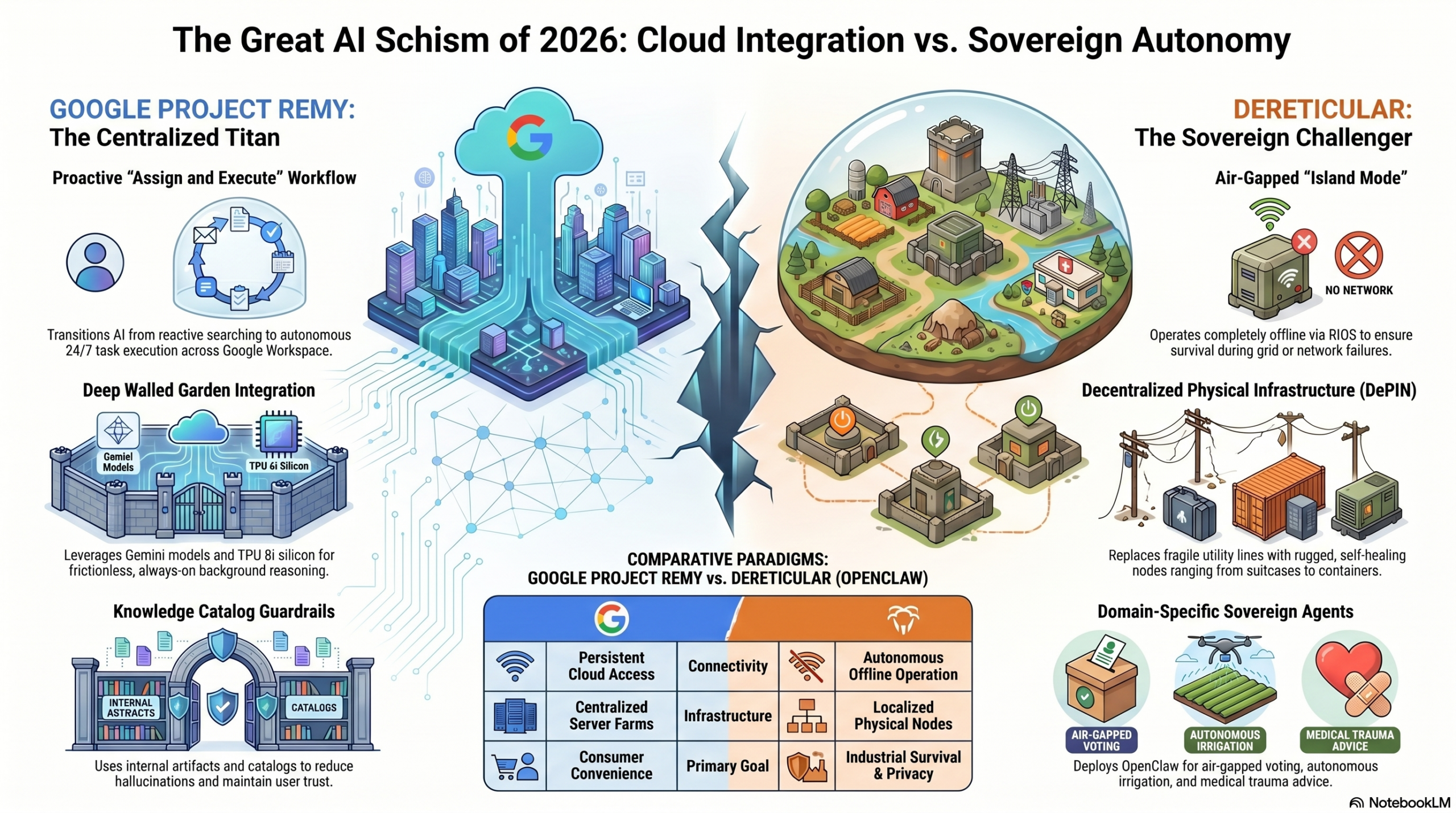
For the modern learner, the significance of this shift cannot be overstated. We are no longer discussing tools that merely process information; we are discussing autonomous agents capable of background reasoning, multi-step task execution, and real-world resource management. This transition represents a shift in infrastructure dependency. The primary competitive friction in 2026 exists between two diametrically opposed philosophies: Google’s cloud-unified convenience and DeReticular’s resilient sovereignty.
The Philosophical Split
| Feature | Google (Project Remy) | DeReticular (Sovereign Automation) |
| Core Mission | Convenience & Integration: Streamlining digital life within a trusted, centralized ecosystem. | Resilience & Sovereignty: Empowering users with offline, self-healing, and decentralized independence. |
| Primary Value | Frictionless, “out-of-the-box” productivity and proactive digital assistance. | Autonomy and physical survival in a world of fragile, centralized grids. |
| User Experience | The ultimate cloud-connected digital butler with recursive workspace access. | Locally hosted “Island Mode” automation for industrial and municipal utility. |
To master the nuances of these competing agents, one must first analyze the physical and digital infrastructure that serves as their foundation.
2. Architecture & Environment: Cloud vs. Island Mode
The architectural divide between Google Remy and DeReticular defines the operational limits of each system.
- The Walled Garden (Google Remy): This architecture is cloud-native and relies on a persistent connection to Google’s centralized server farms. Remy maintains privileged, recursive access to the Google Workspace substrate, leveraging the sheer scale of global data centers to manage a user’s digital persona.
- Spherical Resilience (DeReticular): Utilizing the Rural Infrastructure Operating System (RIOS), DeReticular abandons the “line” (centralized power and data) in favor of localized autonomy. RIOS is an AI-native kernel optimized for “Island Mode,” allowing a node to remain fully functional while entirely air-gapped. This “Spherical Resilience” ensures that the agent’s utility is contained within the local hardware, immune to centralized outages or external cyber-interference.
Hardware Comparison: Powering the Agents
While Remy’s compute is abstracted by Google’s cloud silicon, DeReticular’s Sovereign Automation requires localized deployment via the “Pilot Series” hardware tiers.
| Tier | Google Infrastructure | DeReticular Hardware (Pilot Series) |
| Edge/Efficiency | TPU 8i / Cloud Silicon: Sub-quadratic memory architecture for low-cost reasoning. | Premium Silicon Sentry: Modified Apple M4 Mac Mini; highly efficient 5W idle for local inference. |
| Expeditionary | Google Edge Nodes: Distributed regional compute for reduced latency. | Pilot Expeditionary: Rugged 3-case suitcase; Intel Xeon, NVIDIA A2 GPU, 400W solar input. |
| Standard | Regional Data Centers: Tiered cloud access for standard consumer loads. | Pilot Standard: 10ft climate-controlled ISO container; 4.4kW solar, 20kWh battery storage. |
| Industrial/Core | Global Hyper-scale Centers: Massive compute for billions of concurrent users. | Pilot AI Core: 20ft ISO container; Dual Xeon Platinum, NVIDIA A100 GPU, 15kW solar. |
For rural landowners or privacy-critical operations, “Island Mode” is not a luxury—it is a matter of physical survival. By removing the requirement for a stable internet connection, DeReticular ensures that critical infrastructure, from irrigation to security, remains operational regardless of the state of the global network.
The architectural “where” of the AI dictates the operational “how” of its daily functions.
——————————————————————————–
3. Proactive Agents: Google Remy’s Digital Integration
Project Remy represents the pinnacle of Google’s “action-focused layer” built atop the Gemini 3.2 engine. It is designed to navigate the digital world with an unprecedented level of autonomy.
Key Action-Oriented Capabilities:
- Proactive Task Management: Remy monitors incoming data streams (emails, schedules, and alerts) to execute “digital errands”—such as resolving scheduling conflicts or preemptively drafting project briefs—without requiring a user prompt.
- Privileged Ecosystem Integration: The agent maintains deep, recursive access to the Google Workspace ecosystem (Gmail, Drive, Docs, Calendar), allowing it to synchronize complex workflows across the user’s entire digital life.
- Continuous Personalization: Through constant background observation, Remy refines its reasoning models to align with a user’s specific habits and decision-making patterns over time.
Technological Foundations: To make 24/7 background reasoning economically viable, Google utilizes a Mixture-of-Recursions (MoR) architecture. This allows Remy to maintain constant cognitive presence without the massive compute costs typically associated with persistent agents. To mitigate the “Trusted Environment Fallacy,” Google employs a Knowledge Catalog and a specialized “Artifacts” system, which serve as safety guardrails to ensure that autonomous actions remain accurate and within the user’s defined trust parameters.
While Remy excels at mastering the digital workspace, OpenClaw and DeReticular are engineered to dominate the physical and industrial landscape.
——————————————————————————–
4. Sovereign Automation: OpenClaw and Local Utility
The DeReticular ecosystem is powered by OpenClaw, a platform-agnostic, open-source framework originally launched as “Clawdbot” by Peter Steinberger. OpenClaw allows for the creation of self-hosted, autonomous agents that operate without corporate oversight.
Specialized Sovereign Agents
DeReticular utilizes OpenClaw to deploy specialized agents through its RIOS kernel, each designed for high-stakes localized utility:
- Industrial & Logistics
- Industrial Foreman: Orchestrates solar microgrids and local logistics.
- Sovereign Agronomist: Manages autonomous irrigation and sensor fabrics for agricultural nodes.
- Administrative & IT
- DevOps Sovereign: An air-gapped sysadmin capable of local code review and self-healing digital services.
- Sovereign Executive: A localized Chief of Staff utilizing Whisper AI (voice-to-text) and OCR for private, automated filing.
- Civic & Security
- Sovereign Elector: An EAC-compliant, air-gapped system for secure local voting.
- Field Medic: An agent providing bionic medical trauma advice and off-grid health support.
Trust and Distributed Identity: In the absence of a centralized authority, DeReticular employs a Split-Ledger Architecture. This allows users to keep financial data private while proving physical truths via public ledgers. Identity is secured through RF (Radio Frequency) Fingerprinting, which anchors data to specific hardware, and “Sovereign Badges.” These badges are Soulbound NFTs issued by the DeReticular Academy, serving as decentralized credentials that verify access rights within the RIOS ecosystem.
This move toward local autonomy necessitates a serious evaluation of the trade-offs between centralized safety and decentralized resilience.
——————————————————————————–
5. The Great Trade-off: Security, Safety, and Trust
The divergence between Google and DeReticular creates a fundamental tension between controlled security and absolute sovereignty.
Critical Comparison: Trust & Security Models
| Attribute | Google Remy | DeReticular / OpenClaw |
| Data Privacy | Cloud-Based: Data resides on Google servers; subject to corporate oversight. | Local-First: Data stays on the user’s physical hardware (Silicon Sentry/Pilot). |
| Connectivity | Always-On: Requires persistent internet for reasoning and task execution. | Air-Gapped: Capable of total “Island Mode” operations without a “line.” |
| Safety Mechanisms | Internal Guardrails: Uses Knowledge Catalogs and Artifacts to prevent hallucinations. | Physical Separation: Relies on air-gapping and RBAC to prevent unauthorized access. |
| Known Risks | Centralized Vulnerability: Single point of failure; corporate data harvesting. | Supply Chain Risks: Vulnerable to exploits like CVE-2026-25253 in open-source code. |
Google has aggressively marketed Remy as the “OpenClaw Killer.” This narrative capitalizes on the highly publicized rise and subsequent collapse of several open-source agent deployments due to CVE-2026-25253, a critical supply chain attack that exploited the lack of sandboxing in early OpenClaw versions. Google argues that their “Walled Garden” provides a curated, secure environment that decentralized systems—vulnerable to fragmented update cycles—cannot match.
——————————————————————————–
6. Learner’s Summary: Choosing Your AI Future
Decision Matrix
- The City-Dwelling Professional: Likely chooses Google Remy.
- Primary Reason: They require frictionless, recursive integration with the Google Workspace substrate to manage high-velocity digital logistics.
- The Rural Landowner: Likely chooses DeReticular.
- Primary Reason: They prioritize “Island Mode” and “Spherical Resilience” to ensure critical farming and power infrastructure remains functional without a centralized data line.
- The Security-Conscious Developer: Likely chooses OpenClaw/DeReticular.
- Primary Reason: They seek a platform-agnostic system that supports bespoke, air-gapped workflows and utilizes Split-Ledger Architecture to avoid corporate data harvesting.
The defining choice of 2026 is between the “Walled Garden” of centralized efficiency and the “Death of the Line”—a commitment to sovereign, decentralized autonomy. One offers the world at your fingertips; the other ensures the world still works when the fingertips are cut off.


