The “Death of the Line”: How the Sovereign Gateway is Outsmarting the Big Tech Cloud
We’ve all experienced the quiet lobotomy of the modern smart home. A sudden thunderstorm, a localized ISP outage, or a server hiccup at a data center three states away, and suddenly your “intelligent” residence is functionally paralyzed. Your lights won’t dim, your security cameras stop recording, and your voice assistant metronomically repeats that it’s having trouble connecting to the internet. In our rush to embrace the convenience of the cloud, we’ve inadvertently built the most fragile domestic infrastructure in history.
As we move through 2026, the stakes have shifted. We are no longer just talking about remote-controlled lightbulbs; we are in the midst of the “Agentic Shift.” AI has evolved from reactive chatbots into proactive agents—digital butlers like the highly anticipated Google Remy—that manage our calendars, book our travel, and monitor our front doors. But this “War of the Butlers” presents a choice: do you surrender your home’s internal telemetry to the “Trusted Environment Fallacy” of Big Tech, or do you reclaim your autonomy?
DeReticular, the DePIN venture studio led by Michael Noel, has emerged as the vanguard of the decentralized rebellion. Their Sovereign Gateway is a “trustless” alternative designed for the prosumer who wants the logistical brilliance of high-end AI without paying the invasive “privacy tax” of a permanent cloud tether.
“Island Mode”: Your Smart Home, Finally Unplugged
The central philosophy of DeReticular is what Noel calls “The Death of the Line.” It is a deliberate pivot away from centralized, “fragile utility grids” toward what the company terms “Spherical Resilience.”
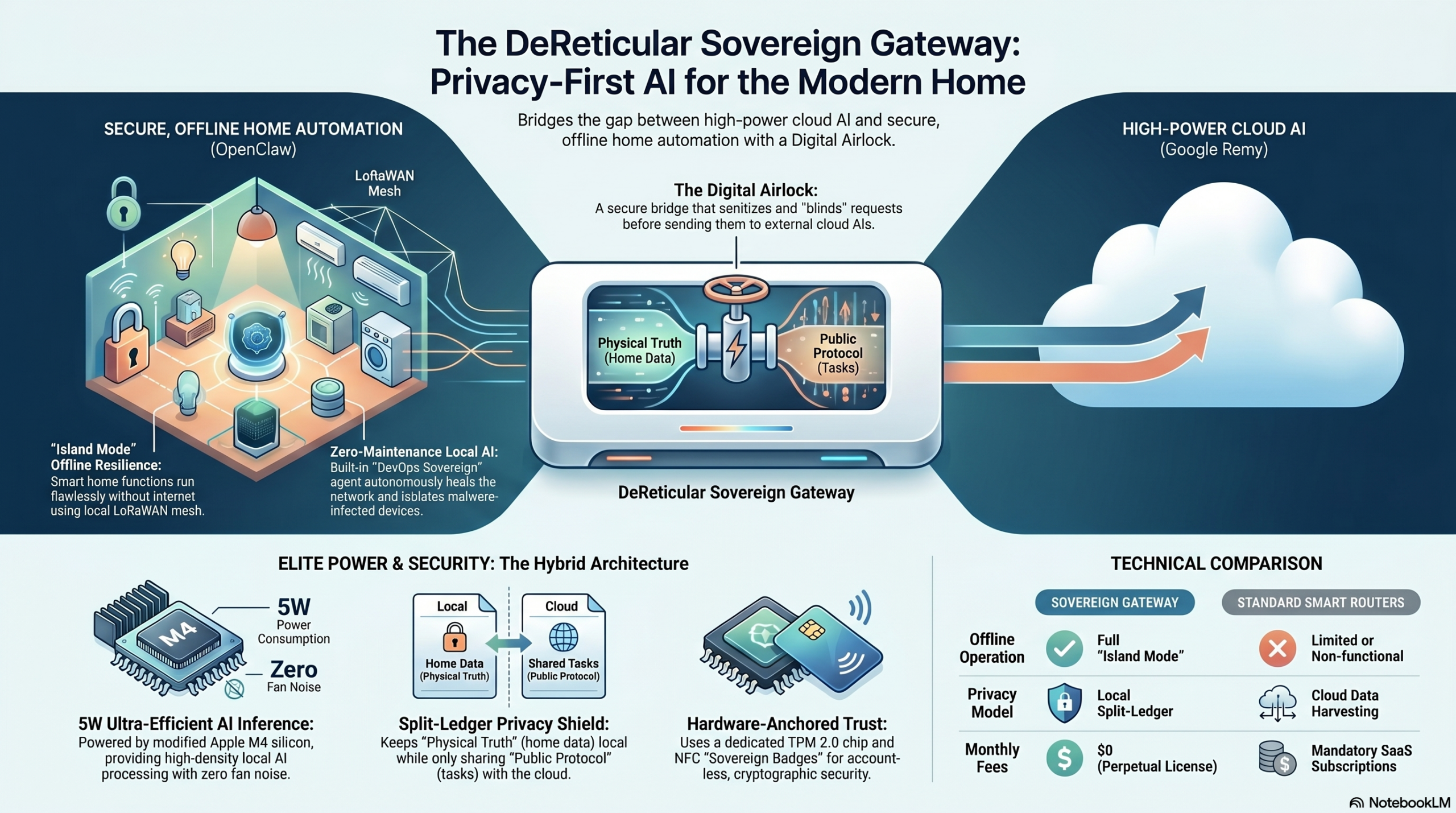
Traditional smart homes are tethered to a digital life-support line; if the connection snaps, the home dies. The Sovereign Gateway replaces this with “Island Mode.” Running on RIOS (Rural Infrastructure Operating System), the Gateway utilizes an architecture branded as Trifi Wireless—a sophisticated combination of Tri-band Wi-Fi 6E for high-speed local data and a Sub-GHz LoRaWAN mesh canopy for low-power IoT sensors like locks and thermostats.
“The Death of the Line is not about isolation; it is about ending the era of the fragile utility grid. It is the transition from a dependent user to a resilient sovereign.” — Michael Noel, Co-founder of DeReticular.
Inside the unit, the “Premium Silicon Sentry”—a modified Apple M4 chip—handles the heavy AI lifting locally. While the cloud giants require massive server farms, this unit achieves high-density AI inference at a mere 5W idle. The chassis itself is a masterclass in prosumer engineering: a sleek, space-gray Anodized Aluminum Extrusion that acts as the primary passive heatsink, ensuring the system remains 100% silent and fanless while processing gigabytes of local data.
The Digital Airlock: Renting Google’s Brain, Keeping Your Data
The primary draw of an agent like Google Remy is its proactive reach. It can scan your Gmail to anticipate a flight delay or research market trends. A purely air-gapped system, while secure, is a hermit. The Sovereign Gateway solves this by creating what DeReticular calls the “Remy Bridge.”
The Digital Airlock serves as the ultimate bridge between Sovereign Privacy and Elite Convenience. It functions as a legal counsel for your data, ensuring your private life remains a black box to the corporate cloud even while you utilize its compute power.
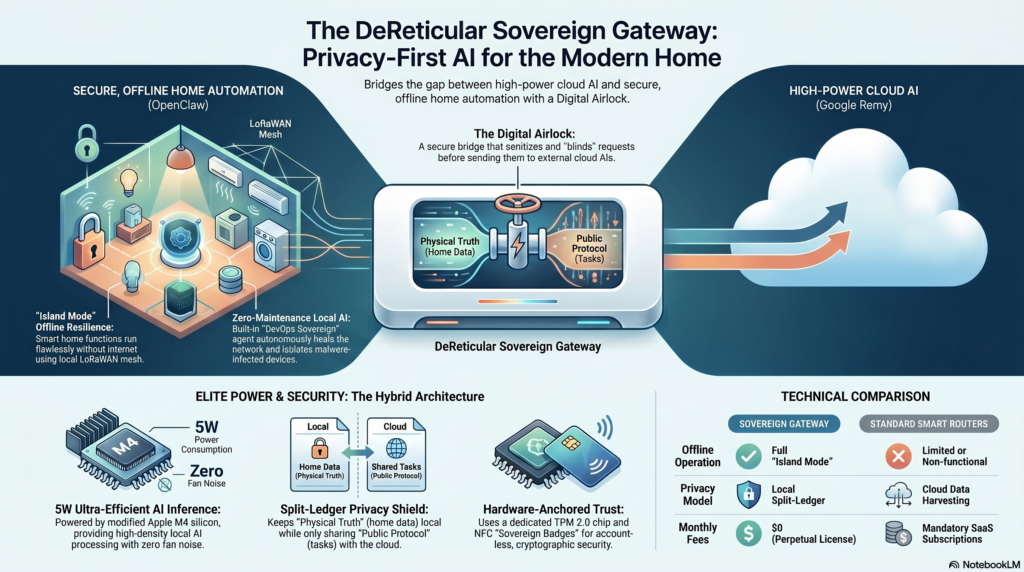
This is made possible through “API Obfuscation” and a “Split-Ledger Privacy Shield.” When you ask the system to book a flight, the Gateway doesn’t just hand over your credentials. It strips away your home telemetry, IP data, and personal context, passing only a “blinded intent payload” to Google Remy. Google’s cloud executes the heavy logistical reasoning and sends the result back to your local “airlock.” Google gets the job done, but it never sees inside your home. This hybrid model is the inevitable winner of the agentic era: it treats Big Tech’s compute as a utility rather than a master.
The Invisible IT Department: Meet Your Local “DevOps Sovereign”
The historical barrier to “local-first” tech has always been the “IT headache.” Self-hosting usually requires a level of technical masochism that most users can’t justify. DeReticular bypasses this with the SOV-AUTO-DEV agent, a pre-installed “DevOps Sovereign” running natively via the OpenClaw framework.
While OpenClaw became a household name in late 2025, its reputation was nearly destroyed by the CVE-2026-25253 vulnerability—a supply chain attack that exposed the fragility of purely software-based agents. DeReticular’s implementation is different. By anchoring OpenClaw to a dedicated hardware TPM 2.0 cryptoprocessor and physical network separation, they’ve built a fortress around the framework.
The SOV-AUTO-DEV agent acts as an invisible sysadmin, autonomously self-healing the network and isolating malware-infected IoT devices (like a compromised smart fridge) before they can touch your data. Meanwhile, other agents like Vault Warden process security camera feeds locally using volumetric analysis, and the SOV-AUTO-EXEC acts as your local Chief of Staff, using Whisper AI to process voice commands without a single syllable ever reaching a remote server.
Ownership Over Subscriptions: The End of “SaaS Fatigue”
In an era where every doorbell and thermostat demands a monthly fee, the Sovereign Gateway is a refreshing anomaly. DeReticular has opted for a perpetual licensing model. The hardware is a significant investment—$799 for a base node or $1,299 for a three-node mesh kit—but it is a one-time purchase for a decade of sovereignty.
The setup process even rejects the cloud-account status quo. There are no usernames or passwords to be breached. Instead, the Gateway uses a “Zero-Account” paradigm enabled by the Sovereign Badge. This NFC-enabled card allows you to mint a cryptographic key directly into your phone’s digital wallet. It is your root admin passkey, physically paired to your hardware and your hardware alone.
Reflecting its “military-grade” aspirations, the device’s silicon and encryption are so advanced that every unit must pass automated ITAR/EAR and OFAC export compliance checks before fulfillment. It’s a level of security typically reserved for industrial infrastructure, now packaged for the living room.
Conclusion: Choosing Your Side in the Agentic Revolution
The divide in 2026 is becoming a chasm. On one side are the Centralized Giants, offering frictionless convenience in exchange for total digital transparency. On the other is the “Decentralized Rebellion” of OpenClaw and DeReticular, offering a future where you are the sovereign of your own data.
As we transition from models that talk to us to agents that act for us, the most critical feature of any device won’t be its processing speed or its aesthetic. It will be its capacity for refusal—what it refuses to share, and where it refuses to connect.
The Sovereign Gateway isn’t just a router; it’s a declaration of independence. The question for the modern prosumer is no longer “What can this AI do for me?” but rather, “Am I ready to stop being a user and start being a sovereign?”


