Comprehensive Briefing: Sovereign Lunar Infrastructure and Off-World Automata
Executive Summary
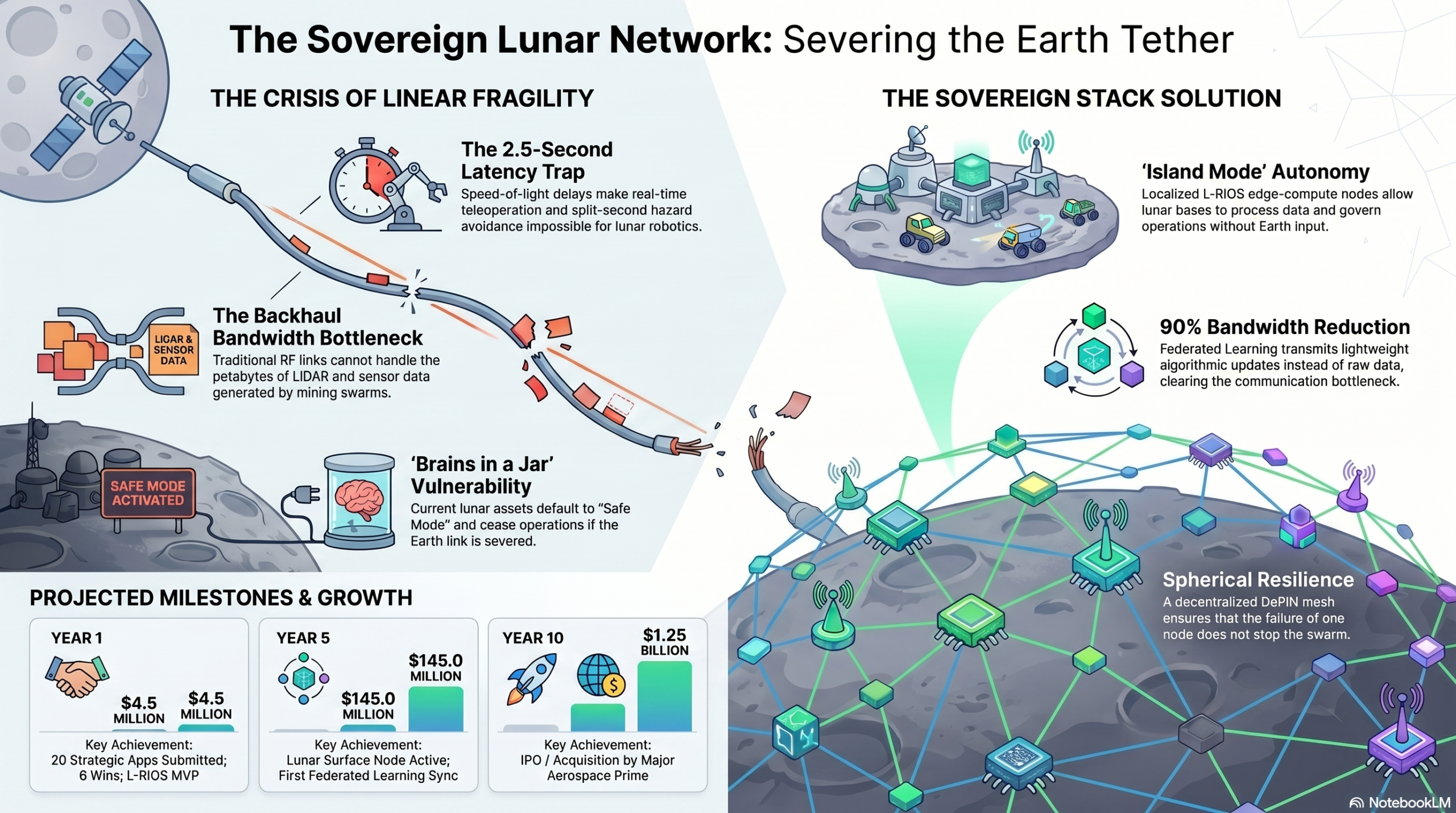
The transition of the lunar economy from scientific exploration to industrial-scale resource extraction is currently impeded by “Linear Fragility”—a fatal dependency on Earth-based centralized computing and the oversubscribed Deep Space Network (DSN). Sovereign Space Systems (S3), a joint venture between DeReticular and a financial sponsor, aims to resolve this bottleneck by deploying the Sovereign Stack, a decentralized operating system designed for “Island Mode” autonomy.
The core of this strategy is the adaptation of Operation Octagon, a successful terrestrial framework for decentralized physical infrastructure networks (DePIN), to the lunar surface. By utilizing Federated Learning, S3 enables robotic swarms to process data locally and share only lightweight algorithmic updates, reducing backhaul bandwidth requirements by over 90%. S3’s immediate tactical objective is a “30-Day Sprint” to secure non-dilutive capital through 20 strategic NASA and DoD applications, positioning itself as the “Software & Intelligence” backbone of the lunar economy with a projected $1.25 billion revenue milestone by Year 10.
——————————————————————————–
1. The Strategic Joint Venture: Sovereign Space Systems (S3)
Sovereign Space Systems is structured to bridge the gap between terrestrial decentralized infrastructure and the lunar industrial landscape. The venture operates as a “Command Center” model rather than a traditional aerospace firm.
Organizational Roles
- The Architect (DeReticular): Provides the core Intellectual Property (IP), including the Rural Infrastructure Operating System (RIOS), Federated Learning protocols, and technical validation from terrestrial deployments.
- The Engine (Financial Sponsor): Provides a $2.5 million “War Chest” to fund a high-velocity 30-day grant acquisition sprint and hire a “Swarm” of grant writers and procurement consultants.
The 30-Day Strategic Strike
S3 aims to “carpet-bomb” the procurement pipeline with 20 simultaneous applications to secure sole-source status and non-dilutive capital:
- 10x SBIR/STTR Phase I: Focusing on autonomous navigation and edge AI.
- 2x Tipping Point Solicitations: Targeting lunar surface edge-computing.
- 2x PRISM Payload Solicitations: Proposing lunar data centers in the Shackleton Crater.
- 2x NIAC: Visionary concepts for DePIN-based planetary terraforming.
- 4x DoD Space Force “SpaceWERX” Pitches: Focusing on orbital defense mesh communication.
2. Theoretical Framework: Overcoming “Linear Fragility”
The current lunar exploration paradigm treats the Moon as a “dumb terminal,” entirely tethered to terrestrial data centers. This results in significant operational vulnerabilities.
The Current Gaps
| Vulnerability | Description | Risk to Industrialization |
| The Latency Trap | Minimum ~2.5-second round-trip delay for data processing. | Impossible swarm coordination and split-second hazard avoidance. |
| Cloud Dependency | Reliance on Earth-based supercomputers for decision-making. | Machines default to “safe mode” during communication blackouts. |
| Backhaul Bottleneck | Narrow RF pipes (S-band/X-band) cannot handle petabytes of LiDAR/Video. | Data traffic jams force the disposal of valuable telemetry. |
| Environmental Degradation | Abrasive dust and crater topography interfere with RF signals. | Severe “dead zones” within critical mining sites (PSRs). |
The Solution: “Spherical Resilience”
S3 proposes a shift toward Spherical Resilience, where infrastructure acts, learns, and survives on the edge. This is achieved through “Island Mode”—the ability for lunar assets to maintain 100% operational uptime without a handshake from a central terrestrial cloud.
——————————————————————————–
3. Technology Pillars: L-RIOS and Federated Learning
The S3 methodology relies on three distinct layers of technology adapted from DeReticular’s terrestrial “Sovereign Stack.”
L-RIOS (Lunar Infrastructure Operating System)
L-RIOS is the “Sovereign Stack for Space.” It functions as the localized brain of a lunar base, managing robotic ecosystems from environmentally hardened data centers (e.g., inside stable lava tubes). It utilizes a Hardware Root of Trust (TPM chips and RF Fingerprinting) to verify machine identities trustlessly.
Federated Learning Mesh
Federated Learning addresses the bandwidth bottleneck by moving the AI model to the data rather than the data to the model.
- Local Encounter: A rover (e.g., Kurb Crawler) hits a novel obstacle (e.g., abrasive dust).
- Edge Processing: Onboard GPUs analyze telemetry and optimize a solution locally.
- Federated Transmission: The rover broadcasts only a lightweight algorithmic update (kilobytes) to the local mesh.
- Swarm Sync: The update is pushed to all other rovers, giving the entire fleet “instant instinct.”
Adapted Product Line
- Agra Dot Astro: Modular nodes providing off-grid baseload power (micro-fission/solar) and 4G/LTE/5G transceivers.
- Kurb Crawlers: Heavy-duty, swarm-capable mining automata that navigate without GPS or Earth-based commands.
- Sovereign Badges: Non-transferable NFT credentials for human-in-the-loop authorization from the Lunar Gateway or Earth.
——————————————————————————–
4. Operation Octagon: The Terrestrial Blueprint
S3’s lunar strategy is based on Operation Octagon, a deployment of eight decentralized nodes in extreme terrestrial environments to stress-test the Sovereign Stack.
- Node 3 (Arizona): Hardens hardware against extreme heat and abrasive dust.
- Node 4 (Uganda): Validates off-grid energy generation and autonomous logistics.
- Node 6 (La Paz, AZ): Tests autonomous transportation fleets (“Kurb Kars”) running purely on the edge.
- Node 2 (Canada): Acts as the systems architect layer for over-the-air updates.
Project LUNA-NODE is the proposed MVP to NASA to demonstrate this architecture. It involves a 72-hour continuous operation where a swarm must maintain productivity during a simulated DSN blackout and solve a physical anomaly via Federated Learning while disconnected from Earth.
——————————————————————————–
5. Revenue Model and Financial Proforma
S3’s financial strategy transitions from government grants to commercial licensing over a ten-year period.
Tiers of Revenue
- Tier 1 (Years 1-2): Non-dilutive grant capital (NASA/DoD). Expected: $3M – $8M.
- Tier 2 (Years 3-5): Prime subcontracting and payload fees. S3 becomes the “Intelligence Provider” for lander companies (e.g., Intuitive Machines). Expected: $50M – $150M.
- Tier 3 (Years 6-10): “The Sovereign Tax.” Recurring licensing fees for every mining company and habitat using the L-RIOS OS. Expected: $500M+.
10-Year Proforma Summary (Millions USD)
| Year | Revenue | EBITDA | Key Milestone |
| Y1 | $4.5 | ($1.2) | 20 Apps submitted; 6 wins; L-RIOS MVP. |
| Y3 | $28.0 | $8.0 | “Tipping Point” funding; First flight hardware. |
| Y5 | $145.0 | $55.0 | Lunar surface node active; First Federated Sync. |
| Y7 | $450.0 | $190.0 | Expansion to Lunar Gateway; P2P Power Trading. |
| Y10 | $1,250.0 | $680.0 | IPO / Acquisition by Major Aerospace Prime. |
——————————————————————————–
6. NASA Funding Acquisition Strategy
To capitalize Project LUNA-NODE, S3/DeReticular follows a phased acquisition strategy:
- Early Stage (Q3 2026): Secure SBIR Phase I ($150k) for feasibility and an Unfunded Space Act Agreement (SAA) for access to NASA’s lunar analogue yards.
- Mid-Stage (2027): Secure SBIR Phase II (850k) for prototype development and a **Tipping Point** award (2M – $15M) for flight-ready integration.
- Deployment (2028-2029): Compete for PRISM Solicitations under the Commercial Lunar Payload Services (CLPS) program to fund the actual launch and landing of hardware.
- Visionary R&D: Utilize NIAC grants for long-term “Algorithmic Terraforming” research.
——————————————————————————–
7. Conclusion: The “Sovereign” Competitive Advantage
Sovereign Space Systems distinguishes itself from traditional aerospace primes (e.g., Boeing, Lockheed) through Speed to Intelligence. While legacy firms focus on 5-year design cycles, S3 utilizes Federated Learning to allow machines to design solutions in real-time. By disintermediating the Earth-link, S3 establishes a “Lunar Truth”—a self-contained, self-healing industrial engine that makes the economic extraction of lunar resources mathematically and operationally viable. As the project states: “The Line is dead. The Mesh is rising. Space is Sovereign.”


