DeReticular Non-Dilutive Capital and Sovereign Infrastructure Study Guide
This study guide provides a comprehensive review of the DeReticular ecosystem, its non-dilutive capital architecture, and the strategic implementation required to scale deep-tech sovereign infrastructure.
Part 1: Short-Answer Quiz
Instructions: Answer the following ten questions in 2–3 sentences, based strictly on the provided source context.
- What is the “structural mismatch” identified between deep-tech ventures and traditional venture capital?
- How do SBIR Data Rights protect a company’s intellectual property when working with the federal government?
- Explain the role of TriFi Wireless within the DeReticular Venture Studio framework.
- What is the primary difference between SEC Regulation D Rule 506(b) and Rule 506(c) regarding the promotion of SAFEs?
- Why is “SBA Affiliation Insulation” critical for the spinout companies within the DeReticular ecosystem?
- What are the three specific types of indirect cost pools required for a Standard Form 1408 (SF 1408) compliant accounting system?
- Describe the technical purpose and the standard target for the Generation 5 (Gen 5) Pod certification.
- How does the “Dual-Track” hybrid model optimize a company’s valuation before seeking private equity?
- What specific requirements must be met to achieve “Certified Microgrid District” status under West Virginia H.B. 2014?
- In the context of Kurb Kars, what is the significance of the RIOS Mesh Networking validation?
Part 2: Quiz Answer Key
- Mismatch: Deep-tech ventures involve high capital expenditure, long technical validation cycles, and complex regulatory lead times. Traditional venture capital economics often force excessive equity dilution and misaligned exit pressures that do not suit the slow de-risking phase of physical infrastructure.
- SBIR Data Rights: These rights grant the awardee commercial ownership of their intellectual property and provide 20-year protection for technical data, source code, and design specifications. This prevents the government from disclosing technical packages to competitors or reverse-engineering the technology for public procurement.
- TriFi Wireless: It serves as a “Prime Contractor Bridge,” allowing portfolio entities to bypass hurdles like security clearances and facility clearance requirements. By routing initiatives through this established prime partner, nascent ventures can build “Past Performance” credentials on federal records more rapidly.
- Rule 506(b) vs. 506(c): Rule 506(b) strictly prohibits general advertising and allows for investor self-certification of accredited status. In contrast, Rule 506(c) permits public promotion and general solicitation but mandates that the issuer take “reasonable steps” to verify accredited status through third-party documentation like tax returns or CPA letters.
- Affiliation Insulation: Under 13 CFR § 121.103, if the SBA determines a Venture Studio “controls” its spinouts, it aggregates their headcounts. If the combined total exceeds 500 employees, the individual companies lose their “Small Business Concern” status and become ineligible for SBIR/STTR grants.
- Indirect Cost Pools: A compliant federal accounting system must establish separate pools for Fringe Benefits (health, payroll taxes), Overhead (R&D facility rent, utilities), and General & Administrative (G&A) expenses (executive salaries, legal, IT).
- Gen 5 Pod Certification: The Gen 5 Pod is a ruggedized field enclosure designed for sovereign communications and edge compute. Its primary certification target is MIL-STD-188-125-1, which ensures high-altitude electromagnetic pulse (HEMP) protection for ground-based C4I facilities.
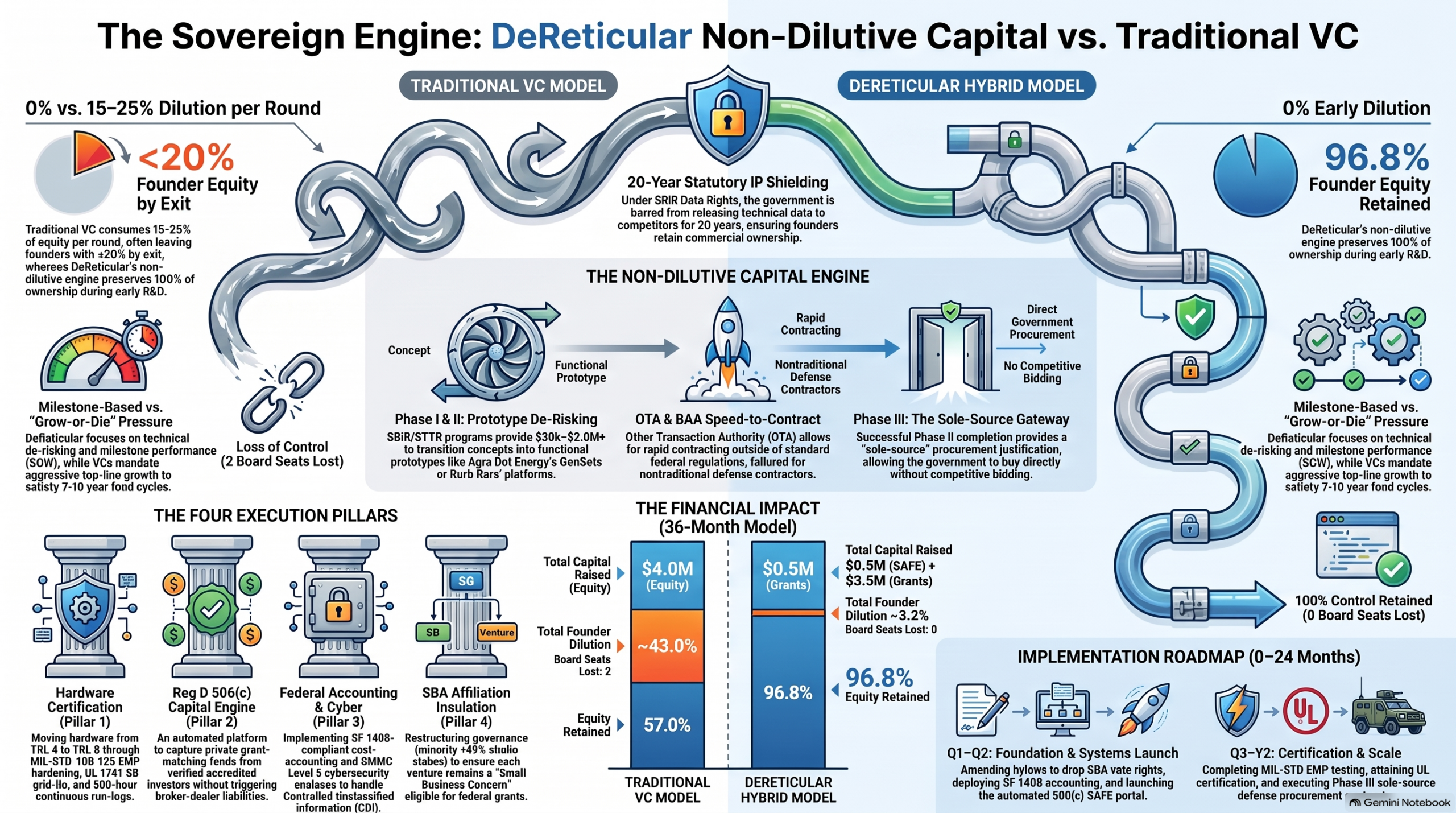
- Dual-Track Model: This strategy uses non-dilutive public capital (grants/OTAs) to fund R&D and eliminate technical risks first. Once the technology is de-risked and validated, the company can raise private capital at a significantly higher valuation inflection point, minimizing founder dilution.
- H.B. 2014 Requirements: Certified status is not self-designated; it must be formally granted by the West Virginia Secretary of Commerce following an application review. While it offers exemptions from certain utility regulations for behind-the-meter use, grid synchronization remains subject to PSC oversight and PJM tariff rules.
- RIOS Mesh Networking: This validation measures inter-vehicle ad-hoc mesh throughput and packet drop rates to ensure autonomous coordination. It is critical for swarm autonomy in “denied-network” or GPS-jammed environments where central dispatch is unavailable.
Part 3: Essay Questions
Instructions: Use the provided source context to develop detailed responses to the following prompts.
- Comparative Analysis of Capital Structures: Evaluate the differences between DeReticular’s Non-Dilutive Capital Architecture and Traditional Venture Capital. Focus your analysis on equity preservation, governance control, and the impact of “Liquidation Preferences.”
- The Four Execution Pillars for Scaling Infrastructure: Discuss the implementation of the four foundational execution pillars (Hardware Certification, Reg D 506(c) Capital Engine, SF 1408 & CMMC Compliance, and SBA Affiliation Insulation). How do these pillars transition a venture from “Prototype” to “Certified Production”?
- Regulatory Compliance and Security in Federal Contracting: Analyze the importance of FAR Part 31 cost segregation, NIST SP 800-171 cybersecurity controls, and CFIUS foreign-investment screening. Why are these frameworks essential for ventures developing dual-use “Sovereign Infrastructure”?
- The Role of Convertible Instruments in Non-Dilutive Stacks: Explain how SAFEs and Convertible Notes are repurposed within the DeReticular model to act as “Strategic Bridges.” Specifically, address their roles in unlocking matching funds and smoothing federal reimbursement latency.
- Technical Maturity and Hardware De-Risking: Using the examples of Agra Dot Energy and the Gen 5 Pods, describe the process of graduating from TRL 4–6 (Prototype) to TRL 7–8 (Certified Production). What role does independent third-party lab accreditation play in this transition?
Part 4: Glossary of Key Terms
Term Definition
Accredited Investor An individual with 200k+ annual income (300k joint) or $1M+ net worth (excluding primary residence); required for Rule 506(c) offerings.
BAA (Broad Agency Announcement) A competitive solicitation procedure used by federal agencies for the acquisition of basic and applied research.
CFIUS The Committee on Foreign Investment in the United States; reviews foreign investments for national security risks, particularly in critical technology.
CMMC 2.0 Cybersecurity Maturity Model Certification; a DoD program requiring contractors to protect Controlled Unclassified Information (CUI).
Convertible Note A debt instrument that carries interest and converts into equity at a later date, often used to bridge cash flow during grant reimbursement lags.
DCAA Defense Contract Audit Agency; responsible for auditing DoD contracts and accounting systems to ensure compliance with federal regulations.
ERA (Exempt Reporting Adviser) An investment adviser that is exempt from full SEC registration because it solely advises venture capital funds.
FAR (Federal Acquisition Regulation) The principal set of rules regarding government procurement in the United States.
HEMP (High-Altitude EMP) An electromagnetic pulse caused by a nuclear detonation in the upper atmosphere, against which Gen 5 Pods are designed to be hardened.
ITAR (International Traffic in Arms Regulations) A set of US government regulations that control the export and import of defense-related articles and services.
MANET (Mobile Ad-hoc Network) A continuously self-configuring, infrastructure-less network of mobile devices connected wirelessly.
Non-Dilutive Capital Funding (such as grants or tax credits) that does not require the founder to give up equity or ownership in the company.
OTA (Other Transaction Authority) A legal authority (e.g., 10 U.S.C. § 4022) allowing agencies to enter into agreements outside the standard FAR for prototype projects.
Plasma Gasification An extreme-heat process used by Agra Dot Energy to convert organic waste into synthesis gas (syngas) for power generation.
SAFE (Simple Agreement for Future Equity) An investment contract where an investor provides cash in exchange for the right to receive equity during a future priced round.
SBIR/STTR Small Business Innovation Research / Small Business Technology Transfer; phased federal grant programs for R&D and commercialization.
SF 1408 The Standard Form used for a “Pre-Award Survey of Prospective Contractor Accounting System” to ensure it can track costs on federal contracts.
Sovereign Infrastructure Local-first power, compute, and comms nodes (like Gen 5 Pods) designed to operate independently of centralized macro-grids.
TRL (Technology Readiness Level) A scale used to measure the maturity of a technology, ranging from Concept (TRL 1) to Operational (TRL 9).
Valuation Cap A provision in a SAFE or Note that sets the maximum valuation at which the investment will convert into equity, protecting investors from dilution in high-value rounds.


