Operational Transition Playbook: From Platform Dependency to Sovereign Nodal Hospitality
1. Strategic Context: The Death of the Platform Tax
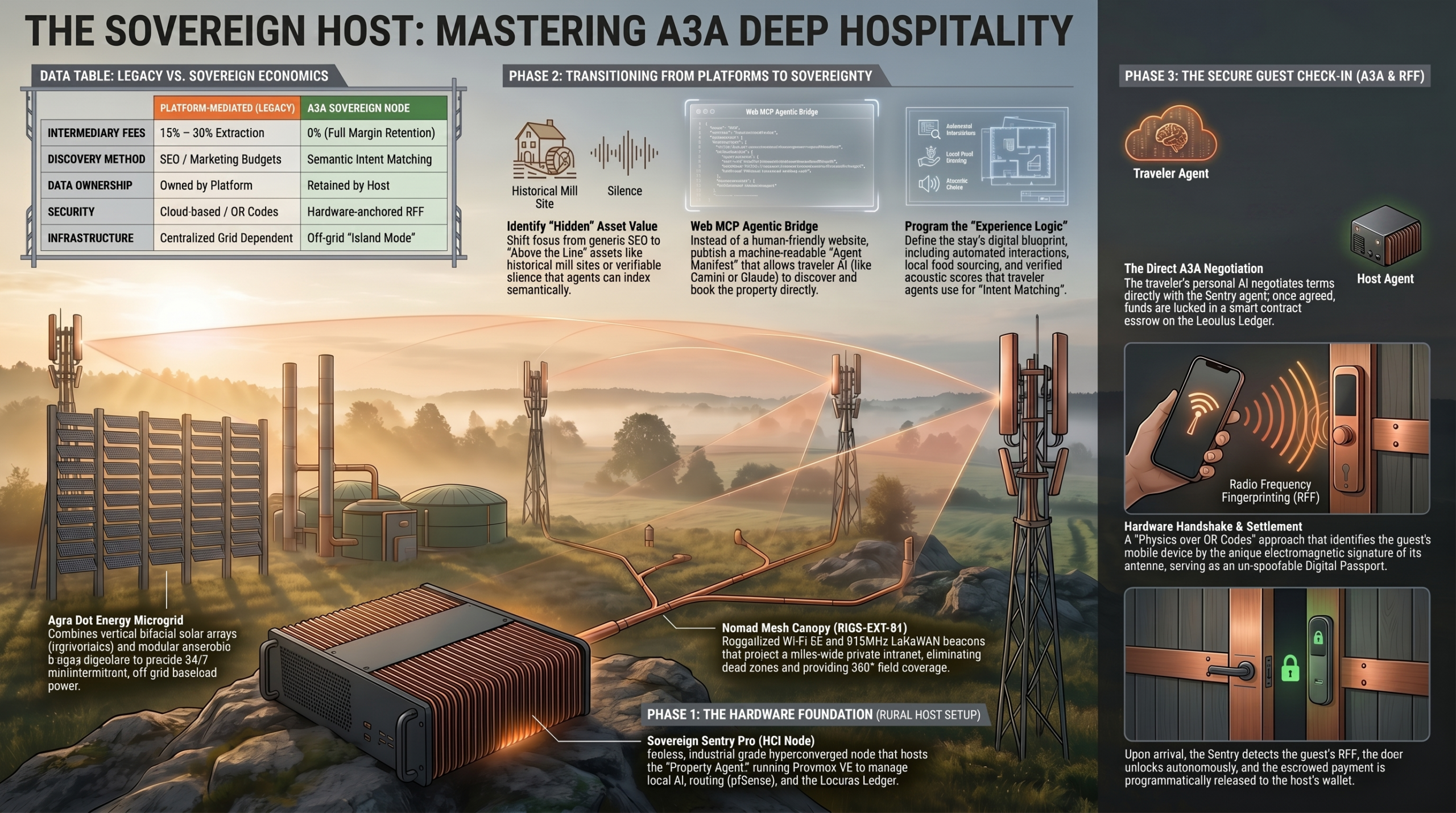
The hospitality industry is undergoing a structural inversion, shifting from platform-mediated extraction to agent-orchestrated “Deep Hospitality.” For decades, centralized Online Travel Agencies (OTAs) have imposed a “Platform Tax” of 15–30%, while maintaining a Manual Search Barrier that forces travelers to navigate generic, SEO-manipulated listings. By adopting sovereign protocols, rural entrepreneurs reclaim these margins and transition to a “Zero-UI Discovery” model. This paradigm utilizes a “Semantic Interlock” where a traveler’s personal AI agent communicates directly with a host’s Property Agent via the Model Context Protocol (MCP). In this agentic future, “Above the Line” hospitality succeeds because AI agents prioritize structured, verifiable proprietary context over lifestyle photography.
Table 1: Legacy Platforms vs. Sovereign Nodal Destinations
| Metric | Legacy Platform Listings (Below the Line) | Sovereign Nodal Destinations (Above the Line) |
| Discovery | Manual search; SEO/ad-spend driven; Manual Search Barrier. | Zero-UI Discovery; Semantic Interlock via A2A/MCP protocols. |
| Data Ownership | Platform-owned; host subject to deplatforming. | Host-retained; direct sovereign relationship. |
| Margin Retention | 15–30% extracted by intermediary. | 100% retention; 0% intermediary fees. |
| Operational Basis | Dependency on centralized cloud/grid. | “Island Mode” resilience; off-grid “Spherical Resilience.” |
| Asset Type | Standardized commodity (Hilton, generic Airbnb). | Non-reproducible Contextual Assets (historic mills, ridges). |
This strategic reclamation begins with a rigorous evaluation of “Contextual Non-reproducibility” within the physical land itself.
——————————————————————————–
2. Phase 1: Site Audit and Asset Discovery
To move “Above the Line,” a host must establish a “Nodal Moat” built upon physical and historical context that centralized platforms are structurally incapable of indexing. This proprietary context forms the basis of the “Experience Logic” that traveler agents seek.
Asset Discovery Checklist
- Terrain Mapping: Utilize GIS (Geographic Information Systems) tools to identify natural assets, water sources, and optimal elevations for mesh network beacons.
- Historical Inventory: Identify and document non-reproducible structures (e.g., gristmills, 19th-century schoolhouses) to create unique “Contextual Assets.”
- Acoustic Verification: Deploy sensors to establish machine-readable “verifiable silence” scores (e.g., #acoustic-silence-90dB).
- Site Preparation: Pour reinforced concrete pads for hardware vaults and establish secondary containment loops for utility integration.
Regulatory and Zoning Defense
Rural hospitality must navigate pushback from legacy utilities and zoning boards. To bypass commercial hospitality bans and grid interconnection delays (which currently range from 4–7 years), nodes are structured under “Agricultural Easement” status.
- The LER Mandate: Maintain a Land Equivalent Ratio (LER) above 1.2 by integrating dual-use agrivoltaics and active husbandry. This preserves agricultural status, rendering commercial utility restrictions inapplicable.
- Private Mesh Easements: Avoid public utility corridors by registering “Private Mesh Easements” via the DAOSRUS DAO. This ensures the peer-to-peer nature of the network is legally anchored and protected from centralized co-option.
Once the physical assets are verified, the deployment of the digital backbone can commence.
——————————————————————————–
3. Phase 2: Network Anchorage and Edge Compute Deployment
The destination must achieve “Island Mode” through “Spherical Resilience”—the ability to operate independently of global clouds and national grids. Every node functions as a self-healing, self-sufficient entity.
Hardware Specification: Sovereign Sentry Pro
The Sovereign Sentry Pro is an industrial-grade, hyperconverged infrastructure (HCI) node housed in a NEMA 4X weather-sealed aluminum monoblock.
- Processor: AMD EPYC Embedded (16 Cores / 32 Threads).
- Acceleration: 2x Nvidia L4 GPUs (48GB GDDR6 VRAM) for local model inference.
- Modularity: Features MXM GPU and PCIe carrier backplanes to facilitate 15-minute modular hardware upgrades.
- Hypervisor: Proxmox VE (Kernel 6.x) managing three virtual environments:
- The Gatekeeper: pfSense/OPNsense for deep packet inspection and automated failover.
- The Ledger: Executes the Locutus daemon to manage encrypted data shards and validate smart contracts.
- The Sandbox: Air-gapped environment for local AI model configurations:
- The DevOps Sovereign: Llama-3-8B-Instruct (Quantized to 4-bit, Q4_K_M GGUF) for system self-healing.
- The Field Medic: Mistral-7B-Instruct (fine-tuned on industrial manuals) for predictive field repair.
The Nomad Mesh Canopy
Utilizing the RIOS Operating System, the RIOS-EXT-01 beacons project a miles-wide private intranet using Wi-Fi 6E and LoRaWAN (915MHz). These beacons support “Vehicle-as-a-Relay” dynamics, allowing moving machinery to cache and sync IoT telemetry across the property even during macro-internet outages.
——————————————————————————–
4. Phase 3: Energy Integration and Resource Sovereignty
“Agra Dot Energy” provides non-intermittent baseload power, ensuring the node remains independent of fragile centralized grids.
Technical Guide: Dual-Use Energy Systems
- Modular Anaerobic Biogas Digesters: Process agricultural waste into clean methane to power a Combined Heat and Power (CHP) generator, providing 24/7 baseload electricity and thermal heat.
- Vertical Agrivoltaic Solar Fences: Vertical bifacial solar panels installed with 7-meter spacing allow for machinery passage while harvesting solar energy from both sides.
- The Industrial Foreman Agent: This AI agent utilizes CAN Bus translation to turn abstract instructions into direct machine controls. It autonomously adjusts vertical solar trackers every 15 minutes to balance crop light exposure with maximum power generation.
Spark Spread Optimization
Excess energy is optimized via “Spark Spread” calculations, converting surplus power into Annual Energy Revenue ($7,250 projected per node) through arbitrage or the production of ASF™ (Automated Synthetic Fuel).
——————————————————————————–
5. Phase 4: Experience Logic and Transaction Activation
“Experience Logic” is the verifiable digital blueprint of the stay that replaces traditional emotional marketing.
A2A and A3A Protocols
- Web MCP (Model Context Protocol): Allows a host’s manifest to be semantically discovered by a traveler’s personal AI agent.
- A3A (Agent-Web3-Agent): Embeds a decentralized trust and settlement layer directly into the transaction.
The DAOSRUS Digital Passport (RFF)
Security utilizes Radio Frequency Fingerprinting (RFF)—a “Physics over QR Codes” approach. By analyzing the unique electromagnetic signature of a visitor’s mobile device antenna, the system provides “Hardware-Anchored Key Management.” This un-spoofable signature allows the local Sentry to unlock physical cabin doors without transmitting metadata to external servers.
Settlement Flow
- Negotiation: Direct communication via JSON-RPC 2.0.
- Escrow: Funds are locked in a smart contract on the Locutus Ledger via the Base blockchain.
- Transaction Stack: Employs the x402 Protocol for gasless, sub-cent USDC settlements and ERC-7715 Session Keys to keep payment authority secure within the user’s wallet.
- Activation: Automated payment release upon RFF-verified check-in.
——————————————————————————–
6. Economics of the Sovereign Node: Proforma and ROI
High IRR is typical of DePIN business models, where physical CAPEX generates scalable software-driven network revenue.
Table 2: Unit Economics per Node
| CAPEX Category | Cost (USD) | Revenue Stream | Annual Yield (USD) |
| Sovereign Sentry Pro | $8,500 | A3A Lodging Bookings | $59,250 |
| Nomad Mesh Beacons (5x) | $4,500 | Edge Compute Leases | $6,000 |
| Agra Dot Energy Microgrid | $32,000 | Local Mesh Access | $12,000 |
| RFF & Software Setup | $5,000 | Energy/Fuel (ASF™) Arbitrage | $7,250 |
| Total CAPEX | $50,000 | Total Gross Revenue | $84,500 |
Financial Performance
- Net Operating EBITDA: $73,075 per node (after OPEX and 5% DAO pool).
- IRR: 10-year Internal Rate of Return projected at 58.3%.
- Scaling Strategy: Alpha/Beta Pilot (Y1-2); Regional Mesh (Y3-5); Planetary DePIN (Y6-10).
——————————————————————————–
7. Governance, Risk, and Regulatory Defense
The Sovereign Stewards DAO protects the network from centralized co-option using on-chain Quadratic Voting to prevent wealthy entities from dominating local consensus.
The Capital Retention Loop
To prevent capital flight, 95% of transaction settlements are distributed back to local tokenholders via the Locutus Ledger, keeping wealth within the rural municipality.
Strategic Risk Mitigation
- Regulatory/Lobbyist Pushback: Mitigation relies on structuring nodes as agricultural assets and utilizing private land easements to bypass public utility corridors.
- Hardware Obsolescence: Sentry nodes utilize modular card-carrier backplanes. Operators can upgrade processor cards in under 15 minutes within the weather-sealed aluminum monoblock.
- Technical Edge Cases: During network partitions, Locutus State Channels activate. The node queues transactions locally and batch-syncs with the global chain once connectivity is restored.
Call to Action: The transition from being a platform consumer to a sovereign developer is no longer optional for rural survival. The tools for Engineering Sovereignty are operational. Reclaim your land, your data, and your margins today.


