Sovereign Node Operational Framework: Modular Energy and Compute Deployment
1. Strategic Foundation: From Linear Dependency to Spherical Resilience
The modern industrial landscape is witnessing the “Death of the Line”—the terminal failure of centralized, linear corridors of power, data, and logistics. When these fragile, top-down links break, the civilization dependent on them experiences catastrophic paralysis. The Sovereign Node represents a strategic architectural shift toward “Spherical Resilience,” re-engineering rural infrastructure as a geometry of defense. These are not mere outposts; they are self-contained “industrial orbs” capable of generating fuel, power, and intelligence in “Island Mode.” By transitioning from a “Consumer Mindset,” which views energy and intelligence as recurring utility liabilities, to a “Developer Mindset,” rural entrepreneurs transform their land into high-density assets.
White Paper
Positioning “Above the Line” creates a Contextual Moat that hyperscale cloud providers structurally cannot replicate. While centralized organizations commoditize generic AI, DeReticular nodes integrate physical hardware with industry-deep context—proprietary soil data, localized chemical logic, and real-time crop cycles. This physical presence in specific soil creates a barrier to entry for generic competitors. In “Island Mode,” the node functions as a decentralized refinery, ensuring that even during total grid collapse or network outages, operational continuity remains uncompromised. The strategic focus is no longer on the “tail end” of the grid, but on the creation of a resilient, planetary mesh.
2. The Hardware Stack: Integrated Energy and Compute Infrastructure
A Sovereign Node treats a land parcel as an operating asset designed to harvest, refine, and monetize fuel, power, and intelligence. By integrating biological systems with high-density compute, rural stakeholders transform negative-cost waste into high-margin data products.
Podcast
Sovereign Energy Components
| Component | Technical Specification | Strategic Function |
| Micro-GTL Unit | Modular reactor using Plasma Gasification (>1,500°C) and NIR Spectroscopy. | Converts negative-cost feedstocks (scrap tires, hemp, plastics, manure) into Syngas and ASF™ Synthetic Fuel. |
| Vertical Agrivoltaics | Bifacial N-Type panels; 7-meter tractor clearance; PAR (Photosynthetically Active Radiation) sensors. | Achieves Land Equivalent Ratios (LER) of 1.2 to 1.6; optimizes “Sun vs. Crop” delivery via dynamic tracking. |
| RIOS-CC-1000 Cluster | Liquid-cooled, NEMA 4X rated housing; passive ground-loop cooling pipes. | Localizes “Move 12” high-density inference for regulated industries (Healthcare, Legal, Ag-Autonomy). |
The “Vertical AI Fence” leverages the 15-minute dynamic tracking protocol. Utilizing PAR sensors, AI agents adjust panel angles to balance three conflicting metrics: maximizing energy harvesting, providing optimal light for shade-sensitive crops, and flattening panels to minimize structural load during high-wind events. This allows for 160% land productivity compared to traditional single-use solar or agriculture.
The “Digital Refinery” infrastructure, anchored by the RIOS-CC-1000, prevents digital capital flight. By hosting large-scale model weights locally, the node provides the “Inference Density” required for autonomous fleets and regulated data processing. Utilizing passive ground-loop cooling instead of power-intensive AC units maximizes net profit, keeping data capital within the rural community.
3. Sovereign Automation: RIOS and Agentic Workflows
The Rural Infrastructure Operating System (RIOS) serves as the kernel-level logic governing the “Spark Spread.” It is an air-gapped system that manages the trade-offs between energy generation, compute allocation, and fuel production. Central to this model is the “70/30 Rule” of agentic labor: agentic workflows handle 70% of routine preparatory and maintenance tasks, leaving only the 30% of high-level strategic judgment to the human owner.
The Specialized Agents Suite
- Field Foreman: An autonomous agent managing CSTR (Continuous Stirred Tank Reactors) and machinery diagnostics. It predicts methane yields with a 43% boost over manual operation and acts as a defensive software layer to bypass predatory OEM repair locks, returning “Right to Repair” control to the owner.
- Vault Warden: A Sovereign Sentry security AI utilizing high-mounted LiDAR to create a 360-degree point-cloud of the perimeter. It monitors physical assets with 2-millimeter precision, enabling autonomous response if security triggers are breached.
- Field Medic: An air-gapped, HIPAA-compliant diagnostic engine for decentralized community care. It provides localized medical insights and keeps patient records in a Secure Data Vault, ensuring care availability during network outages.
Total connectivity is maintained via the Nomad Link mesh canopy. This private LoRaWAN/Wi-Fi 6E intranet enables Agent-to-Agent (A2A) communication across the entire property, allowing node components to “talk” to buyer agents without global cloud dependency.
4. Economic Integration: Spark Spread Arbitrage and the Locutus Ledger
The primary economic engine of the Sovereign Node is the “Spark Spread”—the arbitrage between local energy production costs and retail grid rates.
A Sovereign Node produces energy at approximately $0.04/kWh, while grid prices often exceed $0.12/kWh. RIOS dynamically allocates this $0.08 delta. Based on real-time spot prices, the system decides whether to sell power to a neighbor via the local microgrid, synthesize ASF™ for local mobility, or host high-margin edge compute. To attract institutional capital, nodes issue Inference Bonds—financial instruments secured by the projected “Inference Yield” of the data clusters.
The Locutus Ledger serves as the P2P settlement layer, using Energy-Backed Tokens (representing physical joules or teraflops) to keep capital local.
Video
Asset Valuation: From Consumer to Developer
| Consumer Mindset (Linear) | Developer Mindset (Nodal) |
| Overhead Focus: “How do I lower my bills?” | Asset Focus: “How do I maximize power-per-acre?” |
| Passive Dependency: Trusts “The Line” for data/power. | Active Resilience: “Island Mode” ensures zero downtime. |
| Capital Drain: Money leaves town via utility bills. | Capital Retention: Re-invests the “Spark Spread” locally. |
5. Financial Deployment Model: Node-as-a-Service (NaaS)
To overcome CAPEX hurdles, the framework utilizes Node-as-a-Service (NaaS) and Revenue-Based Financing (RBF). This model avoids traditional bank debt; instead, the node is deployed in exchange for a percentage of the Spark Spread until recovery goals are met.
Investment Tiers
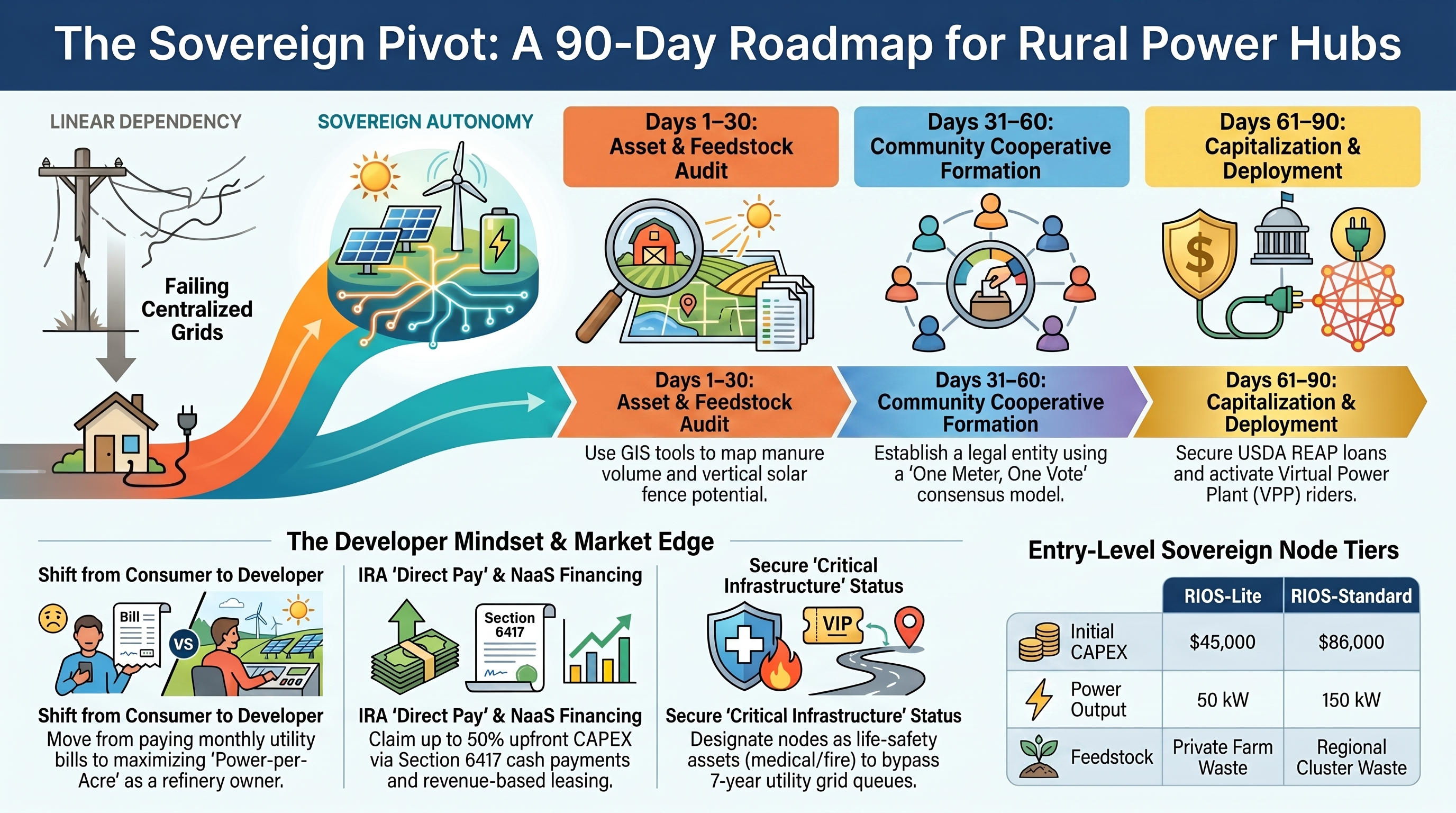
- RIOS-Lite ($45,000): 50 kW output; private farm waste feedstock. $200/mo OPEX; 2 hrs/week supervision.
- RIOS-Standard ($86,000): 150 kW output; regional cluster waste. $500/mo OPEX; 5 hrs/week supervision.
- Municipal-Grid ($250,000+): 1 MW+ output; industrial sludge/refuse. $2,000/mo OPEX; Dedicated Remote Agent.
Financial efficiency is secured through IRA “Direct Pay” (Section 6417), allowing non-profit co-ops to claim 30-50% cash rebates as upfront equity. The 10-year proforma leverages the “Physical AI Supercycle,” projecting ROI based on a 5% annual inflation in energy demand contrasted with a 15% annual deflation in compute costs.
6. Operational Roadmap: Establishing the Sovereign Node
Operating a node requires an “Industrial Integrator” skill set—bridging biology, chemistry, and IT.
90-Day Implementation Plan
| Phase | Milestone | Key Focus Area |
| Days 1-30 | Asset Audit | Use GIS to map feedstock (manure/scraps) and vertical solar LER potential. |
| Days 31-60 | Entity Formation | Form a community co-op; establish “One Meter, One Vote” consensus. |
| Days 61-90 | Capital & Setup | Leverage USDA REAP loans, VPP riders, and NaaS placement. |
Physical Constraints Checklist
- Geotechnical Anchors: Use deep ground screws to handle wind loads for vertical fences.
- Phase 3 Power: Verify transformers are rated for high-capacity export.
- Housing: Ensure NEMA 4X rated enclosures for all sensitive electronics.
- Water Recycling: Secure consistent water input for biogas, ideally recycled from site operations.
7. Regulatory Sovereignty and Risk Mitigation
Sovereign Nodes bypass the 4–7 year grid interconnection queue by remaining “Behind-the-Meter.” This provides immediate deployment and insulation from utility “operational sclerosis.”
The “Right to Repair” Offensive is a core defensive strategy. The RIOS “Foreman Agent” provides a proprietary software layer that performs diagnostics and overrides on farm machinery, nullifying OEM software locks. Furthermore, nodes are designated as “Critical Resilience Infrastructure” (providing medical diagnostics, fire suppression power, and emergency fuel). By functioning as “Civilization Stabilizers,” nodes are structurally insulated from utility-led anti-competition rules.
In the decentralized AI economy, Rural America is the new strategic center. The Sovereign Node transforms the farm into a fuel and digital refinery, serving as the high-density energy relief valve for the nation.


