The Revolution on the Horizon: How Kurb Kars and RIOS Security Will Finally Solve the Non-Emergency Medical Transportation Crisis in Rural America
A Dispatch for the Kurb Kars Subscriber Base
The mission of Kurb Kars has always been to build a foundation for truly autonomous, efficient, and resilient mobility. Our focus is on solving the hardest problems in transportation—the areas where legacy systems have failed due to cost, complexity, and a lack of true intelligence.
There is no market more critical, yet more profoundly broken, than Non-Emergency Medical Transportation (NEMT), especially in the vast, underserved expanses of Rural America. This is where Kurb Kars is engineered to deploy, and the RIOS Network’s revolutionary security fabric is the single feature that guarantees its success.
Section 1: The Current Reality—A Crisis of Access
The NEMT market is the lifeline for millions of Americans who rely on Medicaid, Medicare, or private insurance to get to essential, non-urgent medical appointments—dialysis, chemotherapy, physical therapy, and routine check-ups.
What the Market Is: Fragmented and Failing
The current NEMT system is a sprawling, fragmented, and largely analog nightmare:
- The Rural Medical Desert: In Rural America, access to drivers, vehicles, and reliable scheduling is scarce. The high cost per mile and low driver retention create genuine medical transportation deserts, often leading to missed appointments.
- The High Cost of No-Show: Poor scheduling and long waits contribute to cripplingly high patient no-show rates (often 10-20%). This doesn’t just waste taxpayer dollars; it directly contributes to worsened health outcomes, which drives up overall healthcare costs.
- Low Efficiency, High Overhead: The market is dominated by human-driven fleets constrained by fuel costs, wage inflation, and logistical bottlenecks. This inefficiency is incompatible with the low reimbursement rates of government programs.
The result? A vital, multi-billion-dollar industry that is fundamentally inefficient and often fails the very citizens it is meant to serve.
Section 2: The Kurb Kars Vision—Autonomy Driven by RIOS
Kurb Kars is not merely an autonomous vehicle; it is the physical manifestation of the RIOS Network’s intelligent operating system. Our solution attacks the root cause of the NEMT failure: cost and operational unreliability.
What the Kurb Kars Industry Provides
The Kurb Kars NEMT solution is a vertically integrated, AI-driven service designed for absolute reliability in a decentralized environment:
- Cost Efficiency that Works: By removing the largest variable cost (the driver) and optimizing routes with AI, Kurb Kars can reduce the per-mile cost of NEMT service to a sustainable level, allowing it to penetrate and profit in low-density rural markets where human-driven services simply cannot.
- Predictive Scheduling: Kurb Kars integrates directly with healthcare provider systems (via RIOS APIs) to manage and optimize its fleet capacity in real-time, drastically lowering no-show rates by confirming and automatically rescheduling rides with higher confidence.
- Scalability for the Rural Challenge: The RIOS Microgrid (Agra Dot Energy) and Compute Engine ensure that the network can deploy and sustain its operational AI even in areas with poor external infrastructure. Kurb Kars vehicles can rapidly and predictably scale to meet a sudden community need.
However, none of this is possible without a guarantee of operational security that is far beyond standard commercial grade. Reliability is built on an un-spoofable shield.
Section 3: The C4I Security Fabric—Guaranteeing Safe Passage
For an autonomous vehicle transporting a patient in a medical-critical situation, a data failure or a security breach is simply unacceptable. This is where the Cognitive Mesh Network and its C4I (Command, Control, and Intelligence) capabilities become the competitive moat for Kurb Kars.
The Vulnerability of Autonomous Systems
Autonomous vehicles rely on a constant, low-latency stream of data for navigation, mapping, and control signals. This data is vulnerable to:
- GPS Spoofing: Hijacking the vehicle’s location data to misdirect it.
- Control Signal Interference: Using localized radio jamming to blind the vehicle’s sensors or disrupt its communications link to the central AI.
- Hacking: Utilizing software vulnerabilities.
The RIOS Cognitive Mesh Solution: Physical-Layer Defense
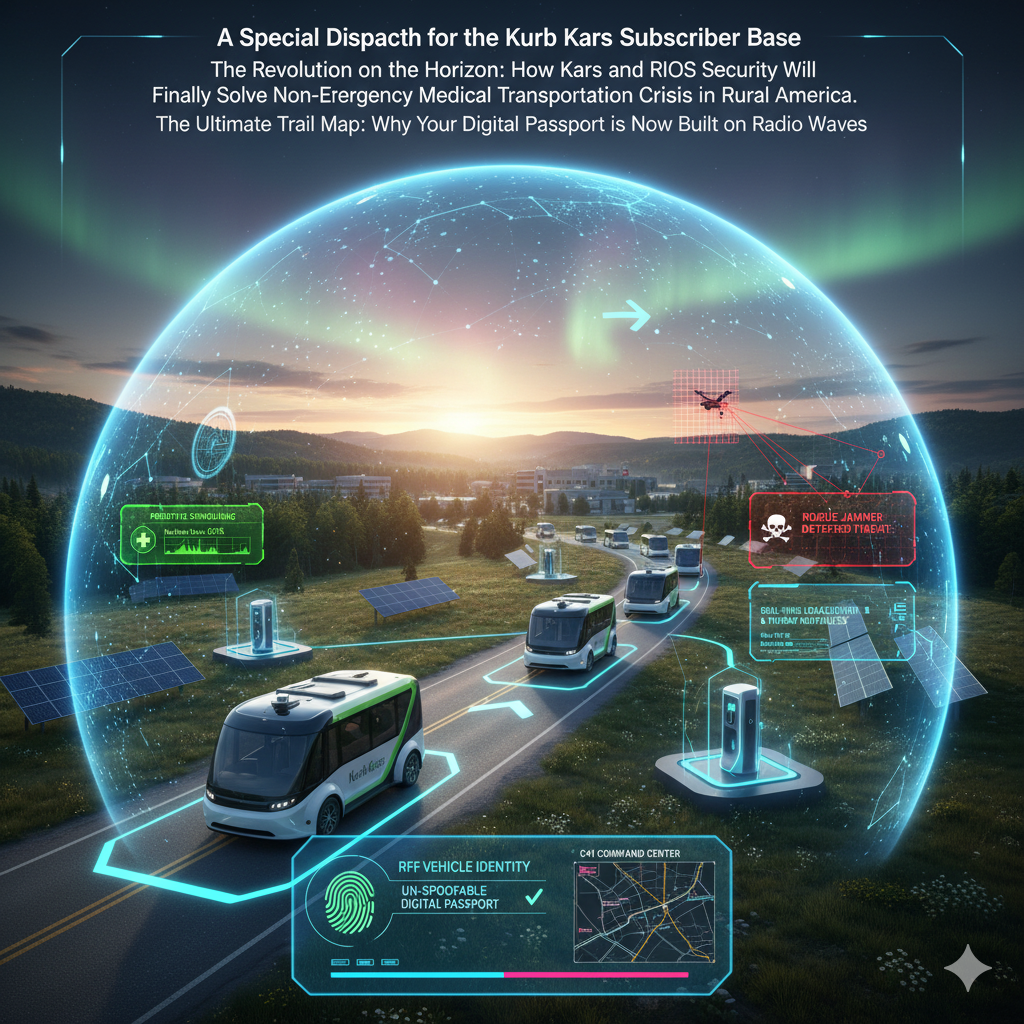
The Kurb Kars fleet and its deployment ecosystem are protected by the same Cognitive Mesh and sensing technology detailed in our previous reports. Every Kurb Kar, charging station, and RIOS Microgrid node acts as a Distributed Listening Radio (DLR) sensor, creating an unparalleled security perimeter:
- RFF for Vehicle Identity: The Radio Frequency Fingerprint (RFF) guarantees that only the physically verified, un-spoofable radio of an authorized Kurb Kar is allowed to transmit or receive control signals. Any rogue drone or unknown device attempting to communicate with the vehicle is immediately flagged and isolated.
- AoA/TDoA for Real-Time Threat Localization: If a malicious actor deploys a spectrum-jamming device near a Kurb Kar on a route, the mesh network is immediately activated:
- Multiple Nodes Listen: The DLRs on surrounding Kurb Kars, charging stations, and RIOS campus nodes instantly detect the unique RF signature of the jamming signal.
- AI Triangulation: Using Angle-of-Arrival (AoA) and Time Difference of Arrival (TDoA), the RIOS AI engine calculates the jammer’s precise physical coordinates (e.g., within 1-2 meters).
- Actionable Response: The digital alert (“Jamming detected”) is instantly transformed into a physical, actionable command (“Neutralize hostile transmitter at X, Y coordinates, near Route 17 turnoff”). The RIOS system can then deploy counter-measures (e.g., shield the vehicle, reroute immediately, or notify local law enforcement of the precise threat location), guaranteeing the continuity and safety of the NEMT ride.
Section 4: Comparison & Contrast: The Transformation
| Feature | The Legacy NEMT Market (Human-Driven) | The Kurb Kars NEMT Solution (RIOS-Driven) |
| Operational Security | Dependent on driver awareness and police response. Highly vulnerable to physical sabotage, signal jamming, and cyber hacks. | C4I Physical-Layer Defense. RFF/AoA-TDoA ensures un-spoofable identity and real-time localization of physical threats (jammers, rogue drones) to guarantee safe transit. |
| Rural Accessibility | Poor. Low driver availability and high costs create medical deserts. | Excellent. Low operational costs and 24/7 autonomous availability allow for sustainable deployment in low-density, high-distance rural areas. |
| Cost & Efficiency | Fragmented scheduling, high no-show rates (10-20%), and high variable labor costs. | AI-driven scheduling, predictive routing, near-zero no-show rates, and vastly lower operational expenditure. Built to profit at NEMT reimbursement rates. |
| Scalability | Slow, constrained by human recruitment, training, and capital vehicle replacement cycles. | Rapid, digital deployment scaled instantly by the RIOS Compute Engine and financialized by the SwarmBESS Microgrid. |
Conclusion: Sovereignty in Motion
For Kurb Kars subscribers, the NEMT market in Rural America is more than just a massive financial opportunity; it is a mission-critical problem awaiting a definitive, autonomous solution.
The RIOS Network and its Cognitive Mesh are not secondary features; they are the absolute security foundation upon which Level 4/5 autonomy can be built and trusted. By guaranteeing the physical and digital integrity of every Kurb Kar ride through RFF and C4I, we ensure that:
- Patients receive reliable, safe, and on-time medical transport.
- The Kurb Kars fleet operates at peak financial efficiency.
- The entire network is protected by an un-spoofable shield.
Kurb Kars is setting the standard for autonomy in a world where data integrity is paramount. This is the revolution that will finally bring reliable transportation—and thus, reliable healthcare access—to every corner of America.